Three Ways to Get the Data Nobody Has: A Go/No-Go Evening at Lumafield
August 26, 2026 - Lumafield Headquarters, San Francisco
Haomiao Huang opened the panel with the Underpants Gnomes from South Park. Their business plan has three steps: collect underpants, question mark, profit. As a venture investor, he said, he hears the data version of that plan constantly. Step one, collect a lot of data. Step two, question mark. Step three, value. Then he turned to three founders who have each spent years building the machinery to collect data the internet does not have, and asked them to fill in the question mark.
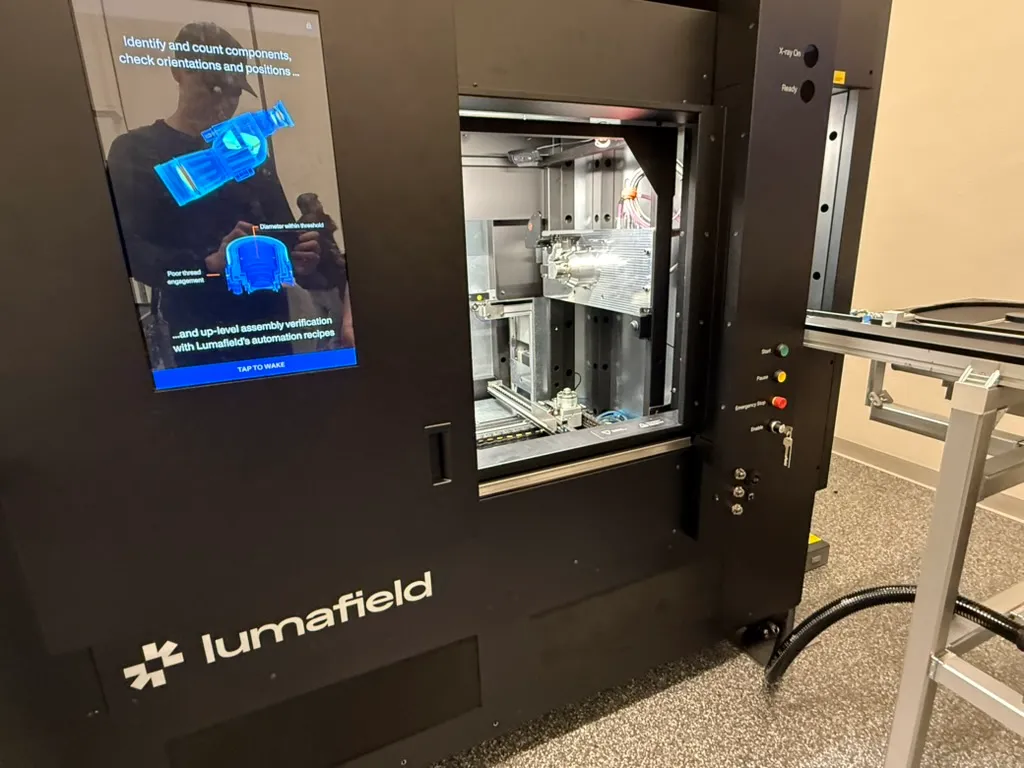
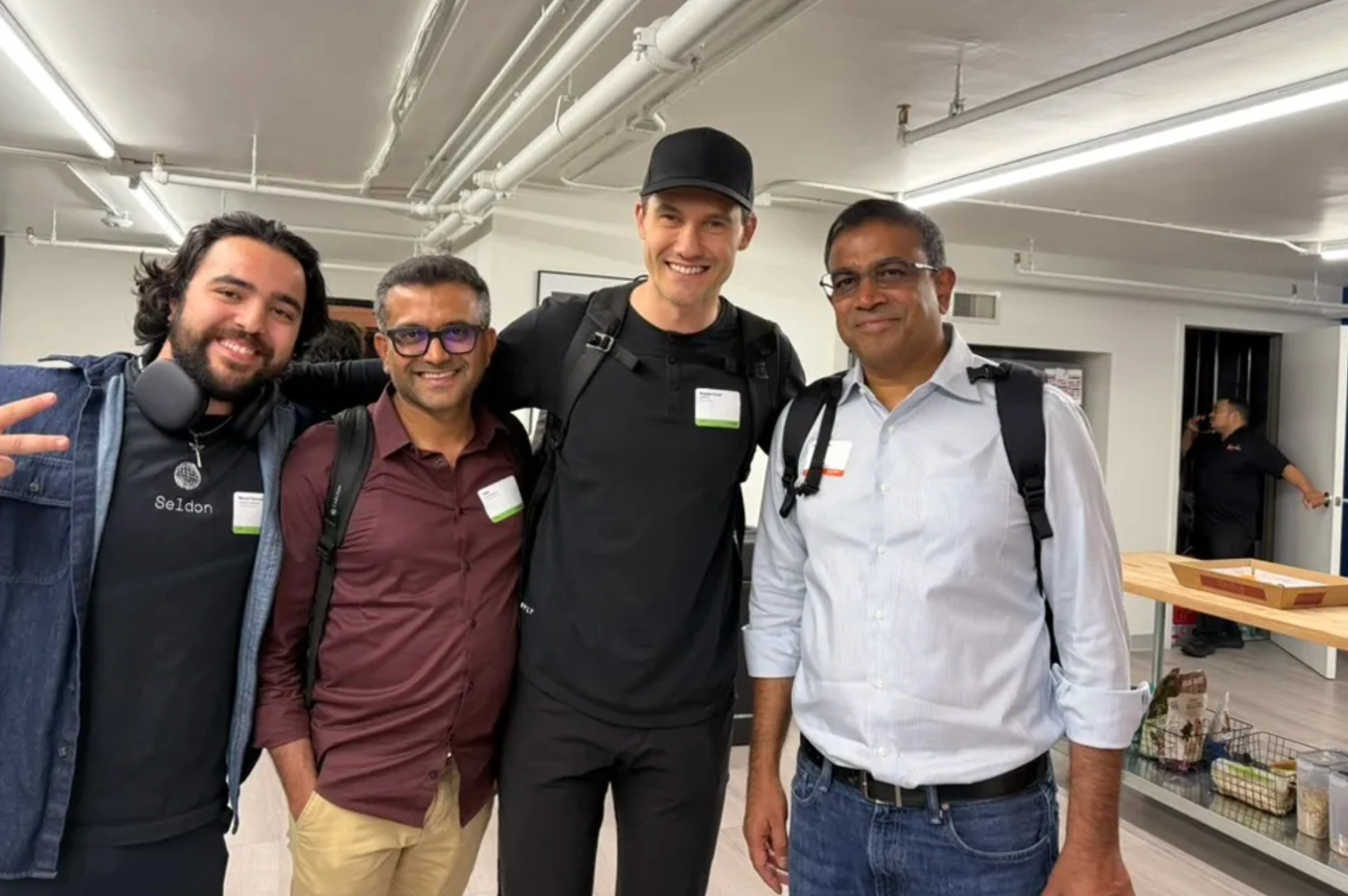
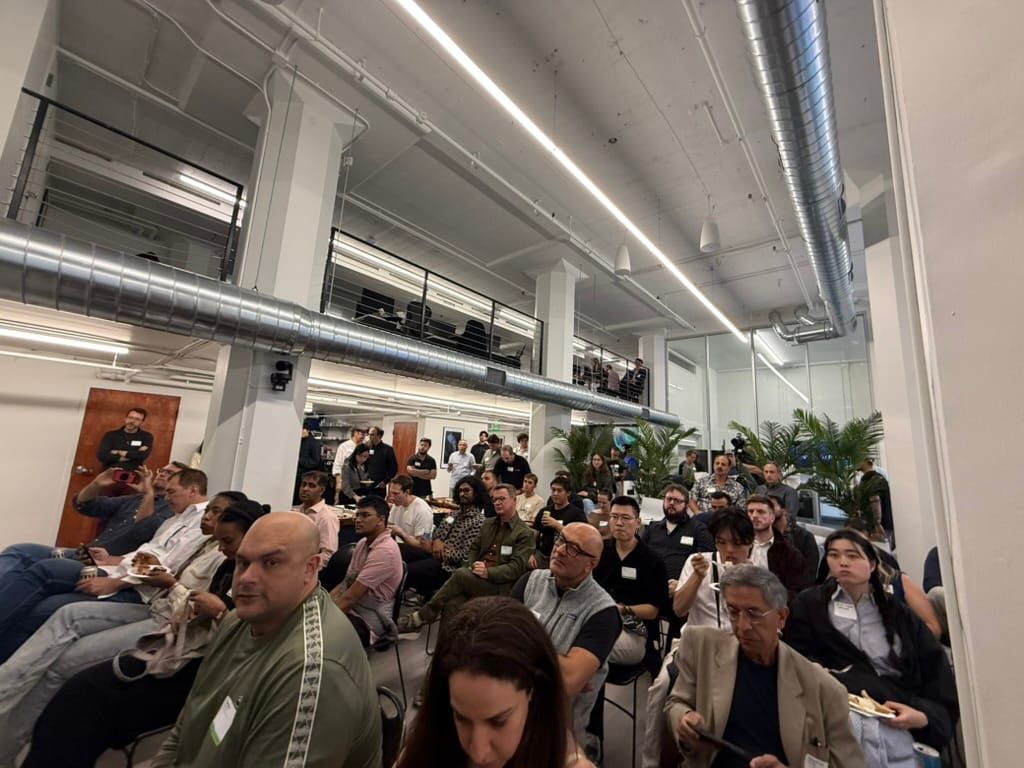
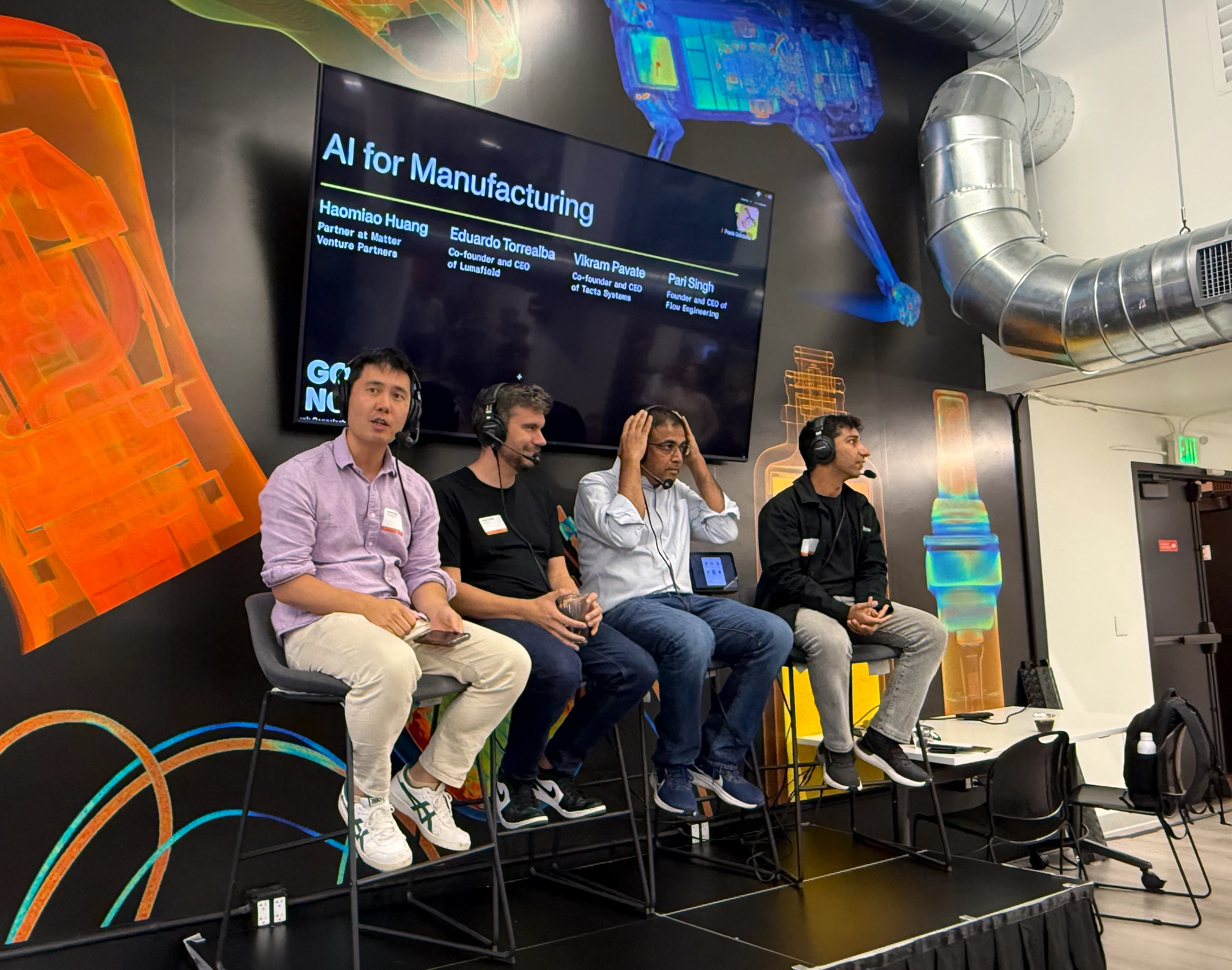
The setting was Lumafield's new San Francisco headquarters on 3rd Street, where close to 300 people showed up for an open house and a live recording of Go/No-Go, Lumafield's podcast on the decisions that make or break physical products, hosted by Jon Bruner. Haomiao, founding partner at Matter Venture Partners, moderated. On stage: Eduardo Torrealba, co-founder and CEO of Lumafield; Vikram Pavate, co-founder and CEO of Tacta Systems; and Pari Singh, founder and CEO of Flow Engineering. Lumafield and Tacta are both Matter portfolio companies, which Haomiao disclosed in his first minute. Before the panel, Neptune scanners ran live demos in the lobby, and the invitation asked people to bring objects to put inside them.
For friends who missed it, here is what was said, with names attached. This was a public event recorded for a podcast, so the speakers earned the credit. Jon said the episode should be up on Go/No-Go within a week or two.
The backgrounds explain the companies. Eduardo is a mechanical engineer from Texas who founded an IoT startup, then ran engineering on Formlabs' SLS printers before starting Lumafield in 2019. Vikram studied materials science before, in Haomiao's words, going to the dark side and getting an MBA; he was part of LuxVue, the micro-LED company Apple acquired in 2014, then founded Locix, a supply chain visibility company, before co-founding Tacta in 2023. Pari is a mechanical engineer who started at BAE Systems, founded a rocket engine design consultancy called The Engineering Company, and turned it into Flow.
Three answers to the question mark
Eduardo went first, with a confession on behalf of his generation. "Data is the new oil" was the phrase when he was younger, and most of that promise never paid off. The original Internet of Things pitch was a sensor on everything, question mark, magic. What changed was large language models, which proved that the data already sitting on the internet, harnessed correctly, produces something that works. That is the argument behind the piece he published that morning in response to Jensen Huang's five-layer AI cake of energy, chips, data centers, models, and applications: the cake is missing a layer, because none of the other five exist without data. You could have invented the transformer in the 1980s. You would have lacked the chips to train it, and more to the point you would have lacked the internet to train it on, the biology datasets behind protein folding, and the driving corpus Tesla collected. Any application without a public corpus is stuck at the starting line. So Lumafield, and both of the other companies on stage, are in the business of acquiring datasets that are not openly available and are hard to come by, because those datasets are what make the AI workflows on top of them possible. Lumafield's version is a lead-lined box with an X-ray source inside. Neptune, Triton, and the new in-line Mars system produce what Eduardo called the world's best data on manufactured objects, for customers ranging from the infrared flares that protect the F-35 to continuous glucose monitors to corn and soybean crops.
Vikram took the same question into the hand. Everything deployed in robotics so far is vision-based, he said, on the assumption that vision is enough. Tacta's team has decades on factory floors, and they know that when a person seats a connector, runs a hand along a cable, or finds a part in a bin, the eyes have no access to what the fingers are doing. That tactile data has never existed, because nobody had a way to collect it. Cameras, voice, video, YouTube: all useful, and none of it gets a robot to high success rates on dexterous work. So Tacta built a tactile sensor smaller than a grain of sand, put it on a hand with fifteen actuated joints, and put the same sensor on a glove. "It's literally a glove that you can purchase in Home Depot," with tactile sensors on the front, motion capture on the back, and a scene camera or head-mounted camera for the rest. Workers wear it while doing their normal jobs, following the standard operating procedure they were trained on, which makes the data clean and scripted by default. The arithmetic he offered: a factory with 10,000 workers wearing the glove generates roughly 20 million hours of data a year. He listed nurses and pianists as future wearers, and named electronics, AI infrastructure, automotive, defense, and aerospace as the target industries. Tacta came out of stealth in July with TactaBot, and the first units ship to customers in early 2027.
Haomiao teed up Pari as the one living in a magical software world where data flows like water. Pari's answer was that data, and specifically context, is the missing ingredient for AI in hardware. His story: ten years ago a newly minted mechanical engineer chose between being a CAD monkey, an Excel monkey, or a simulation monkey, and companies still hire 200-IQ engineers who know exactly what they want to build, then bury them in hundreds of hours of low-level execution. When agents arrived, the original Flow vision became possible: automate the monkey work and promote the engineer to architect, the way Claude or Cursor lets you describe what you want and does the rest. The intelligence to design most physical products already exists, he argued. What is missing is context. His poor man's version: ask a coding agent to find you a fan, and it has no idea what the fan is for. The CAD, the packaging constraints, the reference designs, the tribal knowledge that a human engineer absorbs in a week are scattered across so many sources that no single place can hand them to a model. Raytheon, a Flow customer, has millions of requirements, maybe tens of millions. Pari put that at hundreds of trillions of tokens, which no context window will hold. Kelly Johnson held the entire SR-71 in his head as a systems problem. What context you give the model, when, and how you aggregate it is the limiting factor, and Flow's product is a system of record for requirements built for that job.
Punched in the mouth
Haomiao's second question was the Mike Tyson one: everybody has a plan until they get punched in the mouth. He wanted the punches.
Eduardo described his business travel: fly somewhere, rent a car, drive two hours, because manufacturing happens in the suburbs of Pittsburgh and Detroit and further out, and almost never in San Francisco. One customer in the defense supply chain sits in Arkansas, nowhere near a major airport, in a facility with no air conditioning and a tight turnaround SLA, because when the machine goes down the line stops. Lumafield's first-generation machine needed a lot of maintenance there, and a good chunk of the field team spent last summer flying to Arkansas. "I didn't know that a person could break a machine quite that way," he said, "over and over and over again." The team got the equivalent of campaign medals. The celebration came when V2 shipped with every fix from that deployment built in.
Pari opened with a line for the room: "I feel like software founders are amateurs. If you can deal with complex supply chains, you can deal with anything in life." Then his own punch. He is coming up on ten years at this. Flow started in 2017 as a rocket engine design consultancy, when everyone he pitched told him to build software. The fastest teams in the world design a rocket engine in twelve weeks; his team could do it in about twelve hours, and that became the seed of the product. Product-market fit arrived about three and a half years ago, customers went from zero to thirty, and last October Sequoia led the $23 million Series A. The morning after the round closed, he woke up and realized the pitch he had been telling for seven years was over. That pitch: software went from waterfall to agile, Lockheed is waterfall, SpaceX is agile, and hardware would follow the same path. But software had moved again, from agile to agentic, from a weekly sprint to fifty pull requests a day, and somebody had to do that for hardware. So he killed a working product. The code went in the bin, he flew from London to San Francisco, and he rebuilt the organization from scratch over six months. Flow v3 started selling in January, and thirty customers became a hundred in six months. "You have to be able to burn the entire thing down at any point to be able to do the next thing," he said. Haomiao's reaction was admiration mixed with envy: a hardware mistake costs a rebuild where a software mistake costs a reboot. Pari conceded the point: Falcon 9 and Starship show hardware iterating more like software, and the cost of failure and the bar for certification and safety stay higher all the same.
Vikram is on his fourth startup in 25 years and has lost count of the demos that went wrong. Tacta spent its first year and a half designing chips and sensors before there was a glove to put them in. In March of this year, the team showed up at its first customer site with a glove that twenty people in industrial design and product had worked on. The screens lit up with tactile and motion data; you could see when the operator seated the connector wrong and when he got it right. Thirty minutes in, the operator handed it back. "I can't use your glove anymore. It's too sensitive. It's too soft. You need to make it a little bit more rugged." They added silicone and layers. The lesson he drew: you learn the environment by putting the product in it, and there is no substitute for a customer using it in anger. Haomiao's version was that you have not shipped until a customer has cursed you out. Vikram said that depends on the country, and Korea is the hardest.
The missing middle
Haomiao moved to reshoring and asked how it works in places that have not seen a factory in years.
Eduardo answered through bottlenecks. Lumafield's value is decision speed: a ten-second scan replaces weeks or months of waiting for information you can rely on. Building a factory has no equivalent shortcut; you cannot outsource one in two weeks. The customers he sees building new facilities, at what he called the pointy end of reindustrialization, are doing it for the same economic reasons any business would. China is getting more expensive, and national security dollars and policy are pulling specific products home. He was careful to call China a sophisticated manufacturing playground where almost anything can be made better than anywhere else. The US is good at the super high end, jet engines and chips, and by necessity makes food and consumer packaged goods at scale, because shipping those across an ocean makes no sense. In between sits what he called the missing middle: products that cost between five and five hundred dollars to manufacture. That is where automation, robotics, and the software workflows discussed on stage can take a low-gross-margin business, push cost down and certainty of success up, and shorten the time to ROI until objects under a thousand dollars become sustainable to make in the United States. He called automation and AI the only hope for that middle chunk.
Haomiao added the best anecdote of the evening. One of the top Chinese robot actuator companies makes actuators as a side gig. Its main business is motors for automatic mahjong tables, the ones that shuffle the tiles themselves. To compete with them on actuators you almost need the mahjong-table volume first, the way Nvidia sold gaming chips and picked the best ones for AI. Volume in the middle is what gets you practice with process.
Pari gave what he called the optimistic version, and it started dark. Reindustrialization is real because it is driven by serious and scary things. The old line was that China copies and cannot invent. His read now: "the American dream seems to be more alive in China." He had dinner the night before with a customer, a large OEM that imported Chinese vehicles and tore them down, and learned that Chinese OEMs now run engineering in 24/7 shifts, one engineer working twelve hours and handing the problem to the next. Chinese speed was always faster; the Western consolation used to be that American cars were better. He called 2025 and 2026 the tipping point: Chinese robotics is the best in the world, Chinese drones are the best in the world, Chinese EVs and autonomy now beat the West, and the slope is still up. His two reasons for optimism. First, the pressure forces the West to do what it does well, which is invent, and AI is the lever for rethinking how engineering gets done. His cautionary tale is that the British invented most of manufacturing in the industrial revolution and the Americans did it at scale, faster; AI was invented in his neck of the woods at DeepMind and America took it from there. This time the West has to do both the inventing and the scaling. Second, he graduated in 2016 wanting to go into hardware, looked at the top ten stocks, and saw Google, Facebook, and Amazon: "people selling ads and people selling ads and people selling ads." Hardware was unsexy for a long time. Now the capital, the talent density, and the enthusiasm are lined up to rebuild the industry. Haomiao's addendum: even the ad companies got to the top by innovating on their own hardware substrate, data centers and custom chips.
What gets founded now
Haomiao closed with his own thesis. Great companies cluster in eras: the internet companies of the 1990s and early 2000s, the car and aerospace companies of the first half of the last century. His bet is that a hundred years from now the list of top manufacturing companies will include several founded around 2026, companies that start out with Lumafield inspecting their parts, Flow designing agentically, and Tacta's hands doing the work. He asked what those companies will look like, and what the upside is beyond competing with China and running short of people.
Vikram called it a transition point. Most of Tacta's work today is understanding what makes skilled humans skilled, so that a worker can demonstrate and a robot can take over. What excites him sits past that. Electronics manufacturing is limited by what human hands can do below a certain size, which is why that work concentrates in Asia regardless of where the product was designed. Humans get the job because humans are flexible; unless you sell a product for a thousand dollars at fifty percent gross margin, a special-purpose machine does not pay, so everyone else uses people. A flexible, general-purpose machine that exceeds human capability could build products that were never buildable, in thousands and hundreds of thousands at lower price points: a heart pump, a stent, the things that cannot be made affordably at scale today. He was explicit that labor replacement is the less interesting story. Going beyond human hands is the one he came for.
Pari answered with Moore's Law-style compounding. Era one was Silicon Valley in the literal sense, Intel and the CPU companies, with tools and processes built to double chip complexity every twelve months or so. Era two was software, Salesforce and SAP and everything since; compare Windows 3 to anything on your screen today. The era starting now, he argued, is hardware compounding. "I said this five years ago and everyone thought I was crazy." Put the tools, processes, talent, and capital in the right place and acceleration follows. His two reference points: the moon program started by strapping monkeys into boosters, and a decade of iteration through Mercury, Gemini, and Apollo got around the moon. And video games, from the big triangles of the PlayStation 1 to photorealistic ray tracing today, which is what a decade of compounding looks like. If hardware is in its Mario World 2 era today, he asked the room to imagine ten years out. His answer: a decade of insanity.
Eduardo framed it as centralized versus decentralized. The 2012 story was that 3D printing would make rapidly reconfigurable micro-factories possible, and that did not play out. Tesla built the Gigafactory instead, much larger complexes that turn raw ingredients into cars, through sheer force of will and an amazing team. BYD's facilities make a Gigafactory look modest, with every size prefix now in play. His bet is on automated tools that build at scale with far less of the human effort and coordination that mass production required until now. The picture he left the room with: going from a working design for a breakthrough medical device to manufacturing it for every human on Earth at the speed of regulation, out of massive facilities stood up quickly from reconfigurable elements, with self-driving cars handling distribution.
A few things to remember
- The question mark gets filled by a customer with a problem today. Eduardo built a lead box, Vikram built a sensor and sewed it into a work glove, Pari built a system of record for requirements. Each captures a corpus the internet never had, and in all three cases the customer pays to generate it while solving something else. It is the same sales-to-deployment-to-data loop this newsletter keeps finding in the companies that work.
- The bottleneck in engineering AI has moved from intelligence to context. Pari's Raytheon example, hundreds of trillions of tokens of requirements, makes the case that the winning products decide what a model sees and when.
- The customer is the spec. A glove too soft for a factory hand, a scanner that a crew in an un-air-conditioned Arkansas plant kept breaking. Both companies learned the environment by shipping into it, and the version that came back is the one they celebrate.
- Willingness to burn it down is a founder skill, in software and in hardware. Flow killed a working product with thirty customers the morning after a Sequoia round and grew to a hundred on the rebuild. Software lets you do that in six months. Hardware charges more for the same move and still needs the willingness.
- The missing middle is the reshoring opportunity. Five-dollar to five-hundred-dollar products. The high end and consumer packaged goods already make sense in the US; the middle comes home with automation or stays where it is.
Thanks to Jon Bruner and the Lumafield team for hosting, and to Haomiao for moderating. The full recording will be on Go/No-Go, and it is worth the listen for the parts that did not fit here.
References
- Go/No-Go podcast - Lumafield
- Tacta Systems unveils breakthrough robotic hands for high-value manufacturing - PR Newswire, July 27, 2026
- Announcing Flow's $23M Series A, led by Sequoia - Flow Engineering, November 2025
- Introducing Mars for 100% production inspection - Lumafield, July 22, 2026
- Jensen Huang on AI's "five-layer cake" at Davos - NVIDIA Blog, January 2026
Company figures, customer anecdotes, and market claims cited above were shared by speakers on stage at Lumafield on August 26, 2026 and reflect their own reporting.