One Million Hours and One Demonstration: Two Days at Actuate 26
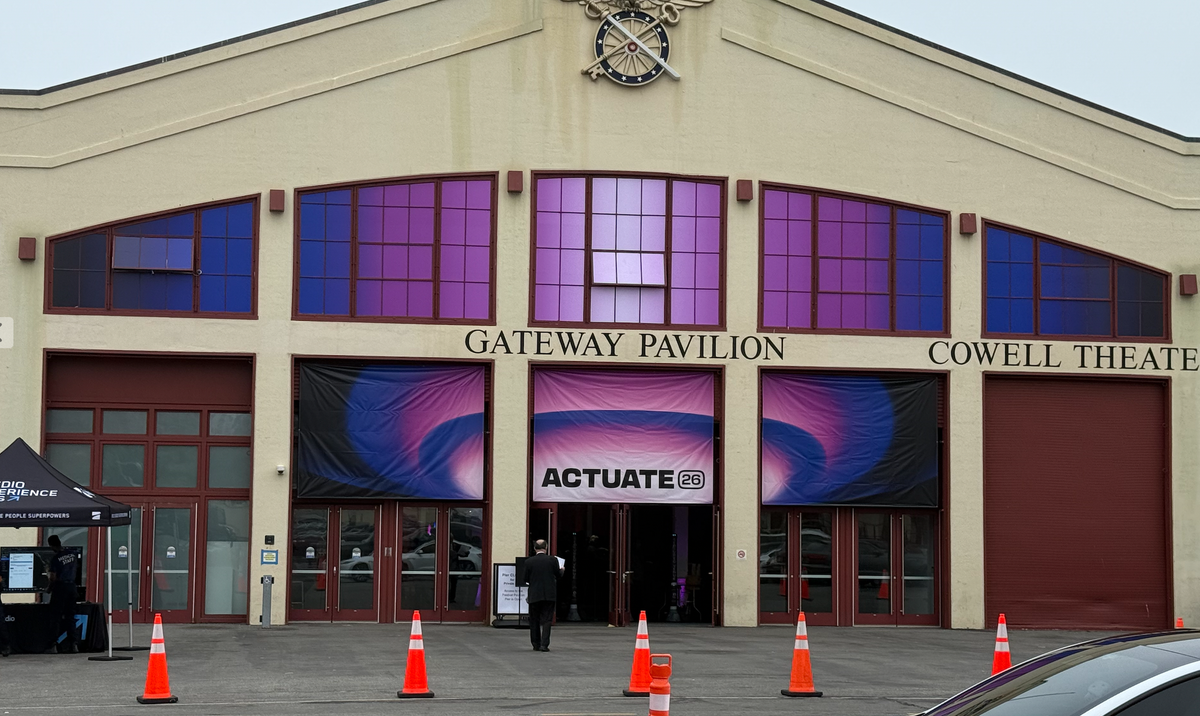
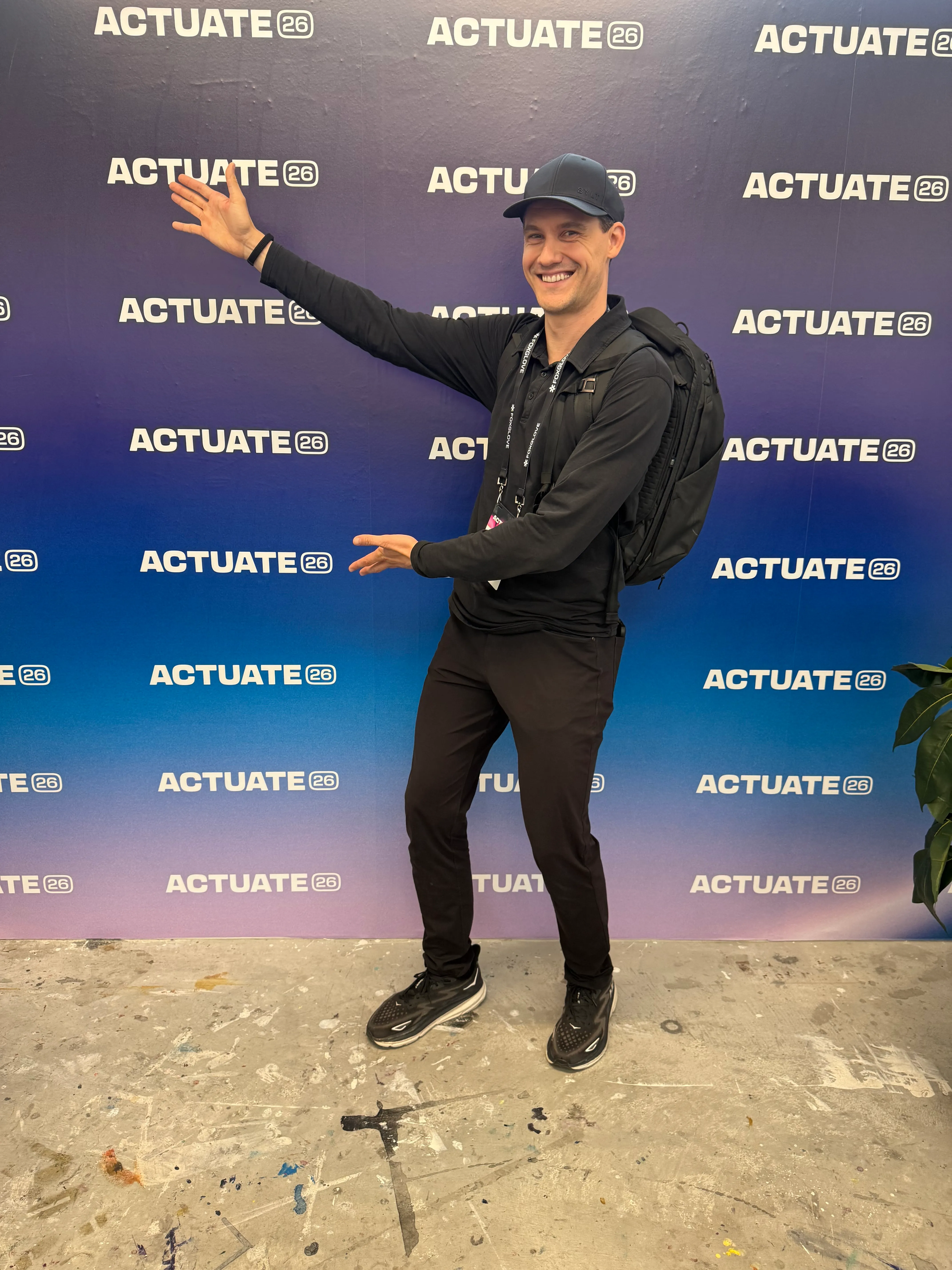
August 18-19, 2026 - Fort Mason, San Francisco
On Tuesday morning, Jason Ma of Dyna Robotics described a foundation model pre-trained on one million hours of human video - roughly 170 years of continuous waking experience. On Wednesday afternoon, Pete Florence of Generalist showed a model that learns a new task from a single demonstration lasting three to twelve seconds. The two results were announced nine days apart, presented from the same stage, and both teams believe they are holding the recipe. The distance between those numbers - how much experience a robot needs, and in what form - was the live question underneath everything at Actuate 26.
Actuate is Foxglove's conference for the people who build robots, now in its third year. Adrian Macneil, Foxglove's co-founder and CEO, opened with the growth curve: 250 attendees in year one, 500 in year two, and this year 1,500 sold-out tickets across 40,000 square feet at Fort Mason, with people still messaging him for last-minute passes the night before. The format stays technical by design - keynotes, twenty-minute talks, and panels where researchers argue about training objectives in public. For friends who missed it, here is what happened on the main stage, with names attached - this was a public event, and the speakers earned the credit.
The state of physical AI, in numbers
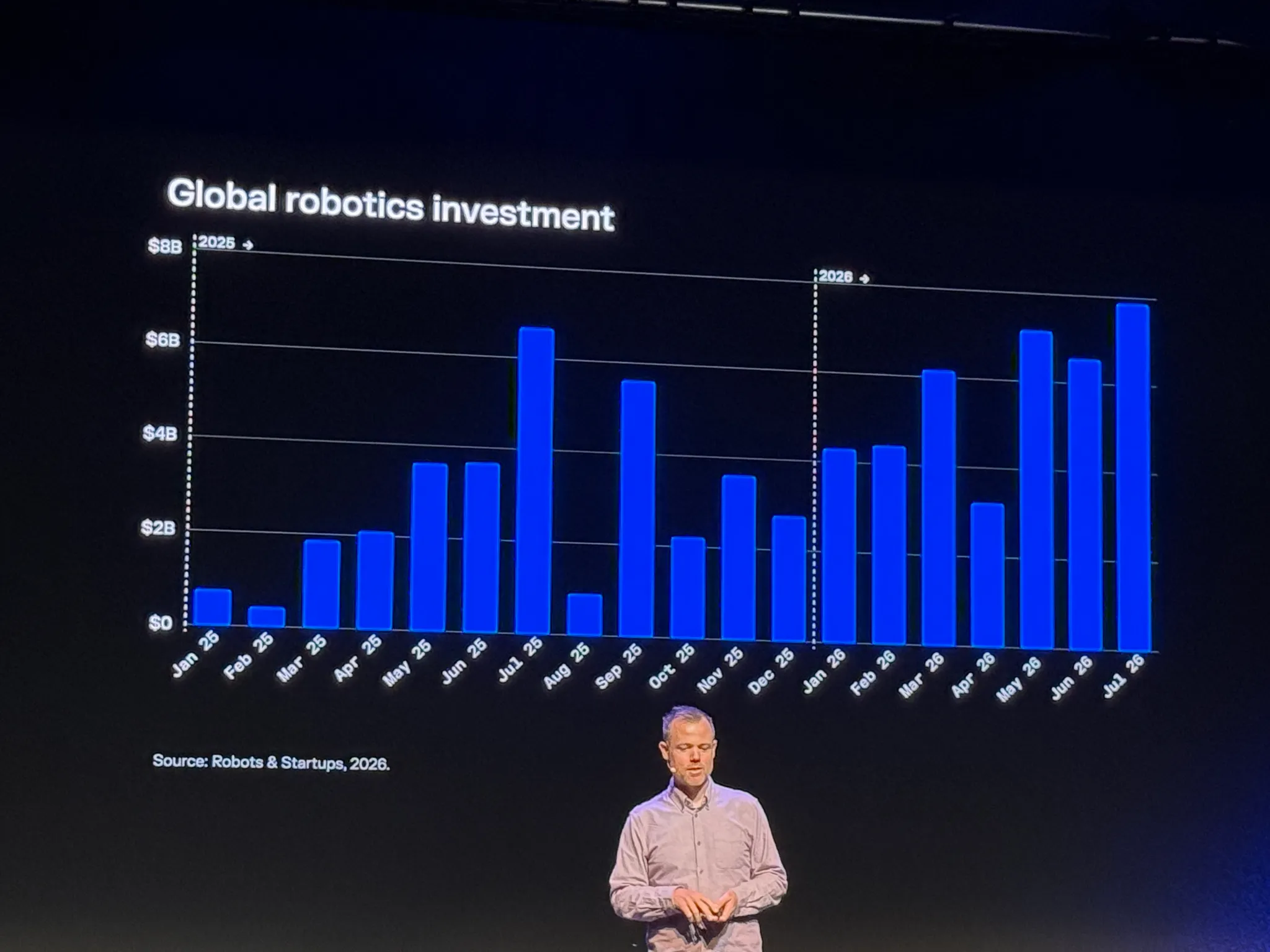
Macneil's opening keynote doubled as a market report. By his count, physical AI companies raised about $36 billion in all of 2025; seven months into 2026 the figure has already passed $55 billion, triple the pace of last year at the same point, with the average round climbing from $31 million to $48 million even after excluding Waymo's outlier February round, which he put at $16 billion. Recent multi-hundred-million raises from Bedrock, Apptronik, and Generalist made the point without needing a chart. He also remembered pitching investors five years ago and hearing, "What robotics industry?"
Deployment numbers followed. Waymo went from 50,000 paid rides per week in March 2024 to 500,000 as of this March, with more than 3,000 vehicles across ten cities. Zipline makes a delivery every 30 seconds and has flown over 140 million autonomous miles - to the moon and back 280 times, as Adrian framed it. Aurora has passed 440,000 driverless truck miles. Amazon runs more than a million robots across 300 facilities. The data exhaust is its own story: a single humanoid can log a terabyte a day, an autonomous vehicle a terabyte an hour, Foxglove customers upload petabytes a month, and robotics datasets on Kaggle grew from about 1,000 to over 70,000 in eighteen months, now the platform's largest category.
Then he tempered the room. LIBERO, a standard manipulation benchmark, is considered solved at 95 to 99 percent. A Fudan University team presented LIBERO-Plus at CVPR this year: perturb seven properties of the scene - camera position, lighting, object layout, instructions - and performance on the same models falls from 95 percent to as low as 30. That is not even the sim-to-real gap; it is a camera nudge inside the simulator. RoboDojo, a benchmark launched six weeks ago with 42 simulation tasks and 18 real-world tasks, is harsher still: the best of ten leading policies, a fine-tuned pi-0.5, scored 12.8 percent on the real-world set, and on one of three hardware platforms nine out of ten models scored exactly zero.
His synthesis: the constraint is no longer data volume, it is turning data into learning. Every company he talks to runs some version of the same six-stage loop - collect, triage, mine, train, evaluate, deploy - and most take weeks or months per full iteration, with a third to half of engineering time spent on undifferentiated infrastructure. The teams that win, he argued, will be the ones that close the loop fastest.
Foxglove's own news slotted into that thesis. Foxglove 3.0 shipped remote access over WebRTC for debugging and teleoperating robots in the field, comparison mode for lining up runs side by side, and semantic search built on NVIDIA's Cosmos embedding model - trained on robotics, driving, and egocentric human video - so you can type "robot climbing stairs in snow" against petabytes of unlabeled logs and get the moments back. The platform also rebuilt around agents: a sidebar agent that finds data, builds visualizations, and investigates failures, plus an MCP server so Claude Code or Cursor can drive the app directly. Foxglove now counts 30,000 monthly active users and 30 petabytes indexed, and MCAP, its open logging format, ships as the default in ROS 2 and NVIDIA Isaac Sim. His closing frame was the market: manufacturing, energy, logistics, and agriculture together make up roughly a third of global GDP, software only optimized them around the edges, and he expects a billion autonomous devices deployed over the next decade.
The end of starting over
Cheng Chi, co-founder and CTO of Sunday, structured his talk - his first in-person talk since finishing his PhD - around three unspoken rules of academic robotics and what it took to break them. Rule one: every paper starts a new codebase. That ended for him in the summer of 2022 with Diffusion Policy, the last repo he started from scratch; the field has since converged on the same shape, a large transformer over observation tokens with a diffusion action head. He met Tony Zhao over a Twitter DM after Diffusion Policy and ALOHA published a month apart, a friendship that eventually became Sunday. Rule two: every paper claims a new robot, walled off in a corner of the lab with a do-not-enter sign, because one bumped camera invalidates the dataset. His answer was UMI, the 3D-printed handheld gripper that let three people collect 1,400 demonstrations around the Bay Area in two weeks - including at restaurant tables before the waiter arrived - and train the first end-to-end policy that generalized to unseen environments.
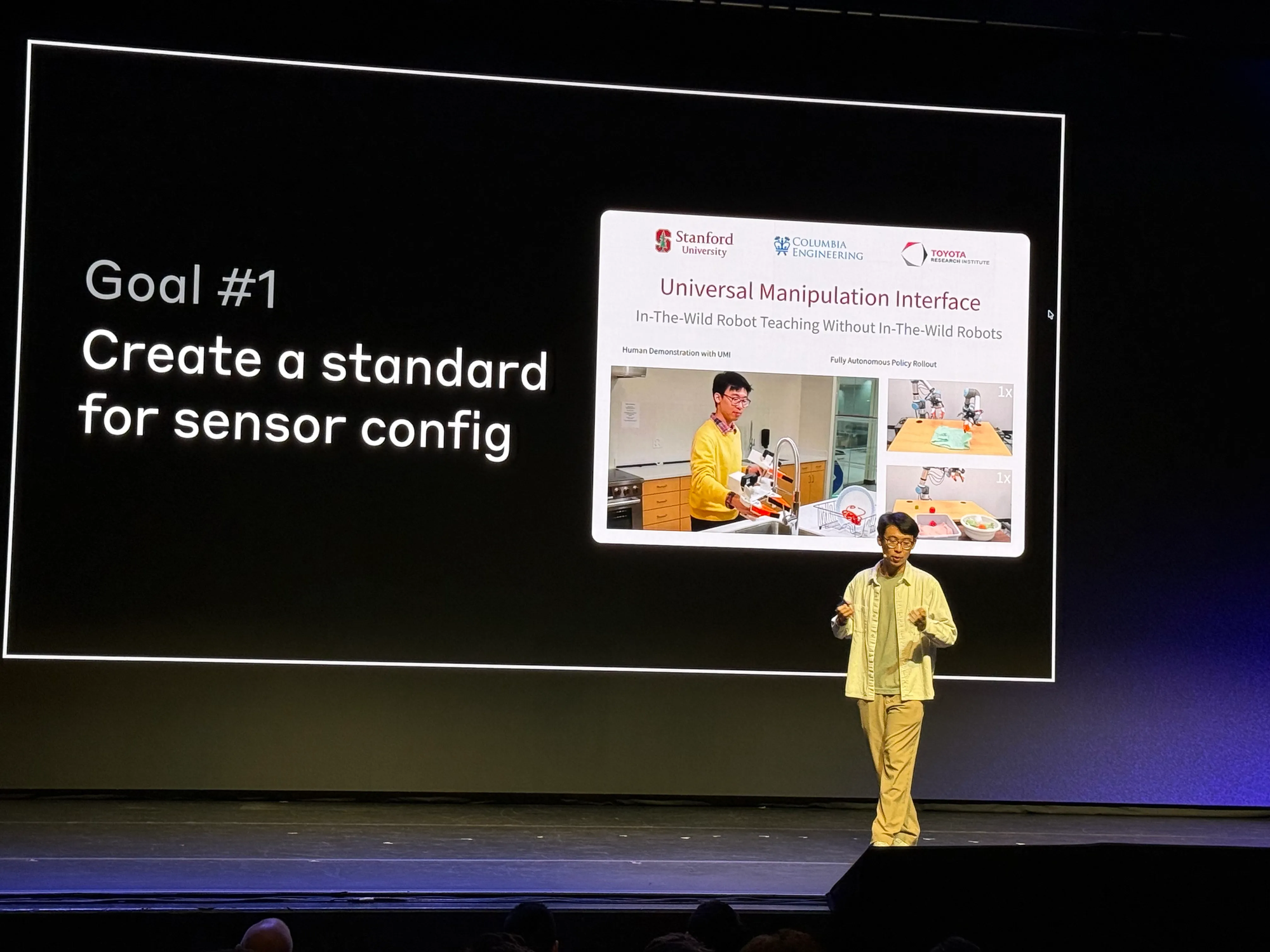
Rule three is the one Sunday exists to break: fine-tuning on narrow data destroys the base model's generality. Collect targeted recovery data, fine-tune, and the lab success rate hits 90 percent while the in-the-wild rate collapses to 10. Cheng calls the difference the generalization gap, and argues it explains the bimodal shape of robotics releases today - models that are capable in one room, or general and unreliable everywhere. Customers want both, which is why nobody has a robot at home yet.
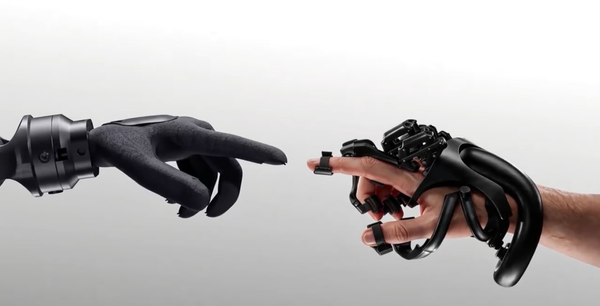
ACT-2, the model behind Sunday's Memo home robot, is his claim that scaling pretraining closes the gap. With enough high-quality, high-diversity pretraining - Sunday collects it through roughly $200 sensorized gloves worn by paid human Memory Developers, no robots involved - improvements made in the lab transfer to homes the robot has never seen. Improving a robot model finally behaves like normal software development: see a failure in the wild, fix it in house, deploy, and the fix holds. The published evidence is 785 autonomous laundry-folding attempts across 31 unseen homes with a single checkpoint and zero per-home adaptation: 99.1 percent success. One demonstration can now teach qualitatively new folding strategies - the triangle, the burrito roll, the fling - none of which existed in the pretraining set.
Two grace notes stuck with the audience. Sunday's team includes an investment banker running daily operations and a former freelance DJ managing the glove-wearing data army. And Cheng closed by thanking Adrian for building the tooling generation he started his own career on - so that, in his words, his generation of roboticists does not have to start over.
A million hours of other people's hands
Jason Ma's talk landed nine days after Dyna Robotics published Dyna-2, and it read as a direct answer to three open questions: what is the right pretraining source for robotics, does scaling it produce predictable returns, and does the training objective matter. Dyna-2 is a world-action model - it jointly predicts future video and future actions - pre-trained on more than one million hours of egocentric human video, with no robot data in pretraining at all.
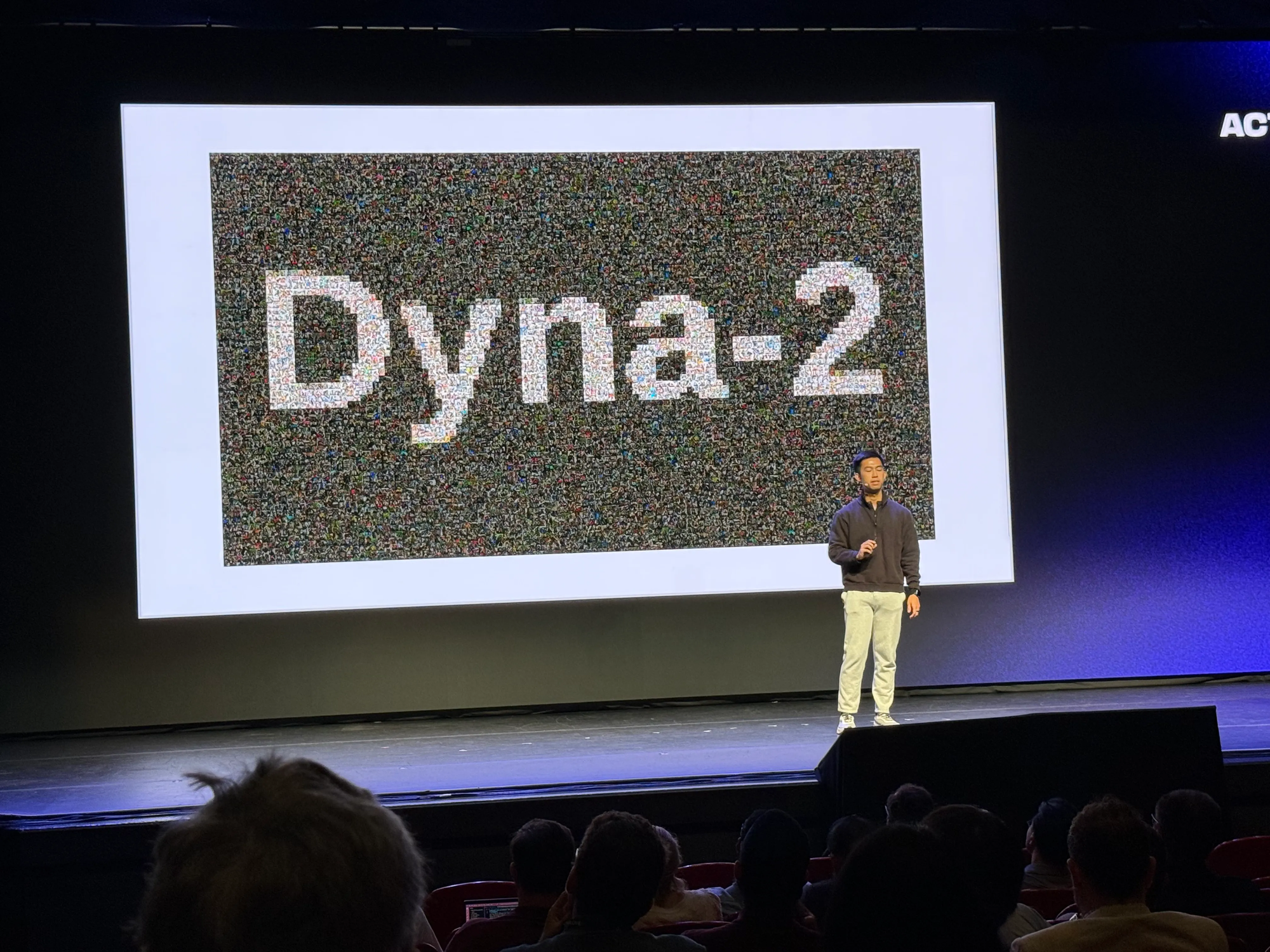
The headline results are scaling laws. Performance on held-out human data improves smoothly across four orders of magnitude, from 1,000 to 1,000,000 hours. More surprising, that human-data scaling law implies a scaling law on robot data the model has never seen: more human video predictably improves zero-shot action prediction on robot embodiments, and after light post-training - at most ten hours of robot data per task, in one case thirteen minutes for a dexterous hand gently unscrewing a bottle cap - average scores across fourteen tasks and three embodiments climbed from 20 to 53 percent as pretraining grew. The dexterous hand benefited most, which makes sense when your teachers are all human hands.
The mechanism finding is the part both panels kept returning to for the rest of the conference. Training on action prediction alone produced little human-to-robot transfer. Jointly predicting video and actions did better. The transfer only emerged clearly once large amounts of action-free video entered the mix - video is a second scaling axis, and the knowledge that crosses the embodiment gap is not finger positions but how the world responds to contact. The commercial evidence: in the office, Dyna-1 and Dyna-2 both pass at 100 percent; at new customer sites, pretraining scale shows up, with Dyna-2 close to doubling the older model's pass rate zero-shot. The emergent robustness demos were fun - folding under strobe lights no teleoperator could work in, chopping steadily with the top camera covered, a brave researcher's hands in the workspace - and the closing message was infrastructure: at million-hour scale, the hard part is neither robots nor GPUs, it is everything in between, from ingestion to I/O locality to launch speed for training runs.
Fifty miles between faults
Vibhor Sood, co-founder and VP of engineering at Burro, brought the outdoor reality check: about 750 robots across 16 countries and five continents, a million hours of outdoor autonomy in vineyards, nurseries, and industrial yards, and a talk built from failures. A ghost obstacle on a weekend test, a remote clear, a stuck turn, and $1,500 of burned motors by Monday. A nursery that rearranges itself so completely in twenty minutes that localization gives up. Robots in Australia arriving covered in spiders on one camera and mud on the other. My favorite detail: tectonic plates move at different speeds - about 2.5 centimeters a year in the US, 7.5 in Australia - so a robot promising sub-centimeter repeatability year over year has to compensate for the continent drifting underneath it.
The metric Burro lives by is miles between faults. Under ten, a person walks with the robot. Ten to twenty-five, remote babysitting. Burro sits at fifty, which at their three to five miles per hour means roughly a week of operation before a human intervenes. Their second act is route networks: one shared map per site, up to fifty robots, each black dot a destination, with traffic rules, speed segments, and intersections - Google Maps for places Google has never mapped.
The Data Wars panel: from war to buffet
The first of the two panels I want to cover in detail put five people who collect and consume embodied data at scale on one stage: Ryan Julian, staff research scientist at NVIDIA's GEAR lab, moderating; Philipp Wu, co-founder and CEO of XDOF; Naveen Kuppuswamy, head of robot data and VLA lead at Flexion; Ashwin Balakrishna of Physical Intelligence; and Coline Devin of Generalist.
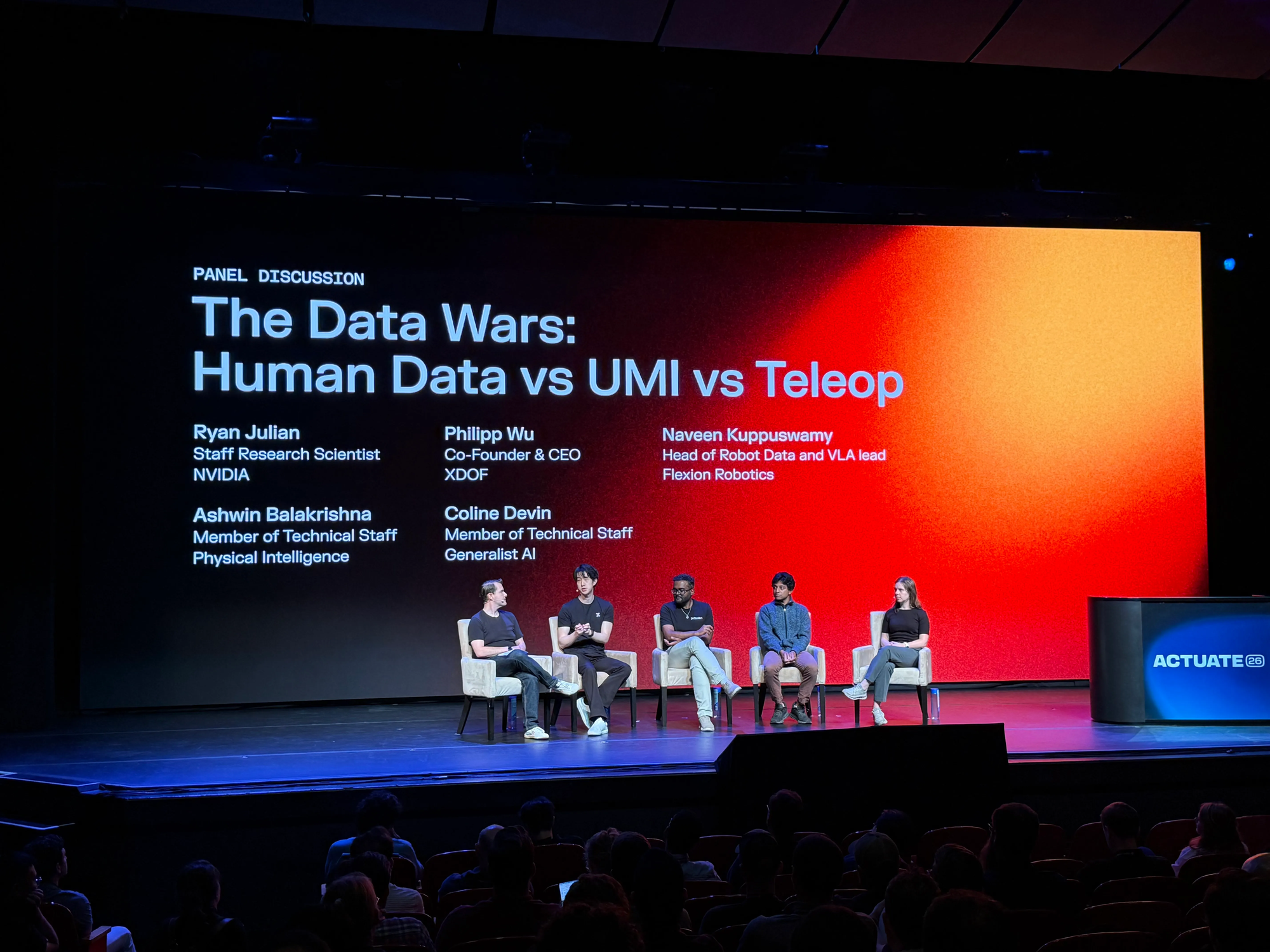
Julian opened with the obvious provocation: language models won by scaling a messy bucket of internet text, so is scale all robotics needs? Nobody bit cleanly. Wu answered as a practitioner: robotics is complicated enough in practice that scaling is never the only thing, and human teleoperation has shown for years that the hardware can do far more than the autonomy can. Devin drew the sharper line. Internet soup gave language models common sense, and adding value on tasks people care about still required curation and RL environments; robotics will rhyme, with physical common sense coming from messy, diverse data and usefulness coming from post-training. She also pointed at a structural difference: language is an abstraction humans chose to type, while video and sensor streams carry the physics of the world, including everything that happened around the person that nobody intended to record.
The quality-versus-quantity exchange produced the panel's most quotable moments. Balakrishna described Physical Intelligence's approach of annotating data quality in detail and conditioning on it, so desirable behavior can be pulled out at test time - "analogous to telling Claude to make no mistakes" - which lets lower-quality data help rather than hurt. Kuppuswamy compressed his position into an adage: "All data is good data. Some data is better data." Labels can be fixed later; the collection moment cannot. His deeper worry was repetitiveness: robot datasets get their diversity from episode counts while each task stays monotonous, and in five years we may wish we had collected wider from the start. Balakrishna backed that with the DROID story - a diverse dataset the original paper could barely learn from, which looked like a mistake until the field's methods caught up months later and made it useful.
The egocentric-video segment went deepest. Julian pressed on the missing ground truth: a GoPro on a head and cameras on wrists give you no joint angles and no contact forces, only estimates. Kuppuswamy, who is bullish on ego video, answered with a Sufi parable - Nasruddin searching for his keys under the streetlamp because that is where the light is - and asked whether pseudo-labels, and maybe ego video itself, are the streetlamp: convenient for bootstrapping, blind to tertiary contact, slip, and full-body interaction. His reframe gave the panel its lasting image: this is a data buffet. Ego video is the appetizer table, cheap and plentiful at $3 to $40 an hour with vendors offering tens of thousands of hours in a single day, and the mistake is filling your plate with only that. Balakrishna agreed from a different angle: stop treating pseudo-labels as ground truth at all; use video to learn physical common sense, affordances, and how humans approach tasks, and accept that closing the last mile of dexterity still requires well-designed robot or robot-like data.
Two more threads worth keeping. On whether application-specific post-training ever goes away, Balakrishna said adaptation may become lightweight but never optional - motors wear, environments drift, and the physical world is one continuous distribution shift, the same reason coding agents still need to learn a company's quirks. And on quality at million-hour scale, Wu described XDOF's pipeline with the specificity of someone who has been burned: humans reviewing every data point, automated validation, LLM validation, and a separate auditing layer, with batches organized by task so annotators build genuine expertise, plus filters for data robots have no use for, like footage of people walking around or eating lunch.
VLA versus WAM, or what a robot should predict
Day two's panel took the architecture question head on: do robots need to predict the world, or only the next action? Chris Paxton of Agility Robotics moderated Ben Burchfiel, co-founder and CTO of Walden Robotics and previously a lead on large end-to-end models at TRI; Armon Shariati of Shield AI; Danfei Xu, research lead at NVIDIA, whose team works on the GR00T models; and John Macdonald, head of AI at Bonsai Robotics.
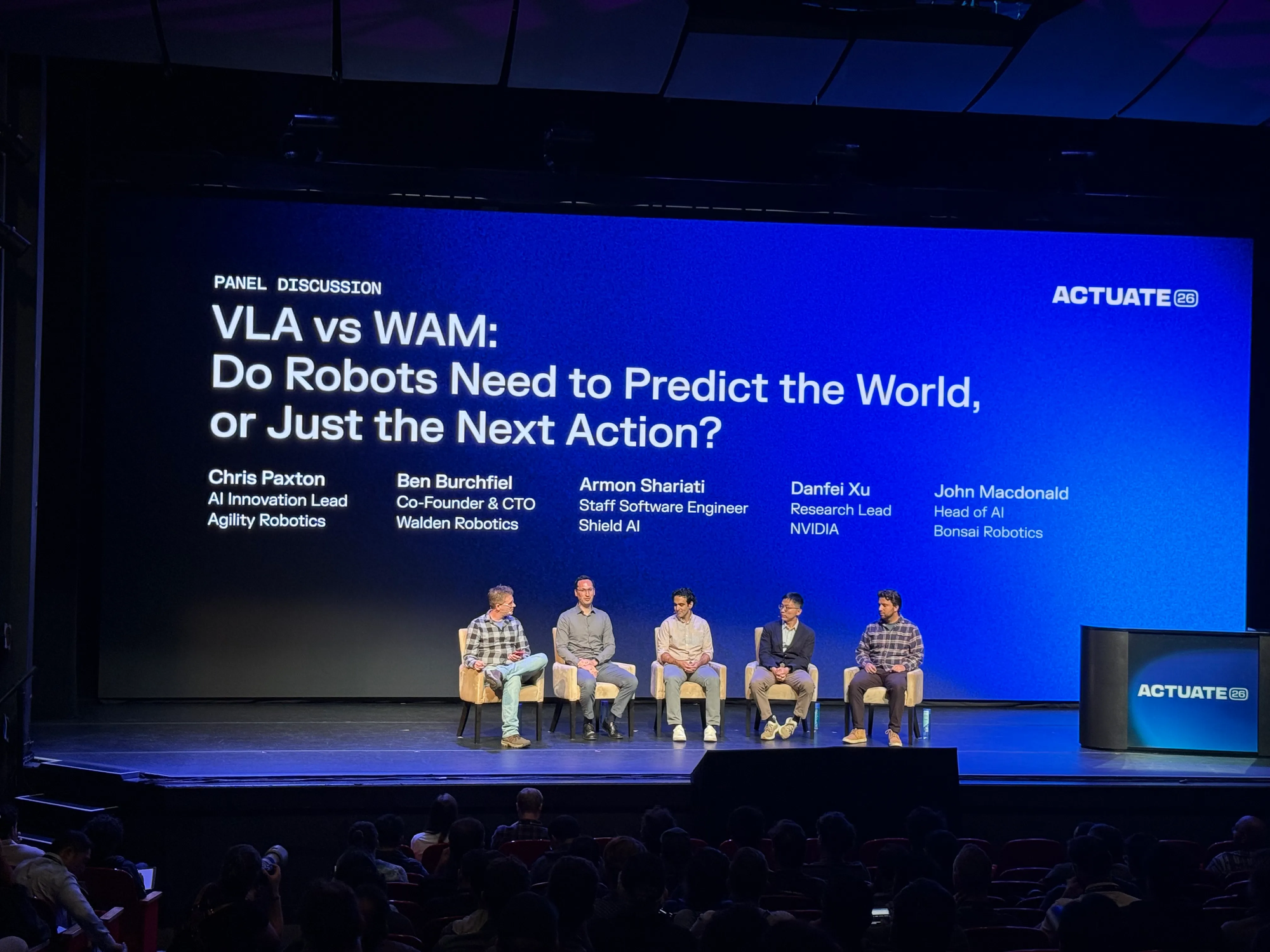
Definitions came first. Xu gave the textbook version: a world model is an action-conditioned dynamics model that predicts future state, which in practice now means video generation conditioned on current observation and language, with an action head attached if you want a policy. Burchfiel's contrast was crisp: a VLA is a policy that started life as a vision-language model and was uptrained onto actions, and when a VLM predicts the future it predicts it in language space, "but that's not the world our robot lives in."
Macdonald made the practical case for world-action models from agriculture, where the data asymmetry is brutal. A robotaxi company can pre-collect on the exact streets it will serve, in every season; an orchard robot cannot. Learning from video without paired actions changes what is reachable, and a trained world model doubles as a simulator: his fleet's failure cases become synthetic edge cases overnight. He described it as giving the robot dreams, mostly nightmares - flocks of birds, strange obstacles - and pointed at biology for the existence proof, since sleep-deprived rats go insane and every animal we know of sleeps. He was also careful to run a thought experiment against his own position: if robotics gets its internet of video-action pairs in ten years, WAMs and VLAs probably converge; today's gap is practical, and it is wide.
The counterpoint came from the aerospace seat: an earthworm probably does not dream. Shariati argued that reflexive competence - balance, picking up a glass - may never need future prediction, that pixels are the wrong currency when your compute has to fly on a small aircraft, and that in aviation vision itself matters in only a sliver of the domain. Latent-state prediction is his practical middle ground. He also offered the panel's most useful fidelity rule: match the simulator to the question. A world model that cannot render a small distant object is useless for training that detector, and perfectly good at sketching rivers, forests, and mountains fast enough to train higher-level reasoning.
Burchfiel spent his time dissolving the dichotomy. Nothing is special about action as a prediction target - cameras, torque, force, and commands are all streams, and when data is scarce you want to supervise on every rich signal you have rather than crown a favorite. Model capacity is a feature: harder, richer prediction objectives force better representations in pretraining, and post-training can sharpen from there. His best pushback landed on the claim that state prediction transfers across embodiments while actions do not: pixels differ across embodiments too, and "a Jacobian is actually not a very complicated thing" - the complexity of robotics lives in the semantic richness of the world, not in the kinematics. Xu supplied the honest limits from the world-model side: a deployed policy will poke holes in your model by visiting states the training distribution never covered, and there is still no good recipe for patching a world model short of classical model-based RL. His near-term bet is test-time compute arriving for world models the way it arrived for language.
Where they converged is where the field seems to be converging. The divide is mostly about which base model you start from and how you spend a fixed compute and data budget, the recipes are getting flexible enough to co-train everything, and the winners will craft the mixture for their workload instead of joining a camp.
Force intelligence: Eka's case for superhuman
Pulkit Agrawal, MIT professor and co-founder of Eka Robotics, gave the talk I heard people arguing about at the happy hour. His opening move was an audience trap. He played a state-of-the-art VLA folding a box and asked whether the video was sped up. It was - eight times. At real speed the robot is glacial. Then he played Eka's system picking up a raspberry and asked the same question. That video had been slowed down 25 times so the audience could see the manipulation at all.
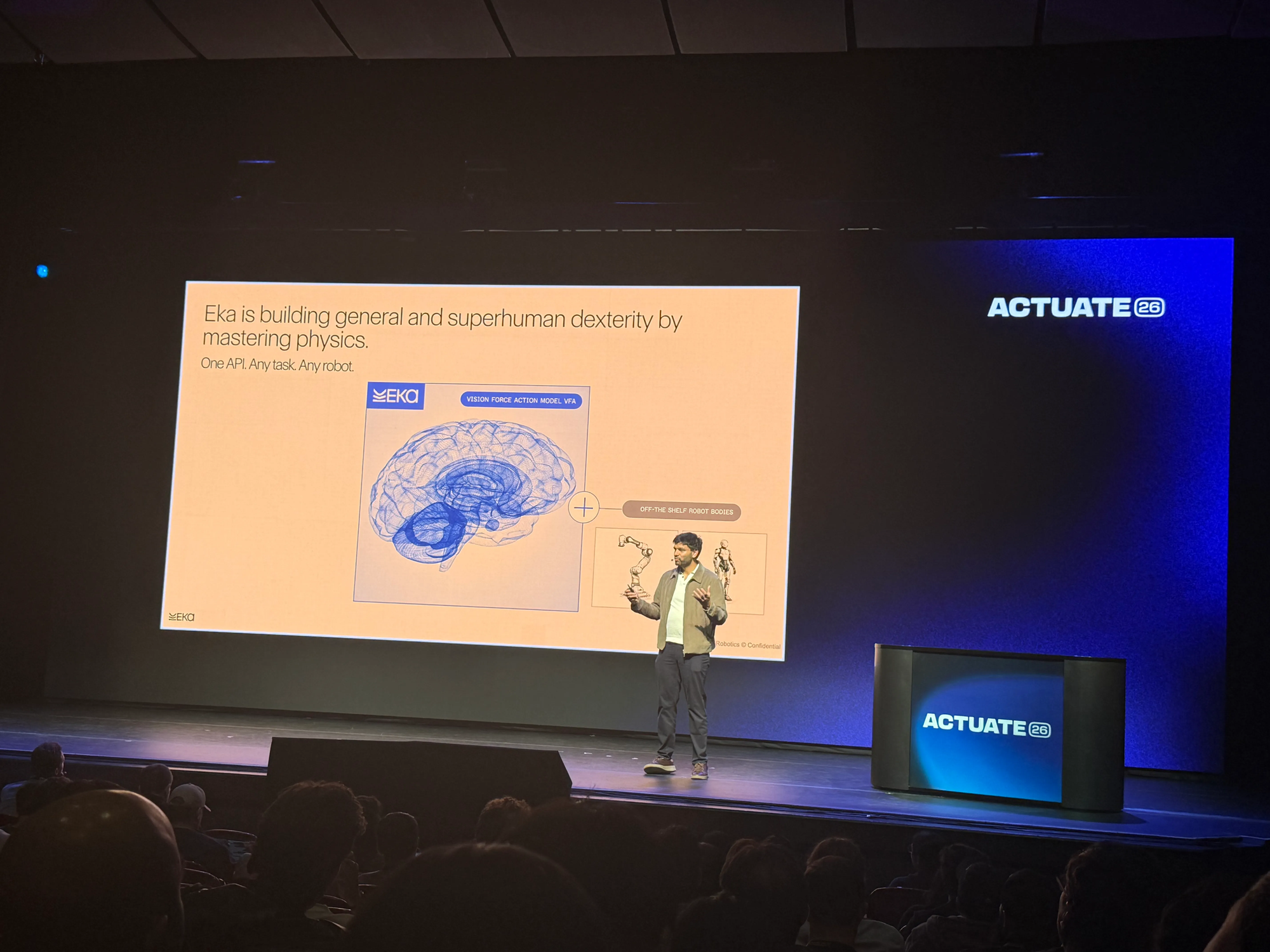
His framework has two axes: performance, meaning reliability and speed together, and generality. Industrial robots sit at 99.99 percent reliability and superhuman speed with zero generality; learned robots are general and slow. Below a certain performance threshold nobody pays, no matter how impressive the generality, and he argued that scaling video or teleoperation data moves the generality axis without touching performance. You can watch tennis on YouTube forever and never develop a serve, because the data never contains what the ball feels like on the racket. His deeper claim is architectural. A robot loop runs plan, control, action, world, observe; VLAs and video-trained world models, built from vision and language, cover planning and a little control while ignoring the physics. Manipulation is not vision-led. Driving is - and yet everyone in the audience who pulled a phone from their pocket did it without looking, on force feedback alone. "The language of physics is forces." Vision proposes the plan; forces do the control.
So Eka builds a vision-force-action model, and the data strategy follows from the physics. Human demonstration scales linearly with humans, arrives slow, and shows only successes - and a system that never sees failure cannot become reliable. The technique that learns from failure is reinforcement learning, the technique with a track record of producing superhuman systems, and the only place to run it at scale is simulation. The raspberry pick came entirely from sim, transferring to objects the model never trained on. The examples escalated from there: 1,500 picks per hour on tasks where humans manage around 600, and driving a screw into glass, where too much force shatters it and too little fails - his nod to Ken Goldberg's old line that changing a light bulb stands between us and general-purpose robots. Speed usually reads as danger, so he made the safety claim explicit: you would not put your hand under most fast-moving robots, and at Eka you can.
The pitch underneath is a reordering of the industry's defaults. Human-level is a benchmark, not the goal; the products that win history - cars, calculators, the code assistants half the audience uses - win by being superhuman, and he sees no reason robotics resolves differently. Whether sim-trained force control generalizes as far as the scaling crowd's video does is the argument the two panels had been circling for two days, now with a company on each side of it.
Generalist and the GPT-3 question
Pete Florence, co-founder and CEO of Generalist, had the enviable slot of presenting GEN-1.5 hours after announcing it. His talk title asked what the GPT-3 moment for robotics looks like, and his answer was specific: the moment prompting replaces training - when a robot can watch a task once and do it.
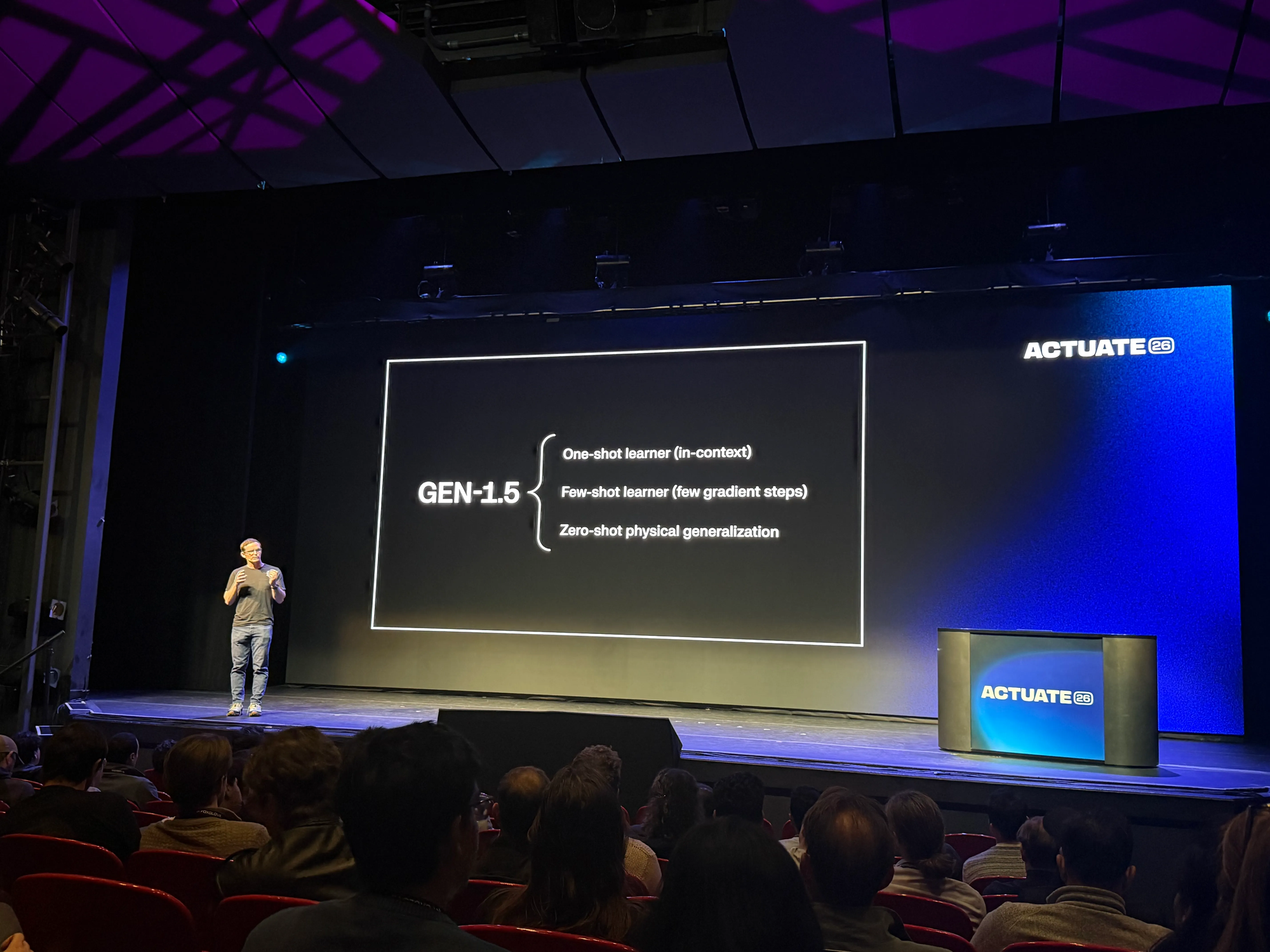
He earned the claim with history. A young child watches beads go into a cup and copies it, no words exchanged; the capability is clearly learnable. Devol's 1954 patent behind Unimate, the first industrial robot, was record-and-replay - one demonstration, zero intelligence. MIT's 1970 copy demo stacked blocks from a single example under crushing constraints. A decade ago, pre-transformer papers used attention to condition on one example without training on it, ambition running ahead of hardware. Generalist's own arc compressed the same story: a year ago their in-context learning demo could build Lego towers - 99,000 possible combinations, "a big universe in some ways, a tiny universe compared to everything" - then GEN-0 established scaling laws, then GEN-1 reached 99 percent mastery on post-trained tasks.
GEN-1.5, announced Wednesday, is the one-shot learner. A three-to-twelve-second demonstration - performed by a human with handheld grippers, by the robot itself, or inside a simulator - loads into the model's context as what the company calls a physical prompt, and the robot attempts the task immediately, no gradient updates. Across ten held-out tasks that produces 59 percent average success from pure in-context learning, rising to 83 percent with ten gradient steps on five minutes of data. The numbers are modest and Florence said so; the capability class is the news, and it emerged from eight months of pretraining rather than being trained in on purpose.
The demos carried the argument. Several were shot that same morning and did not yet exist on the internet: a single human demonstration of pouring, loaded and executed in real time. The one he called "the most beautiful possible thing" was a failure - the robot fumbles a marker at the rim of a cup, then fixes it, because a prompt specifies intent rather than a trajectory to replay. Prompts compose: demonstrate unzipping a pouch, separately demonstrate removing money from it, and the model chains them into one continuous skill with connective motions - repositioning, regrasping - that appear in neither demonstration. Prompts cross the sim-to-real gap zero-shot. And the physical generalization runs ahead of the prompts entirely: taught to sweep a block into a bowl with a brush, then handed a banana, the robot uses the banana as a brush; handed a dustpan instead, it switches strategy, nudges the block on with its other hand, and dumps it in.
Sitting there with Dyna's million hours from the previous morning still in my head, the two talks resolved into complements rather than rivals. Dyna's result says human video scales predictably into robot competence. Generalist's says enough pretraining turns a few seconds of new experience into a usable skill. The million hours is what makes the one demonstration enough.
Veeda comes out of stealth, on stage
The closing keynote doubled as a launch. That morning, The Logic broke the news that Sanja Fidler - University of Toronto professor and, until a few weeks ago, NVIDIA's VP of AI research running the Toronto Spatial Intelligence Lab - had raised more than $90 million in seed funding co-led by Khosla Ventures and Radical Ventures for Veeda AI, a world-model company she founded with longtime collaborators Zan Gojcic and Huan Ling. It ranks among the largest seed rounds ever raised by a Canadian company. By late afternoon she was on the Actuate stage making the argument for why it exists.
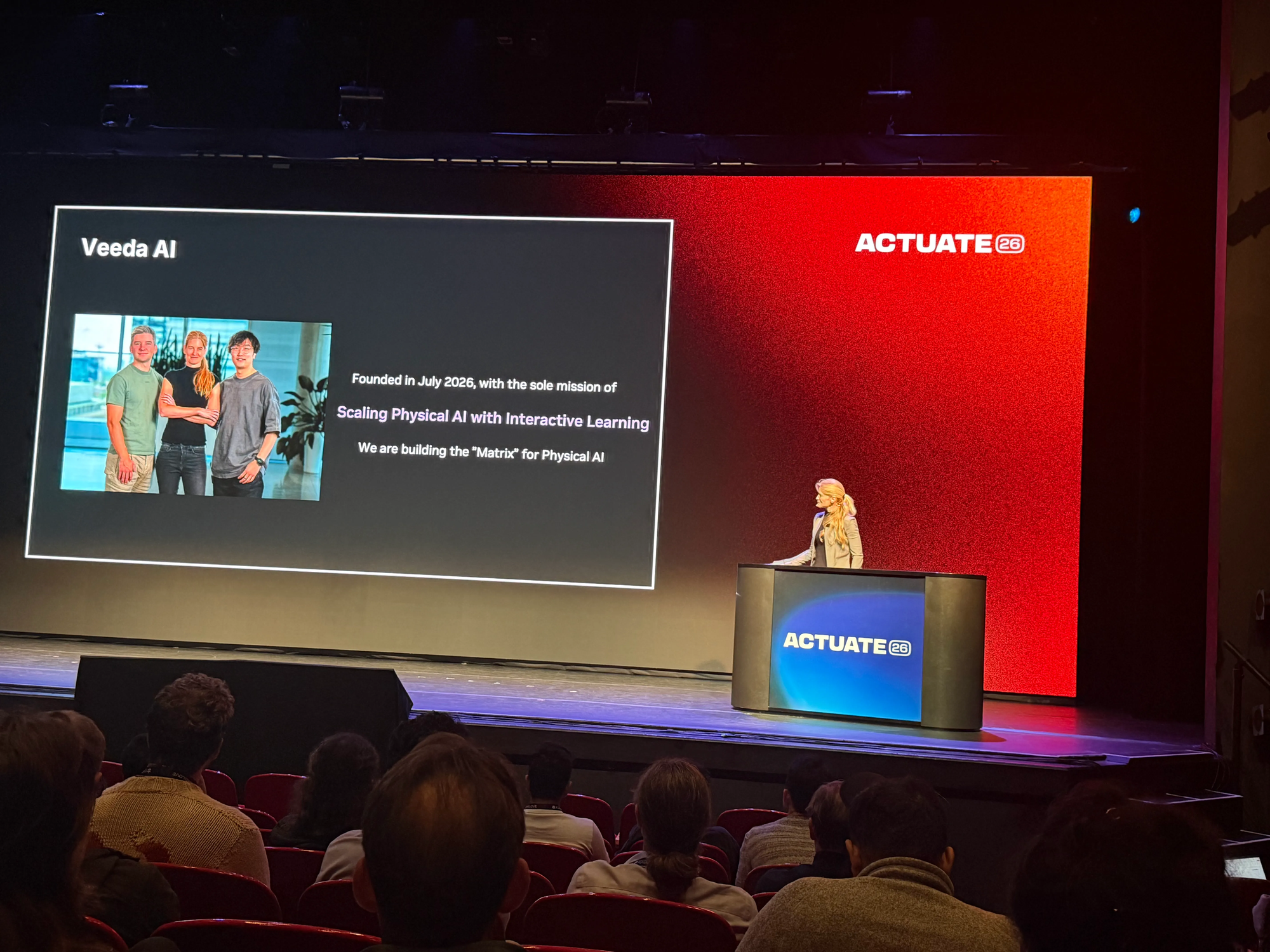
Her case starts from the limits of imitation. Humans learn by watching, and then they learn by trying - and trial and error is a luxury robots do not get in the real world, where hardware is scarce, time runs at one second per second, and failure is expensive. Her pop-culture anchor was Groundhog Day: Bill Murray gets a thousand attempts at one day until he saves everyone and gets the girl. Simulation is how robots get their Groundhog Day, bounded by compute instead of physics, and in her view the only scalable path to interactive learning and honest evaluation.
She walked the room through three generations of simulation. Graphics engines with hand-authored assets, where testing a new intersection means two months of artist time. Neural reconstruction, which the top autonomous-vehicle companies now run in production and which solved content creation - record a ghost-braking incident, reconstruct it in 3D, test every future software release against it - but which can only replay worlds already observed. And generative world models, where simulation becomes purely a data problem: an LLM-shaped system over sensor and action tokens that can invent scenarios outside the data lake, swap embodiments, and edit a scene with a text prompt. Her evidence for the velocity was NVIDIA's own arc, which she helped build. Cosmos Drive Dreams in 2025 took five minutes to generate five seconds of passive video; by March 2026 the interactive version ran in real time on a B300; by June it ran on a consumer GPU. Then an NVIDIA research scientist proved the point live, driving through a generated Bay Area street on a small machine with a consumer RTX card, steering with a handheld keyboard, crashing into parked cars to probe the model's learned physics, and re-prompting the same street into a rainy night and a Toronto winter with a single image edit.
Veeda's bet is that this third generation becomes the infrastructure layer for physical AI - a simulated reality where embodied models practice, fail, and improve millions of times before touching the real world. The matrix, built on purpose, for robots.
Noteworthy:
- The data war ended in portfolio management. Kuppuswamy's buffet beat the panel's title. Nobody on either panel defended a single-source strategy; the arguments were about sequencing video, simulation, teleoperation, and deployment data against a budget - and Dyna-2's finding that video is its own scaling axis gave the buffet a price list.
- The benchmarks flipped from capability to reliability. LIBERO-Plus and RoboDojo on Adrian's opening slides, Sunday's 99.1 percent across 31 unseen homes, Dyna's customer-site pass rates, Foundry's line-as-eval. The number that matters now is what happens under a nudged camera, an unseen home, or step fourteen of twenty.
- Interfaces are becoming the product. Physical prompting at Generalist, natural-language search over petabytes at Foxglove, text-prompt scene editing at Veeda. The recurring move is collapsing an engineering workflow into showing or telling.
- Performance is the contrarian axis. While most of the field scales generality, Eka and Foundry both built companies on the observation that below some threshold of speed, precision, or reliability, generality has no buyer. Superhuman-narrow versus general-modest is a live investment question, and I left less certain of the consensus answer than I arrived.
- The people who built the last wave are seeding the next one. Thrun teasing a stealth robotics company two decades after Stanley, Fidler launching Veeda the morning of her keynote, the Diffusion Policy and ALOHA authors running Sunday. The talent recycling loop in physical AI is spinning at full speed, and it is the strongest bull signal of the week.
Congratulations to Adrian Macneil and the whole Foxglove team on a third edition that tripled in size and kept its engineering soul.
References
- Actuate 26 - conference site, Foxglove
- Foxglove 3.0 release notes - Foxglove, August 2026
- ACT-2 Preview: Generalizing Reliability - Sunday, July 2026
- Dyna-2: A 1-Million-Hour Scaling Law for World-Action Models - Dyna Robotics, August 2026
- GEN-1.5: Embodied Foundation Models are One-Shot Learners - Generalist, August 2026
- Sanja Fidler's world model startup Veeda AI raises $90M in seed funding - SiliconANGLE, August 2026
- The Era of Eka: New Startup Unveils Vision-Force-Action Model to Crack Dexterity - Humanoids Daily, April 2026
- LIBERO-Plus: In-depth Robustness Analysis of Vision-Language-Action Models - Fei et al., CVPR 2026
- RoboDojo: A Unified Sim-and-Real Benchmark for Generalist Robot Manipulation Policies - arXiv, July 2026
- Archer buys former rival Wisk Aero - TechCrunch, August 2026
Company figures and market statistics cited above were shared by speakers on stage at Actuate 26 and reflect their own reporting, except where linked to a published source.