Labor as a Cloud Service: One Operator, 100 Machines | Christoffer Jørgenvåg, Hive
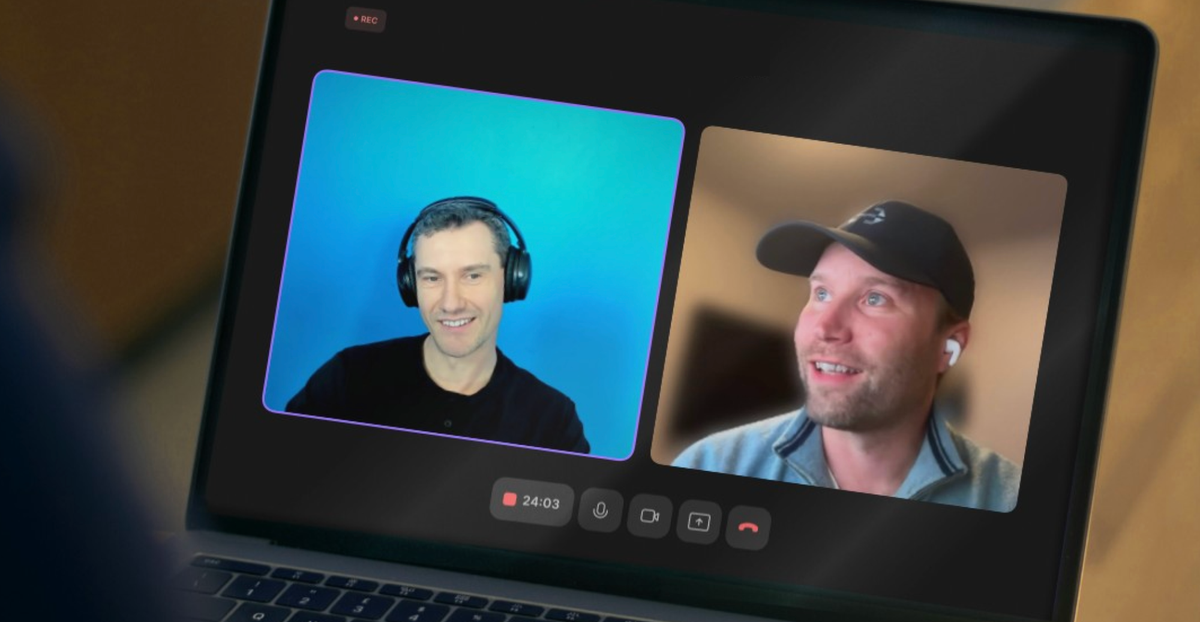
Christoffer Jørgenvåg is the co-founder and CEO of Hive, which builds what it calls a silicon brain for industrial machines: a sensor kit and an AI model installed on the wheel loaders, excavators and forklifts a company already owns, so the operator moves from the cab to a control room and supervises several machines at once. Christoffer started his first company, Red Rock, at 23, grew it to more than 80 people building lifting systems for offshore and marine customers, and sold it to Ocean Infinity in 2021. A year later he started again. Disclosure: I am an investor in Hive through SHACK15 Ventures.
Summary
Hive is named for the swarm: many agents solving tasks as one collective intelligence. Its tagline, "Built for the moon, proven on Earth," is a statement of ambition. If physical labor costs 40 dollars an hour on Earth, Christoffer told me, it is a different league in orbit, so everything Hive learns here makes more sense the farther out you take it.
The argument that runs through the whole conversation is that Hive is not in the automation business. The company does not sell kits or specialized machines. It sells productive machine hours, with a human operator at the back end for the moments the model cannot handle, and it intends to push that operator's reach from one machine to ten next year and to 100 by 2029. Christoffer's comparison is Amazon Web Services: he once built servers himself, then AWS packaged compute as something simple and scalable. "It is labor delivered as a cloud service."
A brain nobody would buy
Christoffer never wanted to build machines. Red Rock started with apps, payment systems and mobile ticketing, and after an introductory course on neural nets at Michigan Tech his plan was to build a smart control system and sell it to the machine manufacturers. "Nobody wanted to buy that," he said. So, almost out of spite, he hired electrical, mechanical and hydraulics engineers, took a 180,000 dollar bank loan, and built the machines himself: a factory in Norway, steel fabrication in Poland and Romania, complete products built in Brazil and India, deliveries to China, Japan, the US and Canada. Simple at first, then more robotic and semi-autonomous with each generation.
What twelve years of that taught him cuts against the instinct of most robotics founders. Building a good machine is extremely hard, down to how a cable is terminated and which paint system you use, and there is very little innovation left in the machines themselves. "They have been perfected over tens or hundreds of years." The best crane in the world is very cool, in his words, and does not change the world. The innovation is in the operator.
What an empty seat costs
In the US the machine is called a front-end loader; in Europe, a wheel loader. Either way it is a heavy wheeled machine with a bucket, and a shift is load, drive, dump, repeated across a quarry or a plant. Christoffer spends a lot of his own time with the people who drive them, and he said everybody has some kind of wear-and-tear problem with their body.
The cost to the company is harder to put a number on, and he would not. What he sees is that skilled operators are hard to find, so quite a lot of plants run one shift short of what they want, with an expensive asset and a whole plant behind it sitting idle. "It's for sure not low."
Sensors on the machine, an operator at the back end
The retrofit is a set of sensors (radar, lidar, GPS, cameras) plus compute and communication over Wi-Fi or 5G, and it takes a day or two to install once Hive has pre-integrated with that machine type. The machines range from a few tons to a hundred.
What the customer buys is not the kit. It buys an operator, a virtual one. When the model cannot perform, a Hive operator takes over, puts the machine back into a known state and hands it back. The customer does not see that handoff, and every one of them becomes training data. When the link drops, the machine brakes, stops, goes to a safe state and waits to reconnect. Hive does not allow any machine to operate without human supervision, and Christoffer does not expect that to change. "There will always be a human who can take over control and who is the decision maker."
For now, he said, the ratio of operators to machines is not the point. The point is generating unique, diverse training data in volume, which is what gets the ratio to one to ten next year and one to 100 in 2029. Without one to 100, he cannot deliver labor cheap enough to make it, in his words, super abundant.
Why retrofit
I gave him the three routes to an autonomous excavator: the OEM builds it in, a startup builds a new machine, or you retrofit the fleet. He conceded that a purpose-built machine can win in highly specialized scenarios, and that it is almost always cooler. "But it's almost never the right answer." The useful modification to an existing machine is subtraction: take out the cabin, the seat and the joysticks and save the cost. Everything else works.
The retrofit also wins on time. The customer already owns the assets, operation starts immediately, there is no large engineering program, and the data starts flowing on day one. His frame is that the machine is the extension of the operator's body, and a customer does not want one specialized autonomous excavator. "They want a full fleet of operators running everything they have."
Bedrock, TerraFirma and a different category
Bedrock Robotics has raised hundreds of millions of dollars and TerraFirma about a hundred million; Hive raised a 15 million dollar seed this summer. Christoffer called both excellent companies and was careful to say he does not sit inside them. His read from the outside is that Hive is building something different: a generalizable physical laborer that can sit in any machine the customer has, whether that is a forklift, a crane or an excavator. The reason is partly data, since you want the most diverse data sets you can get, and partly positioning, since the company that runs every asset on every site is the one that gets perceived as the labor provider. "This is a completely new category."
On price, he expects some cost-down from custom PCBs and perhaps custom inference silicon, but most of the path from roughly 20 dollars a machine hour toward one dollar runs through the models: one operator covering more machines as the models improve. The OEMs, he thinks, will split. Some will see competition, some a service they cannot provide themselves, and most, over time, a partner.
London, then Austin
Hive moved its headquarters from Kristiansand to London for talent. The company builds its own models and policies from scratch, and London is where that talent is in Europe. The US expansion follows the same logic plus customers: Hive is working with logistics, mining and a few energy cases there, and Christoffer was flying to Austin the week after we spoke to set up the office and stock components and machines. He does not think the US is a very different sale. The labor shortage is sharper. "I have so many customers who want to add another shift and simply can't."
His pitch to an engineer in London or San Francisco is the same one. He started coding at ten or eleven in Excel's macro editor, because he had neither internet nor a compiler, and learned that in a virtual world you can build anything. In the real world you cannot, and most of the constraints trace back to one person's time being expensive. Make one person 100 times more productive, he argues, and the constraints come off.
The ask, and the hot takes
For the first time in his career, customer access and cash are not the limiting constraint. Demand is high enough that companies are paying for priority. What he needs is people. "If I have one ask for the next 30, 60, 90 days, it's: bring me the best people who want to solve this."
The rapid fire was quick. Humanoids on a construction site: yes, in two to three years, and Hive's silicon brain will power some of them. In five to ten years, no humans on those sites at all, because taking the people out is what lets you run a site on a completely different operating profile. The most common mistake about heavy-machine autonomy, including among investors, is calling an automation project autonomy. Five years from now, 25 percent of heavy machine hours in Europe and the US will be supervised by someone who is not in the cab. And the one thing he wishes he had known before starting Hive: how to package it commercially from the beginning. "It was never about the tech. It was always about selling a service to our clients."
Full episode available on:
YouTube
Spotify
Apple Podcasts
Learn more about Hive: hiveautonomy.no