Why Pixel-Based Robot AI Is an Expensive Detour | Chao Cao, Sancho
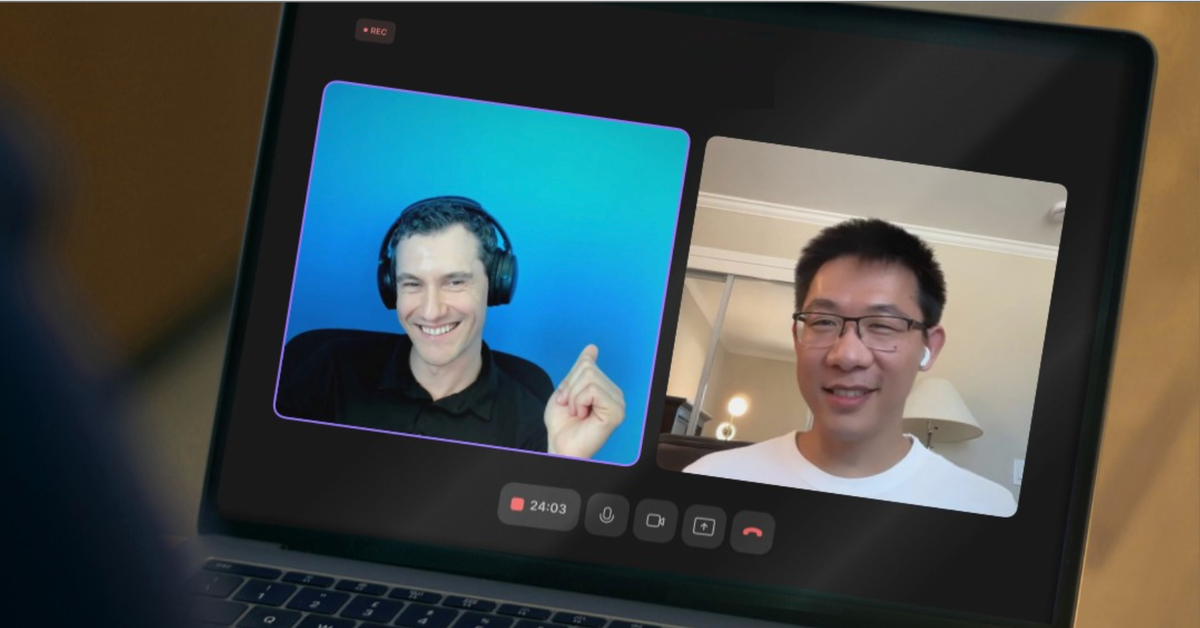
Chao Cao is the co-founder and CEO of Sancho, which builds the intelligence layer that lets general-purpose robots connect the machines in advanced manufacturing. He led the autonomy team for CMU's DARPA Subterranean Challenge entries, spent a year and a half at the Boston Dynamics AI Institute, and just announced an oversubscribed seed round co-led by Fusion Fund and Catapult.
Summary
Chao Cao and his co-founder Jack Yang quit their jobs last October. By December they had a paying customer. By March their work was on stage at NVIDIA's GTC keynote. The velocity is one story. The technical position underneath it is the better one.
The dominant approach to robot intelligence right now is the vision-language-action model: pixel-based systems trained on massive datasets, on the theory that enough demonstrations eventually produce general competence. Chao thinks that path is an expensive detour. His argument comes from three years of sending robots into tunnels and caves, and it starts with a question most robotics pitches skip: how resource-efficient can you get to five nines of reliability?
Humans are the universal connectors
Chao's mental model for advanced manufacturing is a lasagna. The grinder grinds the meat, the mixer mixes the sauce, the oven bakes it all together. Each machine handles one step. Someone still has to carry things between them. "We humans are extremely good at building those machines, however complex the step is," he told me. "CNC cutting metal, 3D printing, even photolithography by ASML. The challenge is at crossing the boundaries of those machines."
Factories have had two options for those crossings. Fixed automation - conveyor belts, assembly lines - works when you know exactly what you'll produce and in what volume, and its upfront cost limits it to the biggest manufacturers. Everyone else uses people. As Chao put it: "humans as the universal connectors between machines."
At one of Sancho's early customers, a cell therapy facility, the connectors are scientists costing $300,000 a year. The machines can produce 150-something doses a day. Output is capped by scientist availability, and humans are the main contamination risk in a process where every dose is personalized and expensive. Sancho's pitch is a third path: general-purpose robots with the flexibility of a person and the reliability of a machine, so flexible automation stops being a big-company privilege.
The case against pixels
Chao traces the VLA wave to research momentum. Language models worked, vision-language models followed, and the field added an action head and hoped the recipe would carry into the physical world. His objection is about representation. Robots operate in three dimensions, and contact is where they succeed or fail. "Geometry - the spatial understanding, the spatial structure - is what matters most a lot of the time."
Pixels encode plenty of information for high-level task understanding. For safety, efficiency, and longer-horizon reasoning, Chao argues they are an inefficient representation, and a costly one: predicting the future in pixel space burns GPU compute, and pixel-level accuracy still doesn't guarantee physical-level accuracy. Sancho goes straight to 3D geometric world models, riding the tailwind of 3D sensors getting cheap enough to put on any robot.
The compactness shows up in deployment. The entire stack runs on a single onboard compute module. No GPU backpack, no cloud connection.
Reasoning at test time
The second bet follows from the first. If you can't collect your way to every situation a robot will face, the robot has to figure things out live. Chao calls the alternative the memorization paradigm: the robot has seen something similar before and reacts accordingly. "You cannot rely on collecting a humongous training dataset and hoping that when deployed, the robot only sees things it has seen before. That's not going to work."
Test-time reasoning means the robot considers which actions it can take, how those actions will change the world, and which sequence leads to the best outcome - in real time, on hardware it carries.
The evidence he reaches for on data is the robotaxi race. Tesla has gathered orders of magnitude more driving data than Waymo. Waymo runs the autonomous service. "The amount of data itself is not necessarily the determining factor," Chao said. Knowing which data to collect, at what quality, matters more than sheer scale. His related hot take: "a huge, huge amount of the data we collect today is going to be wasted," because the field is still guessing at what robots need.
Three years in the dark
Chao's conviction comes from a specific place. He spent three years of his CMU PhD on the DARPA Subterranean Challenge - "literally in the dark," in tunnels, caves, and subway stations - leading the autonomy team and serving as the single human operator supervising eleven robots at once. GPS-denied environments, rough terrain, wheeled robots and legged robots and drones coordinating on the fly.
Two lessons carried straight into Sancho. First, the real world is brutal. Even a staged competition sat far beyond what lab assumptions could handle. Second, no amount of preparation covers everything. "No matter how prepared we were, there were always cases we ran into that we never anticipated." The long tail is the hard part of robotics, and a robot that handles the unexpected shrinks the resources it takes to tame it.
October to GTC in five months
The founding story is short because everything happened fast. Chao left the Boston Dynamics AI Institute believing the industry had reached its eighties-and-nineties-of-computing moment: hardware cheap enough, software good enough. He and Jack met nine years ago during their CMU master's, and Jack brings the industry side - mapping tech lead at Nuro, founding engineer at Phiar before Google acquired it. In Chao's words, they are "young enough to be ambitious but old enough to be experienced."
A former colleague mentioned the loading and unloading problem at what became their first customer, and something clicked: this was the same autonomy they had been building, pointed at a commercial gap. Incorporation in October, paying customer in December, GTC keynote in March, and now an oversubscribed seed co-led by Fusion Fund and Catapult.
Starting at the hard end
The counterintuitive part of Sancho's go-to-market: biopharma and semiconductor first, groceries and hotels later. Most robotics companies run the other direction. Chao's logic is that the skills transfer - "If a robot can make lasagna by connecting the mixer, the grinder, and the oven, then it can also connect different machines to do laundry at home" - while the environments differ sharply. A cleanroom is structured and controlled. A grocery store is chaos with consumers in it, and it tolerates far less cost for the reliability required. High-value regulated environments pay for the robot, and their structure makes the robot's job tractable.
Sancho is hiring: perception engineers who want to work on data-efficient world representations, and whole-body loco-manipulation. Chao's filter is deployment experience and system-level ownership - people who know, in his words, "how brutal the real world is."
Full episode available on:
YouTube
Spotify
Apple Podcasts
Learn more about Sancho: www.sancho.com