From Demos to Deployments: A Day at AUTONOMOUS 2026
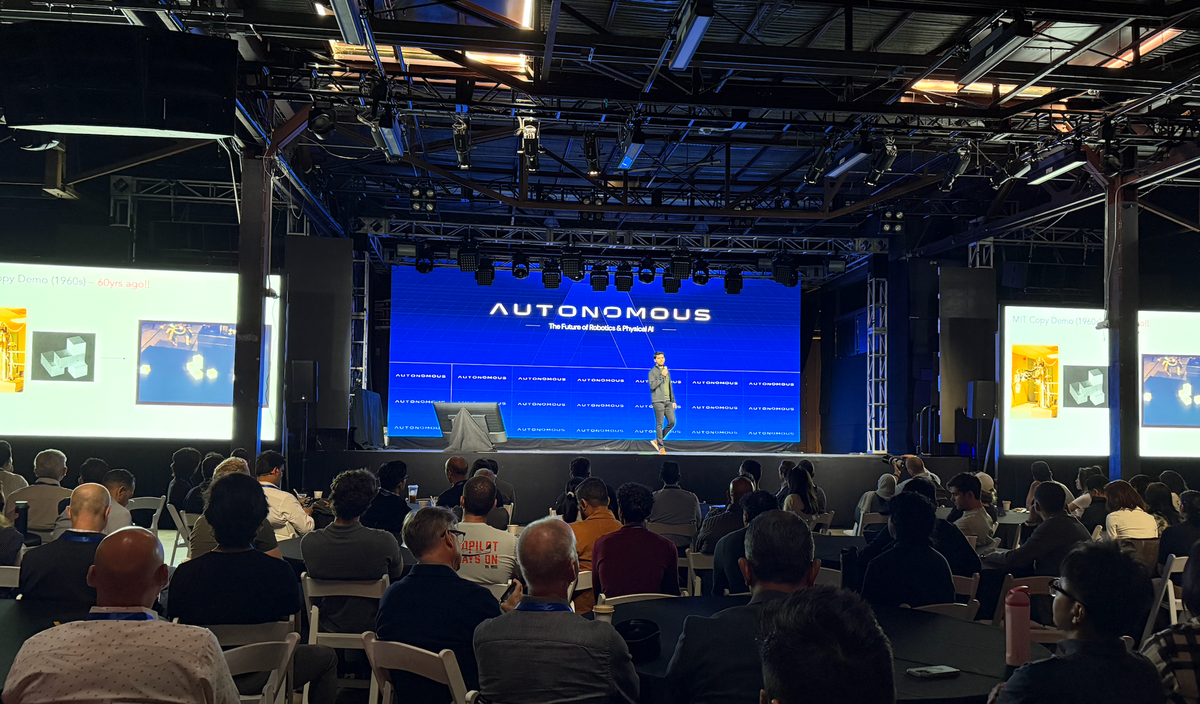
July 16, 2026 - The Midway, San Francisco
Deepak Pathak opened his keynote with archival footage: a robot arranging blocks to match an image, a teleoperation rig with a human puppeteering an arm behind a curtain. The block-stacking result dates to the 1960s. The teleoperation footage is from 1957. Colorize the video and swap the audio, he argued, and most people in the room would guess it was shot two years ago. Robotics has been "almost here" for seventy years.
That was the honest starting point for AUTONOMOUS 2026, a first-year conference that pulled roughly 500 founders, engineers, and investors to The Midway in San Francisco on a single Thursday in July. Rohan Savla, who left OpenAI a few months ago to start Frontier Media, built the event around a simple filter: put people on stage who are deploying robots with paying customers today. Two stages, about sixty speakers, and remarkably little arguing about whether the robots work. The arguments were about data, unit economics, and how long deployment takes.
For friends who missed it, here is what happened, with names attached - this was a public event, and the speakers earned the credit.
The data problem, stated three ways
Pathak, CEO of Skild AI, framed the core constraint through Moravec's paradox: hard is easy, easy is hard. Backflips and kung fu look impressive, and they only require a robot to know its own body, which is fully known. Climbing an arbitrary outdoor staircase requires understanding the external world, which is not. His challenge to the room: find a video of a humanoid climbing unfamiliar stairs in the open world. He claims the only ones that exist are Skild's.
The reason robotics stalls where language models soared comes down to data volume. Language models pretrain on trillions of tokens scraped from an internet that already existed. Every public robot manipulation dataset combined amounts to about a million episodes, each taking a minute or two of human effort to collect. Pathak's answer is to stop looking for a golden path. Every data source fails on at least one of three axes - scalability, diversity, closeness to the robot - and their weaknesses complement each other. So Skild pretrains on video and simulation, post-trains on small amounts of teleoperation data, and then lets deployment data compound. The result is what he calls an omni-bodied brain: one network driving humanoids, quadrupeds, and arms across morphologies it has never seen, including a demo where robots with software-disabled legs relearn how to walk in seconds. He showed a $4,000 arm with a parallel gripper, no hand, no force sensor, cooking omelettes continuously from a single wrist camera. "These are all excuses," he said of the argument that robotics waits on better touch sensing and hands.
Andrew Wooten, co-founder and CPO of Rhoda AI, took the same problem from a different angle. His observation: learning-based robots had close to zero real-world manipulation deployments when Rhoda started, and eighteen months later that still holds. His diagnosis is that the VLA approach - vision-language models post-trained on robot data - inherits a strong prior on language and a weak prior on physics, so it fails the moment the real world deviates from the post-training set. Rhoda's bet is that internet-scale video is the missing pretraining corpus. Their "direct video action model" generates a video of the robot completing the task, then converts that video into actions, which reframes the hardest problem in robotics as a video generation problem. Two obstacles made this impractical before: off-the-shelf video models hallucinate physics (he showed a state-of-the-art model rendering a robot thumb passing through a Coke can), and they took 36 seconds to generate what real-time control needs in hundreds of milliseconds. Rearchitecting diffusion to generate frames sequentially, so each frame depends on the last, was one of about a dozen pieces they had to build.
The proof point was box decanting in a real factory: every box entering a factory or warehouse today gets opened by a human hand. The customer's KPI was one box every 120 seconds at 75 percent autonomy. Rhoda hit 100 percent autonomy in under two minutes per box, with roughly 10 to 20 hours of robot post-training data on top of the video-pretrained model. The plant manager tested generalization by throwing his glove into a tray of bearings. The robot picked it up and threw it in the trash. He then stuffed the glove inside a plastic bag; the robot shook the glove out, trashed it, and put the plastic in recycling. None of that was in the training data.
Fan-Yun Sun, CEO of Moonlake AI, presented the simulation side solo - co-founder Sharon Lee was out sick. His most useful contribution was reframing what simulation is for. Before you ask whether a policy is smart enough, you have to answer questions integrators charge months to answer: does the robot fit in the space, can it kinematically reach the object, which of three candidate arms hits the required throughput. Moonlake reconstructs physically accurate environments from a single video or image in hours, then runs those studies. He described a food-packaging company with hundreds of US factories using this to filter candidate automations, and a government client that discovered in simulation that the robot could not turn around in the hotel corridor it was meant to serve. His team is also building what amounts to an autonomous simulation engineer: an agent that researches product dimensions online, generates object code, tests articulation, assigns fluid solvers where needed, and iterates - the work that today takes a PhD and three simulation engineers. The sobering statistic he collected from vendors on the floor: deploying one robot into one environment takes a median of about a year in the US, and about four months in Japan.
The factory is the moat
The morning's manufacturing panel, moderated by Junfan Zhu of Saturday Robotics, put three different bets side by side: Chris Chen (Co-CEO, Robotics at Faraday Future), Adarsh Kulkarni (CEO, Foundry Robotics), and Lukas Pankau (CEO, Industrial Next).
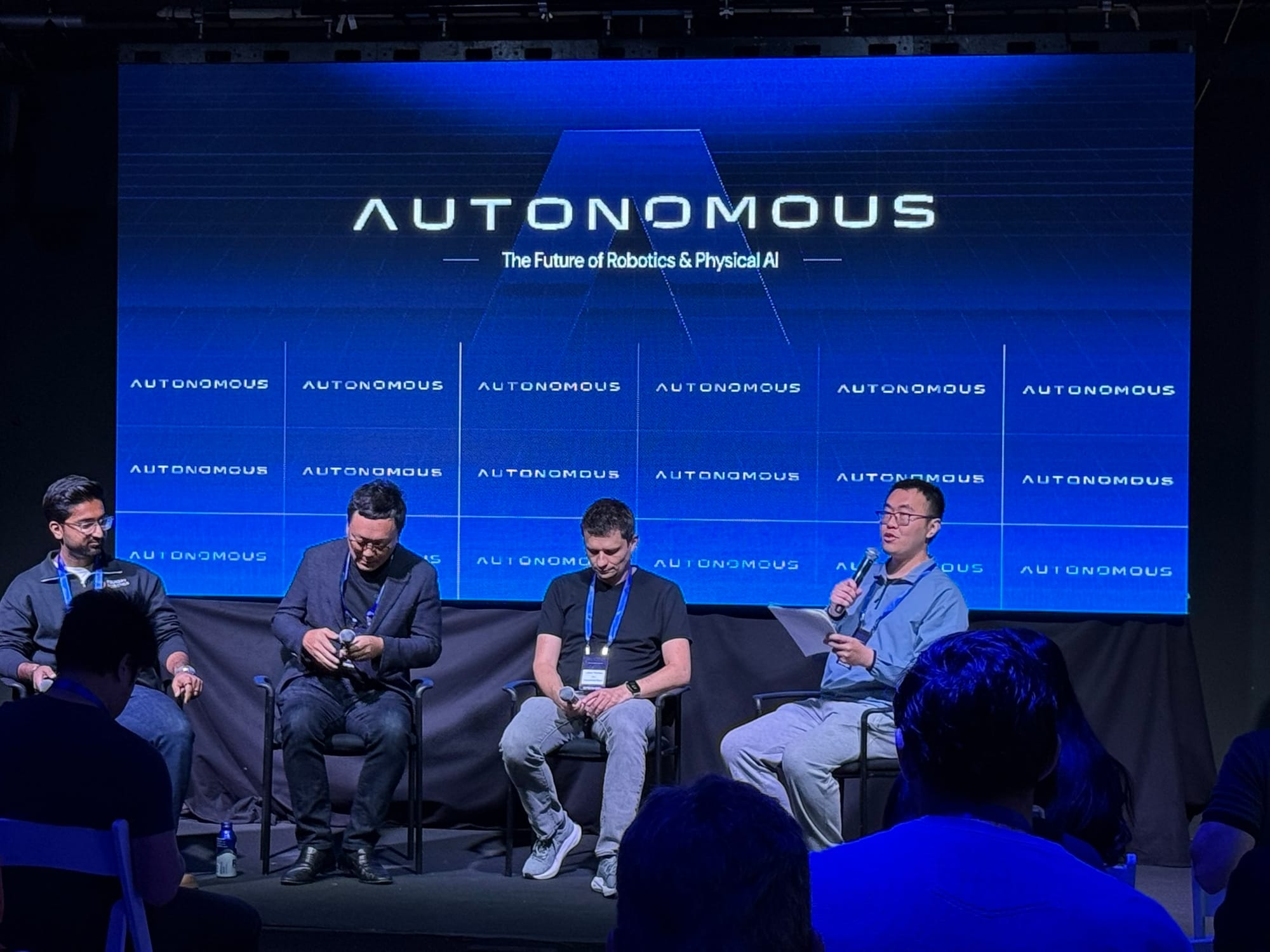
Asked what remains hardest for a factory robot, none of them said intelligence. Pankau said managing change - people modify the line and tell no one. Kulkarni made it concrete: getting "really, really good at screw driving," where an M4 becomes an M3, a torque rating shifts ten percent, and half of American factories skip torque verification entirely. Pankau added that nobody has automated driving M0.5 screws into a laptop; that step remains manual even at Foxconn.
Kulkarni, who built and ran foundational robotics at Scale AI before founding Foundry, laid out the strongest version of a deployment-first thesis I heard all day. Before physical AGI, the most valuable asset is a diverse, high-quality dataset from real production - satellite building, battery assembly, robot manufacturing. After the models get good, the weights alone are worthless without a factory designed to run them: fiber to every robot, GPUs under each cell, a server rack in the basement. Foundry builds the factory either way. His co-founder ran the entire Model Y program at Tesla, and Kulkarni's framing of the division of labor stuck with me: the labs are better at teaching models the laws of physics; nobody is better than a factory operator at teaching them the laws of manufacturing afterward.
Pankau explained the precision constraint that shapes everything at Industrial Next. Edge inference at production cycle times caps model size, and at a fixed size you trade generalization against precision. A sloppy t-shirt fold costs nothing; a half-millimeter miss on an FFC connector at a four-second cycle time breaks the phone. His estimate: models are ten to fifteen percent of an AI-powered production line. Chen agreed on where the rest comes from - Faraday's robotics arm focuses on a handful of tasks like machine tending, material handling, and sorting, delivering hundreds of units and letting each deployment generate the data that trains the next model.
Two moments deserve preserving verbatim. When Zhu asked whether physical AI scales on data, simulation, teleoperation, or manufacturing expertise, nobody picked simulation, and Kulkarni explained why with a wet ping pong paddle: simulating wet rubber, or oil on a ball, costs absurd compute, and hiring people to collect that data is simply cheaper. And in the anti-consensus lightning round, Kulkarni delivered the line of the day: "Humanoids are ridiculously over-engineered. Getting a humanoid to do your dishes basically means that dishwashers suck." Clearing a nuclear reactor, sure, send the humanoid. On reshoring, his answer was know-how: give someone a hundred billion dollars and ask for ten million drones, and there is nothing they can do, because the knowledge of mass-producing complex electromechanical systems in America no longer exists.
What scale looks like when it stops being a demo
Three sessions showed the far end of the deployment curve, and the pattern across them is worth noticing: the technology recedes and operations take over.
James Kuffner, CTO of Symbotic, in conversation with Fast Company's Harry McCracken, casually dropped the largest numbers of the day. Over 20,000 robots, each driving about 50 autonomous miles a day inside warehouses - more than a million autonomous miles daily. Eight million boxes moved per day, on track for roughly three billion this year, across 70 sites, with Walmart as an anchor customer. A typical site runs up to 1,500 bots against 3.1 million storage locations, carrying 60-pound boxes at 25 miles per hour. Parts of the system hit six nines of reliability, and at eight million boxes a day that still fails too often, so uncertain robots call a remote teleoperator, the human decision becomes training data, and the fleet calls for help less over time. His palletization example made the economics tangible: humans stack a pallet about five feet high; Symbotic's algorithm plays 3D Tetris across millions of configurations with business constraints baked in (nothing heavy on light, nothing toxic on food) and stacks eight feet, cutting trucks needed by half. He also noted the human side plainly: average tenure for a person lifting 50-pound boxes in frozen storage is eighteen days. Kuffner spent time on Google's early self-driving team and a decade at Toyota - "I learned how to write good software at Google and I learned how to make good hardware at Toyota. You need both to make a good robot" - and pushed back on the false choice between classical engineering and end-to-end learning. A responsible engineer bounds system behavior with physics and puts the learned components inside those guardrails. His advice to young roboticists: "Don't forget how to do math." Through GreenBox, Symbotic's warehouse-as-a-service joint venture with SoftBank, he wants to rent that capability to mid-sized businesses the way startups rent cloud compute.
John Ha, CEO of Bear Robotics, told the founding story behind roughly 16,000 deployed robots, and it started with a warning: "If you're going through a midlife crisis, don't open a restaurant. Buy a sports car. Once you realize it's a bad idea, you can sell it." Seven years as a Google software engineer, then a restaurant, then shock at how physically brutal the work is behind the curtain. Google robotics friends told him SLAM was open-source and easy - his second bad decision as a CEO. The stories that followed were pure go-to-market: Chili's headquarters asking him to pour orange juice on the floor and scatter forks in the robot's path, a year of tests and executive demos, then months in Japan passing SoftBank's validation gauntlet before an order of over two thousand robots forced Bear into mass production.
Kevin Peterson, CTO of Bedrock Robotics, interviewed by Business Insider's Rya Jetha, is applying self-driving lessons to excavators, and his retrofit-versus-build logic is a case study in focus. Put the calories into the hardest problem - autonomy and reasoning - and inherit the customer's existing fleet instead of waiting for equipment refresh cycles. He learned that lesson painfully in mining: autonomous mine trucks from his 2010-era work have driven hundreds of millions of miles profitably, and it still took the mining companies eight to ten years to refresh fleets. A startup cannot wait a decade for its market to buy new machines. Bedrock now operates across 40 to 50 sites - highways, water treatment plants, data centers - with about 90 percent of machines collecting data and 10 percent running autonomously, and a launch coming for an end-to-end learned system he described as "ten lines of code and a large model." Construction, he argued, differs from driving in kind: cars follow lanes, while a jobsite is continuous problem-solving - bedrock four feet down where the plan said dirt, a tree worth saving, mud that swallows an 80,000-pound machine. The demographic clock adds urgency: half of US construction workers retire within the next decade. In the lightning round he named the buzzword he hates: "World models are massively overused right now. Everything's not a world model. SLAM is not."
Field notes: birds, refrigerators, and one skeptical superintendent
The afternoon panel on deploying at real-world scale, moderated by Michelle Sun of Core Matter Labs, assembled founders with real fleet mileage: Paul Mikesell (Carbon Robotics), Noah Ready-Campbell (Built Robotics), Samuel Reeves (FORT Robotics), and Tessa Lau (Dusty Robotics). Sun framed her research practice around one question - the gap between demo and deployment - which happens to be the question this newsletter exists for.
The war stories carried the session. Ready-Campbell's team chased phantom GPS glitches for weeks on a California solar site, replacing antennas and cabling, until he happened to take a phone call near the RTK base station and watched a bird land on the antenna. The robots' position estimates were jumping meters because of a bird's body. The fix: an inflatable owl. Lau's robots started spinning in circles in the field in October 2023; her team diagnosed a loose motor coupler, shipped a torque-spec fix, and declared victory - until the failures returned the following October. The coupler was never the root cause. The fault was temperature-sensitive, which they proved by cycling robots in and out of a refrigerator. Mikesell, whose laser weeders now run in fifteen countries, listed what breaks at fleet scale: air conditioning, wheel encoders, axles - the unglamorous parts you stop thinking about after the demo works.
On adoption, Lau described winning over a construction superintendent who, thirty seconds into a layout demo, knelt down with his own tape measure to check the robot's work, found it spot on, and smiled - a man his own crew swore never smiles. Her robots have now printed 315 million square feet of layout, and she noted the deployment friction has moved upstream: customers must level up their digital workflows to feed the robot files. Mikesell argued the opposite discipline works in agriculture - fit into the workflow that exists, since every farm activity already has a dollar value attached, and resist the fantasy that the world reorganizes around your robot. His autonomy kit exists because farmers kept telling him the constraint was operators, to the point that customers now say they would buy more laser weeders if the autonomy came with them. Ready-Campbell explained the wedge logic behind Built's focus on utility-scale solar: construction is a fifteen-trillion-dollar global industry that mostly grows with GDP, the US adds only a couple hundred net miles of highway a year, and solar plus data centers are the fastest-growing verticals - with solar being repetitive in exactly the way automation loves. He mentioned a recently announced $75 million deal with the largest construction company in the US, and a roadmap covering about five gigawatts of solar construction.
On labor, the panel converged from different directions. Mikesell: US field agriculture runs almost entirely on H-2A guest workers, fields go unweeded and unharvested for lack of people, and every year someone dies of heat stroke pulling weeds - work he called a waste of human creativity. Ready-Campbell added that current immigration enforcement is worsening the shortage on construction sites, and understaffed crews create quality and safety problems. Reeves, who started in robotics twenty years ago building landmine-clearance robots, called himself a robo-optimist; Lau pointed to a new job title her customers invented - layout robot operator.
The closing lightning round distilled to this: listen to your customers, plan for safety earlier than feels necessary, expect everything to be bigger and slower than projected, and - from a founder burned enough times to mean it - own the whole machine, because vendors rarely know your requirements as well as they claim.
Where the money goes
The investor panel put four different capital models on one stage: Steve Jacobs of Drumbeat Capital moderating Kanu Gulati (Khosla Ventures), James Hardiman (DCVC), and Bilal Zuberi, who launched Red Glass Ventures this year with a $150 million fund focused on AI in the physical world after twelve years as a GP at Lux Capital.
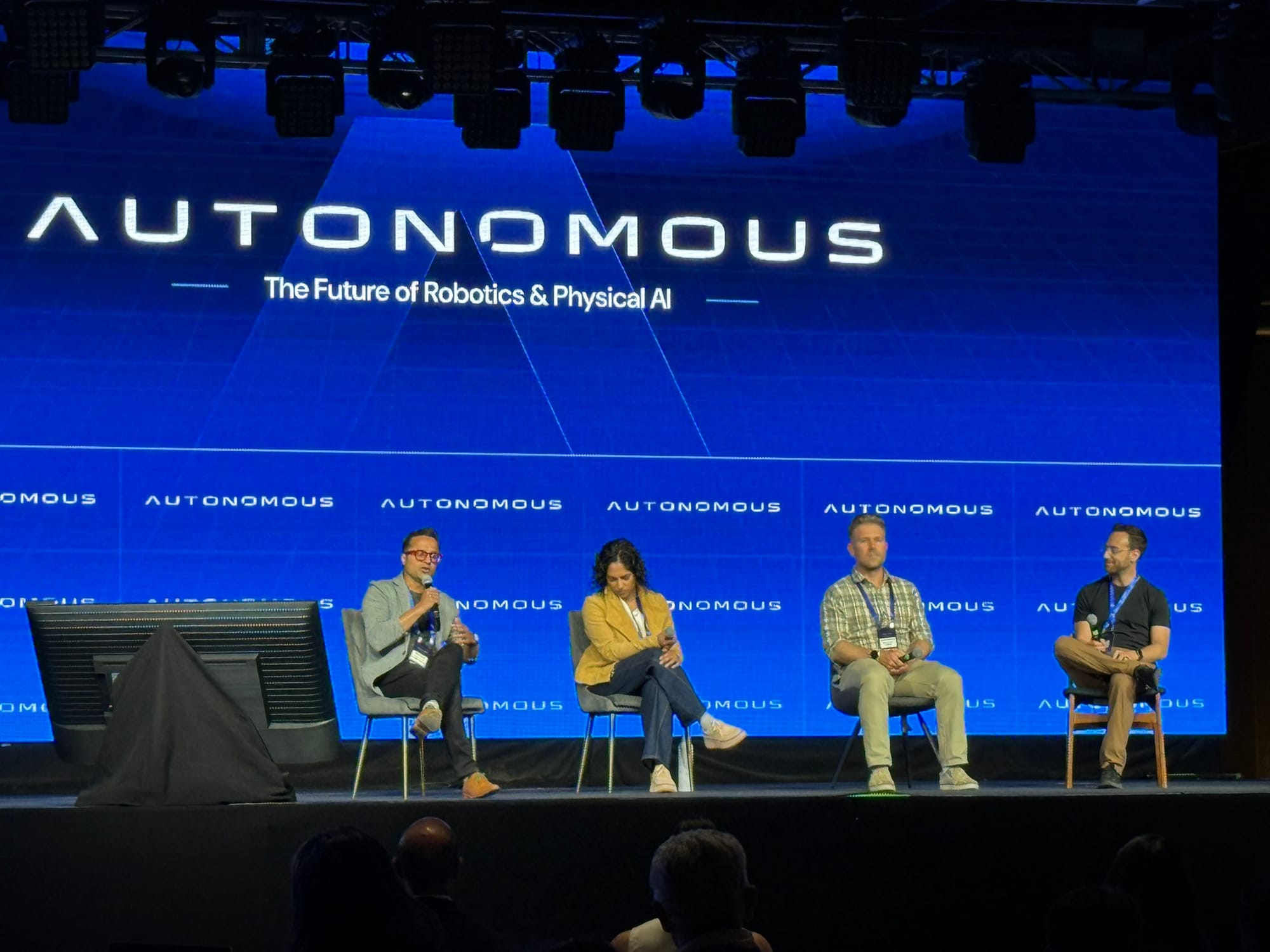
Zuberi's map of the industry was the most quotable: venture has split into a bimodal distribution. On one side, small funds writing lots of lottery-ticket checks - cheerleaders with limited ability to help you recruit or build. On the other, multibillion-dollar platforms for whom a $3 million check is an optionality bet; if it works they deploy more, and if it fails the loss is noise, while for the founder that company is everything. His prescription was to build a capital stack deliberately, the way you would rent a starter apartment before buying the building, matching investor type to company stage. He also gave founders who hate fundraising no quarter, listing the CEO job in five parts: set the mission, hire the best people, get the capital, tell the story internally and externally on repeat, hold people accountable.
Hardiman supplied the mechanics of how over-raising kills companies: raise $20 million when the business needed four or five, burn scales to match, growth fails to justify the next round, and now you are firing thirty people while the company unwinds. He contrasted that with companies that raised little, kept burn flat, survived until the market arrived, and then scaled responsibly. His portfolio-construction advice for founders: average startup outcomes are bad, so investors look for something exceptional on one dimension rather than solid on all of them - figure out your exceptional dimension and lead with it. And his framing of deep tech inverted the classic software bet: software carries high market uncertainty and low technical risk (Slack began as a gaming company and pivoted), while the companies he backs carry high technical risk against known market demand, because a humanoid company cannot pivot into SaaS.
Gulati made the case for concentrated, patient capital, citing Khosla's run as the earliest investor in Impossible Foods and funding the company for seven years before revenue because the team was retiring the right risk in the right order. Her advice centered on sequencing: agree with your investors on which risk each round retires and why hitting that milestone earns the next raise. One warning drew nods across the stage: taking strategic capital too early can quietly tie a hand behind your back, scaring off the other nine strategics who might have partnered with you.
Four builders worth watching from the showcase
The post-lunch startup showcase brought live hardware on stage, and each of the four companies is attacking deployment from an angle worth knowing about.
Andromeda. Grace Brown put Abi, a companion humanoid, on stage and let it introduce itself. Her argument: with roughly $40 billion flowing into robotics last year by her count, a fifteen-fold increase in three years, physical capability determines what robots can do, and social intelligence determines whether people accept them. Abi lives in nursing homes across Australia and California today, speaking residents' native languages, remembering their stories, and running activities. The resident testimonial video - "she's become my best friend" - landed harder than any benchmark.
PSYONIC. Aadeel Akhtar arm-wrestles para-triathletes with his product. The Ability Hand is a bionic hand worn by over 300 people, Medicare-approved, and PSYONIC occupies a position nobody else does: their human prosthetic users generate manipulation data that trains robots. When NASA's Valkyrie humanoid struggled with a zipper on the ISS task board, one of PSYONIC's prosthetic users walked up and did it in under ten minutes. The demo pipeline - touch-sensor-instrumented hand, Meta Ray-Ban glasses for egocentric video, synced into Isaac Lab to feed vision-language-action models - is a working example of the human-to-robot data path everyone else theorizes about. His closer: a patient who lost his hand in a fireworks accident threw out a first pitch at a Giants game and connected at a Padres tryout, which Akhtar called the world's first bionic home run.
Glīd. Kevin Damoa is building autonomous road-to-rail transfer, and his credibility is biographical: he joined the Army at seventeen after 9/11 and loaded tanks onto trains, spent years moving rockets for SpaceX, and worked on the F-35. His pitch: 72 percent of US freight rides on roads while 140,000 miles of rail sit underused, and the machinery of getting a container from road to rail still requires cranes, forklifts, trucks, and an army of people. Glīd collapses that into one autonomous vehicle and one move. The company won TechCrunch Disrupt's Startup Battlefield last fall, beating 199 other startups, and Damoa cited a nine-figure revenue pipeline across military and commercial customers.
Glidance. Amos Miller, who is blind, held his product while pitching it. Glide is a self-steering mobility guide - wheels, a long handle, cameras - that a blind person walks behind: say a destination and it steers you there. The alternative today is a white cane or a guide dog that takes years and up to $100,000 to obtain, which is why, by his numbers, 98 percent of the world's 300 million blind people go without independent mobility. Glidance has over a million dollars in pre-orders and 3,000 testers, including Andrea Bocelli and Stevie Wonder, with 10,000 units planned across the US, Canada, UK, and Europe next year. The second-order thesis is what makes it a physical AI company: robots need general wayfinding without maps, that requires spatial reasoning trained on real pedestrian-world data, and a fleet of Glides walking everywhere blind people go becomes exactly that dataset. He closed by asking the room to picture a blind parent walking their child to kindergarten behind a Glide, and knowing they helped make it possible.
A few things to remember
- The data debate has resolved into portfolio thinking. Pathak, Wooten, Sun, and the manufacturing panel disagreed on emphasis and agreed on structure: no single source wins, and the interesting companies are the ones sequencing video, simulation, teleoperation, and deployment data deliberately. Deployment data is the one source competitors cannot buy, which is why owning the deployment keeps coming up as the moat.
- The frontier of difficulty is not intelligence, it is torque specs. Screw driving, box cutting, connector insertion, GPS-blocking birds. The gap between a viral video and a production line is made of thousands of these, and the founders furthest along talked about them the most.
- Scale is operational before it is technical. Symbotic's million miles a day, Bear's 16,000 robots, Bedrock's 50 sites - each rests on teleoperation fallbacks, retrofit strategies, and service logistics as much as on models.
- Humanoid skepticism is now polite company opinion among people who ship. Kulkarni's dishwasher line got the laugh, and Kuffner made the same point gently: a wheeled robot moving a sixty-pound box on a flat floor beats the anthropomorphic form on speed, cost, and efficiency. Generalize the software; specialize the hardware where the task allows.
- Labor scarcity is the demand signal, in every vertical, unprompted. Agriculture's H-2A shortfall, eighteen-day tenures in frozen warehouses, half the construction workforce retiring within a decade. The market keeps answering the replacement question before anyone asks it.
Congratulations to Rohan Savla and the Frontier Media team on a strong first edition.
References
- AUTONOMOUS 2026 - event site, Frontier Media, Inc.
- AUTONOMOUS 2026 speaker roster
- And the winner of Startup Battlefield at Disrupt 2025 is: Glīd - TechCrunch, October 2025
- SoftBank Group and Symbotic establish GreenBox warehouse-as-a-service joint venture - Symbotic, July 2023
Company figures and market statistics cited above were shared by speakers on stage at AUTONOMOUS 2026 and reflect their own reporting.