The Tabletop That Hears Black Holes
How a 140-year-old desk experiment became the most sensitive instrument humans have ever built
There's a museum exhibit I recently stood in front of that I cannot stop thinking about.
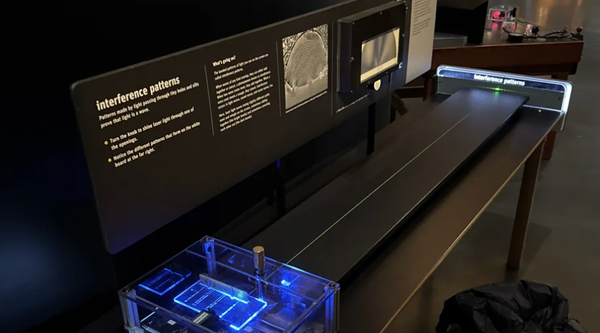
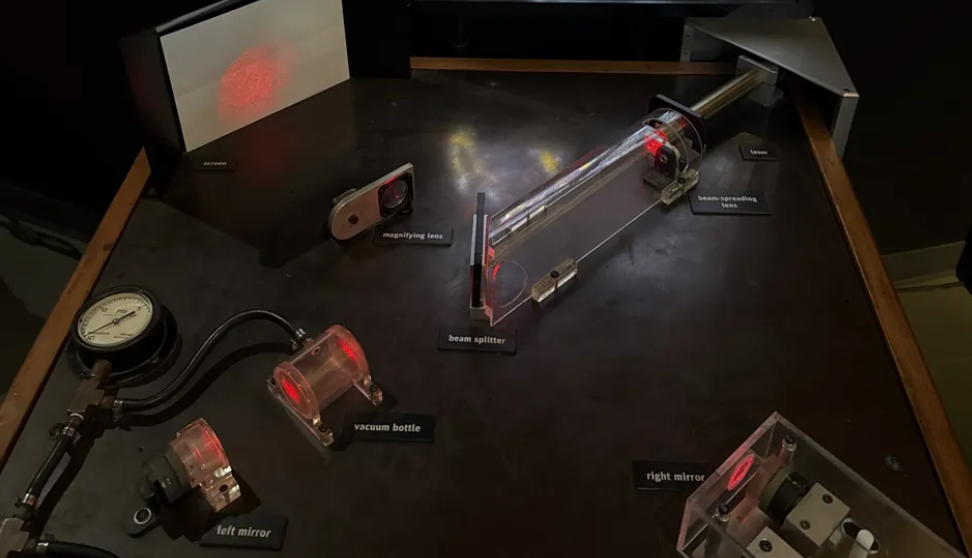
On a dark steel table sits a small helium-neon laser, a piece of angled glass the size of a postage stamp, two mirrors, a vacuum bottle, and a white screen. The laser fires a thin red beam at the angled glass, which splits the light into two beams traveling down perpendicular paths. Each beam hits a mirror, bounces back, recombines at the glass, and produces a bullseye pattern of concentric red rings on the screen.
That's it. That's the whole device.
Now here's the part that broke me: if I lean gently on the edge of the table, the bullseye ripples. If I hold my hand six inches above one of the beams and exhale softly, the pattern shifts. A truck driving past the building outside does something similar, if less dramatically.
The same basic setup, scaled up, is how we detected two black holes colliding 1.3 billion light-years away. Same physics. Same splitter. Same interference. Just bigger arms and fewer museum visitors breathing on it.
I want to walk through exactly how this works and why it's one of the most beautiful ideas in experimental physics.
TL;DR
An interferometer splits a laser beam into two perpendicular paths, bounces each off a mirror, then recombines them. The recombined beam shows a pattern that's extraordinarily sensitive to any difference in how far the two beams traveled. That's the entire idea. Scale it from a museum table to two 4-kilometer tunnels, and you can detect two black holes colliding a billion light-years away.
The piece of glass that does all the work
The star of the exhibit is the beam splitter, a thin piece of glass with a specially engineered partial-reflective coating. When the laser beam hits it at 45 degrees, roughly half the light passes straight through and half reflects off at a right angle. One beam becomes two.
Here's the full path:
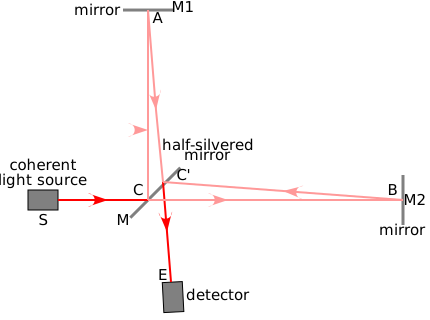
Image source: click here
The whole mechanism reduces to four steps:
- The split. The laser beam hits the splitter. Half transmits toward one mirror, half reflects toward the other.
- The journey. Each beam travels to its mirror, bounces back, and retraces its path to the splitter.
- The recombination. The splitter acts a second time, in reverse. When each returning beam hits the glass, it splits again. Half of each returning beam heads to the screen; the two halves now overlap, traveling along the same line.
- The interference. Because the two beams traveled slightly different distances, their wave crests and troughs don't align perfectly. Where crests meet crests, the light adds up and you see a bright ring. Where a crest meets a trough, the waves cancel and you see a dark ring.
That's the bullseye.
The reason this works as a ruler is subtle. You're not measuring how long each beam path is in absolute terms. You're measuring whether the two paths are exactly equal to within a fraction of a wavelength of light. A red laser has a wavelength around 650 nanometers, roughly 1/100th the width of a human hair. If one path changes by half a wavelength (~325 nm), bright rings become dark rings. Your eye sees the shift instantly.
The key insight
An interferometer doesn't measure distance. It measures whether two paths have stayed exactly equal. That's a much sharper question to ask, and the answer is visible as stripes you can see with your eyes.
Here's how the wave addition actually produces those bright and dark rings:

Image source: click here
A note on completeness, since this tripped me up at the museum: on the return trip, half of each returning beam goes toward the screen, but the other half goes back toward the laser. The interferometer has two output ports, not one. Energy is conserved. When a dark band appears on the screen, that light isn't destroyed; it's constructively interfering at the other port and heading back up the laser path.
You can measure yourself breathing
This is the part that made me giggle at the exhibit.
If you blow gently toward one of the beam paths, the bullseye on the screen dances. You're doing two things at once. Your breath is warmer than room air, and warm air is slightly less dense, which changes how fast light travels through it (the refractive index). That tiny speed change shifts the effective path length of whichever beam your breath crossed, and the pattern moves. You're also introducing turbulence, small swirls of air with slightly different densities, which write themselves onto the beam as a living seismograph.
Same if you lean on the table. The steel top barely flexes under your weight (a few micrometers at most), but "a few micrometers" is thousands of times the wavelength of the laser. One arm gets infinitesimally longer, the other stays the same, and the interference pattern visibly ripples.
This is the whole point. An interferometer is a ruler whose smallest tick mark is a fraction of a wavelength of light. It doesn't measure distance in the ordinary sense. It measures whether two paths are exactly the same length, and it notices when they stop being exactly the same.
Now the question that physics asked in the late 1800s: what if you used this ruler to measure something nobody had ever measured before?
The most famous "failure" in the history of physics
In 1887, two American scientists, Albert Michelson and Edward Morley, set up a much larger version of this apparatus in the basement of a university dormitory in Cleveland, Ohio. They were trying to detect the luminiferous ether, a hypothetical medium that nineteenth-century physicists believed filled all of space and carried light waves the way air carries sound waves.
The logic went like this: if the Earth is moving through a stationary ether as it orbits the Sun, then light traveling in different directions relative to that motion should take subtly different amounts of time to cover the same distance. They floated their interferometer on a pool of mercury so they could rotate the whole apparatus and compare fringe shifts at different orientations. According to their calculations, the expected shift was about four-tenths of a fringe.
They found nothing. No fringe shift. The ether wind didn't exist.
This was devastating at the time. Michelson spent the rest of his career believing light must travel in some kind of medium. But the null result of the Michelson-Morley experiment became one of the most important negative findings in science, because eighteen years later a young patent clerk named Albert Einstein would build his 1905 theory of special relativity on the assumption that the speed of light is constant in all reference frames, which is exactly what the experiment had shown.
Michelson himself won the 1907 Nobel Prize in Physics, the first American to win a Nobel in the sciences, not for detecting the ether (he hadn't) but for inventing the interferometer itself and the precision measurements it enabled. The "failed" experiment turned out to be a measurement tool that would outlive its original question by more than a century.
The same trick, 10,000 times larger
Fast-forward to 2015. In the swamps of Livingston, Louisiana, and the high desert of Hanford, Washington, sit two identical facilities called the Laser Interferometer Gravitational-Wave Observatory, or LIGO. Each one is, at its heart, the same Michelson interferometer you can find on a museum table. Just scaled up in every possible dimension.

Image source: click here
The engineering differences are extreme:
- Arm length: LIGO's two perpendicular arms are each 4 kilometers long, roughly 10,000 times longer than the museum demo.
- Effective arm length: Because the simple Michelson design isn't sensitive enough even at 4 km, LIGO adds mirrors near the beam splitter to create what's called a Fabry-Perot cavity. The laser light bounces back and forth about 300 times before recombining, which effectively turns each 4 km arm into a 1,200 km one.
- Laser power: The laser enters the interferometer at about 200 watts, already industrial-scale. Then a "power recycling mirror" reflects nearly all of that light back into the system, building up the circulating power inside the arms to roughly 750 kilowatts.
- Mirror quality: The mirrors at the ends of each arm are 40-kilogram cylinders of ultra-pure fused silica, each suspended from a quadruple pendulum to isolate them from vibrations. They're so precisely polished that they absorb only one out of every 3.3 million photons that hit them. The rest is reflected.
- Vacuum: The entire 4 km beam path on each arm is held at one-trillionth of atmospheric pressure, one of the largest high-vacuum volumes on Earth, second only to CERN's Large Hadron Collider. It took forty days of continuous pumping to evacuate it the first time.
LIGO by the numbers:
| Spec | Value |
|---|---|
| Arm length | 4 km × 2 |
| Effective arm length (with Fabry-Perot) | ~1,200 km |
| Circulating laser power | 750 kW |
| Mirror mass | 40 kg fused silica |
| Vacuum pressure | 10⁻¹² atm |
| Sensitivity target | ~10⁻¹⁸ m |
The reason for all this engineering is the thing LIGO was built to detect: gravitational waves.
Ripples in spacetime
Einstein predicted them in 1916, as a consequence of general relativity. A sufficiently violent event in the universe, like two black holes colliding, would send ripples through the fabric of spacetime itself, literally stretching space in one direction and compressing it in the perpendicular direction as they pass.
If a gravitational wave rolls through Earth, one of LIGO's 4 km arms gets slightly longer while the other gets slightly shorter. That breaks the equal-path-length balance. The beams arrive back at the splitter out of phase. The interference pattern shifts. In principle, the same physics you see when you lean on a museum table.
In practice, the shift is comically small.
A typical passing gravitational wave distorts LIGO's arm length by about 1/10,000th of the width of a proton.
Just how small is "1/10,000th of a proton"?
Start with a human hair (about 100 micrometers wide). Split it into 10 million pieces: you get one atom's width. Split that atom into 100,000 pieces: you get one proton's width. Now split that proton into 10,000 pieces. That's the distance LIGO is designed to measure.
Measuring this is approximately a hundred trillion times more precise than the smallest thing most physicists can describe in plain language.
This is why leaning on a museum exhibit works, and why LIGO has to be buried at near-perfect vacuum with its mirrors hanging from four-stage pendulums, inside buildings on seismically isolated concrete slabs, in two locations 3,000 kilometers apart so that a local truck or earthquake can be filtered out by demanding a simultaneous signal at both sites. The sensitivity is so extreme that everything that isn't a gravitational wave is noise.
September 14, 2015
At 09:50:45 Coordinated Universal Time on September 14, 2015, a signal swept through LIGO Livingston. Seven milliseconds later, the same signal arrived at LIGO Hanford. Both detectors recorded about 0.2 seconds of data that, when plotted, looked exactly like the predicted waveform of two black holes spiraling into each other at nearly half the speed of light.

Image source: click here
The event, named GW150914, came from the merger of two black holes, one weighing about 36 times the mass of our Sun and the other about 29, colliding roughly 1.3 billion years ago to form a single black hole of about 62 solar masses. Three solar masses of matter were converted to gravitational-wave energy in a fraction of a second. For that instant, the event was radiating more power than all the stars in the observable universe combined.
When the signal finally reached Earth, it changed the separation between LIGO's test masses by about 4 x 10⁻¹⁸ meters, roughly 1/200th of a proton radius.
The LIGO team initially didn't believe it. The first observing run of Advanced LIGO hadn't even officially started yet; the detectors were in engineering mode. The team had also been running "blind injection" drills for years, where a small group of insiders would secretly feed fake signals into the data stream to test whether the collaboration could catch them. Rainer Weiss, one of LIGO's founders, later said that like many of his team members, he initially doubted the 2015 signal was real. It took them months of internal checks to confirm no one had injected it.
They announced the detection publicly on February 11, 2016, exactly 100 years after Einstein's prediction. Two years later, the 2017 Nobel Prize in Physics was awarded to Rainer Weiss, Kip Thorne, and Barry Barish for building the thing.
The gravitational wave era
In the decade since GW150914, LIGO has evolved from a one-off experiment into a steady astronomical observatory. The international LIGO-Virgo-KAGRA collaboration completed its fourth observing run (O4) on November 18, 2025, after 2.5 years of continuous observation. During that run alone, the network detected roughly 250 candidate gravitational-wave events, compared to 90 detections in the first three runs combined.
Detections over time:
| Observing run | Detections |
|---|---|
| O1 (2015-2016) | 3 events |
| O2 (2016-2017) | 8 events |
| O3 (2019-2020) | 79 events |
| O4 (2023-2025) | ~250 candidates |
| Cumulative (confirmed) | 218+ |
Sources: LIGO Caltech, Albert Einstein Institute (GWTC-4.0 catalog).
As of the most recent published catalog (GWTC-4.0), a total of 218 gravitational-wave signals have been confirmed, with another ~170 candidates from later O4 segments still under detailed analysis. Binary black-hole mergers are now detected at a rate of roughly one every two or three days. The collaborations are preparing for a next observing run, tentatively designated IR1, in late 2026.
What started as a single audacious measurement is now a routine way of doing astronomy. Each detection tells us about black-hole formation, neutron-star physics, the expansion rate of the universe, and tests of general relativity at extreme scales. Nine years after the first detection, gravitational-wave astronomy has moved from impossible, to unprecedented, to operational.
The closing thought
The exhibit I stood in front of uses a $30 laser pointer, a few mirrors, and a hand pump. When I breathed on it, I watched the pattern ripple in real time.
The device at LIGO Livingston uses a stabilized 200 W laser, 40 kg fused-silica mirrors polished to sub-nanometer smoothness, quadruple-pendulum seismic isolation, and ten thousand cubic meters of the cleanest vacuum on Earth outside CERN. When a passing gravitational wave stretches space itself, the pattern ripples in real time.
Same principle. Same splitter. Same interference. The only difference is the bar we've set for what counts as a signal worth seeing.
That gap, between a museum demo and a Nobel-winning detection of two black holes spiraling to their deaths more than a billion years ago, is what precision engineering can do over four decades of patient work. If you ever want a reminder of what's possible when smart people take an idea seriously for long enough, go find an interferometer and breathe on it.
Then imagine what a thousand scientists, 4 kilometers of vacuum, and forty years could do with the same trick.
References
- Michelson-Morley Experiment (Wikipedia)
- Michelson-Morley Experiment, Encyclopedia of Cleveland History, Case Western Reserve University
- Michelson-Morley experiment, Encyclopaedia Britannica
- November 1887: Michelson and Morley report their failure to detect the luminiferous ether, American Physical Society
- Michelson-Morley Experiment, Encyclopedia.com
- LIGO's Interferometer, LIGO Lab, Caltech
- LIGO's Laser, LIGO Lab, Caltech
- LIGO Optics, LIGO Lab, Caltech
- Ultra-High Vacuum, LIGO Lab, Caltech
- Seismic Isolation, LIGO Lab, Caltech
- LIGO Scientific Collaboration FAQ on detector sensitivity and interference
- Abbott et al., "GW150914: The Advanced LIGO Detectors in the Era of First Discoveries," Physical Review Letters (2016)
- Abbott et al., "Properties of the Binary Black Hole Merger GW150914," Physical Review Letters (2016)
- LIGO detects first ever gravitational waves, Physics World
- GW150914 Press Release, LIGO Lab, Caltech
- The Nobel Prize in Physics 2017, NobelPrize.org
- 2017 Nobel Prize in Physics Awarded to LIGO Founders, LIGO Lab, Caltech
- Detection of gravitational waves wins 2017 Nobel Prize in Physics, C&EN
- LIGO-Virgo-KAGRA Complete Fourth Observing Run, LIGO Lab, Caltech (November 2025)
- Current gravitational-wave astronomy, Albert Einstein Institute
- GWTC-4.0: Updated Gravitational-Wave Catalog Released, LIGO Lab, Caltech (August 2025)