Why the World's Most Advanced Factories Are Still Flying Blind | Jared O'Leary, SirenOpt

Jared O'Leary is the CEO and co-founder of SirenOpt, a deep tech company building the manufacturing intelligence layer for advanced materials production. Their technology came out of a decade of plasma physics research at UC Berkeley - and they're already deployed at Tier-1 manufacturers across turbines, batteries, and semiconductors.
Listen to the episode here:
Summary
I've been talking to Jared for a while now, and there's one thing he said early on that I haven't been able to get out of my head: manufacturers today are flying blind at the exact moment that matters most. Not in some vague, general sense. Structurally blind. At the specific moment when material properties are formed, when defects are created or avoided, when yield is won or lost - they cannot see what's happening.
That stuck with me because the companies dealing with this problem are not small or unsophisticated. They're making turbine blades for jet engines. Battery electrodes for electric vehicles. Semiconductor structures at the nanoscale. The most advanced physical manufacturing on the planet. And they're still largely doing what amounts to setting a recipe, closing the oven, and hoping for the best.
SirenOpt is trying to fix that with a sensing modality that didn't exist before they built it.
What advanced manufacturing actually is
Before the technology conversation can mean anything, you need a mental model of what we're actually talking about.
Jared's framing: forget the car assembly line image. Advanced manufacturing is about products where thin, sensitive layers of different materials are stacked together with extraordinary precision - and where tiny differences in those layers have enormous downstream consequences. A hammer is what you see: a head and a handle. A battery pack contains thousands upon thousands of unique material layers, each with slightly different chemical compositions, thicknesses, densities, and porosities. Getting those layers right, consistently, at production speed, is the problem.
The performance demands on these materials have also grown dramatically. The most powerful computers in existence in 1990 are less capable than an Apple Watch today. That compression requires a completely different level of manufacturing complexity. We've gotten very good at making more sophisticated materials. We haven't gotten equally good at watching them become sophisticated in real time.
The cost of not seeing clearly
Jared walked through what the blindness actually costs, and the range is wider than most people realize.
The obvious one is yield loss: if a part becomes defective at step one and you don't catch it until step twenty, you've wasted all the value added between those two points. But the less obvious costs are arguably larger.
Manufacturers know they have limited visibility, so they design products to be more robust against that uncertainty. Battery electrodes are made roughly 30% thicker than ideal performance would require - purely as a buffer against defects that might exist but can't be detected. That's a permanent, structural tax on product performance. Not a one-time yield hit. A permanent design compromise baked into every unit shipped.
Then there's the turbine blade example, which I found genuinely striking. Jet engines run above the melting point of their components. The blades survive because of thermal barrier coatings - complex, multi-step coatings that are extremely difficult to measure without destroying the blade. So manufacturers sample about 1% of their output, assume some distribution of quality across the rest, and build in a safety margin accordingly. If they knew the actual uniformity of every blade, they could position blades more precisely and run engines up to five percentage points more efficiently. That number is sitting there, unclaimed, because nobody can currently see enough.
The physics gap
I asked Jared the obvious question: smart people have been working on measurement and inspection for decades. Why hasn't anyone solved this?
His answer was important. It's not that progress hasn't been made. Cameras, x-rays, ultrasound, lasers - all far more advanced than they were thirty years ago. But each of those tools was designed to measure a specific property in a specific way. A camera was never designed to measure conductivity. An x-ray was not designed to measure chemical composition. The measurement philosophy has always been: pick a property, design a tool for that property, measure it. Never designed to be generalizable. As advanced materials have become more complex and multi-property, the gap between what these tools can see and what manufacturers actually need to understand has widened.
The missing piece wasn't better engineering of existing tools. It was a different sensing modality entirely. That's the physics gap.
What cold atmospheric plasma actually does
SirenOpt's core technology is built on cold atmospheric plasma - which Jared was careful to explain is not the exotic thing it sounds like. Plasma is just a charged gas. It's the most common state of matter in the universe. Neon signs are cold atmospheric plasma.
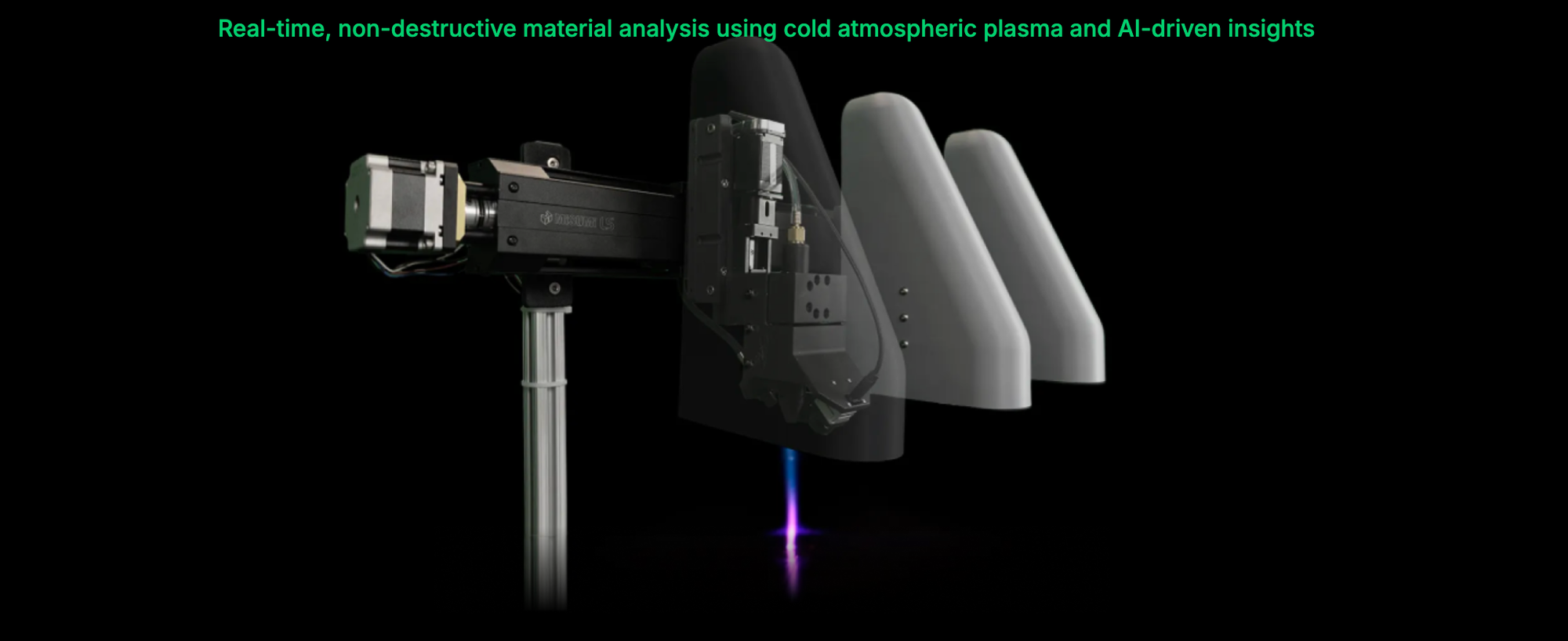
What makes it useful for measurement is this: when cold plasma comes into contact with a material, it induces a set of simultaneous chemical, electrical, and thermal interactions. The material responds to the plasma, and the plasma responds to the material. SirenOpt's thesis is that those interactions carry a rich, multi-dimensional signal that encodes the material's fingerprint - and that if you record that signal well enough, you can translate it into multiple material properties simultaneously, non-destructively, in real time, from a single instrument.
The key word there is simultaneously. Existing tools measure one property. SirenOpt measures porosity, adhesion, chemical composition, conductivity, and defects at the same time, with the same measurement. In battery electrode manufacturing, they can detect metallic contaminants smaller than 30 microns inside the bulk of the material - something that currently can only be found by destroying the sample and examining it in a lab.
Jared was also precise about what the machine learning component actually does here: "The data we collect is inherently physics-grounded. The goal is to discover what's happening physically within the system - not just find patterns in a black box." Physics-informed machine learning is the distinction. It's not throwing a neural network at a signal and hoping it generalizes. It's using models grounded in the underlying physics, which is why the outputs are interpretable and why they hold up beyond the training distribution.
From sensor to platform
The part of this conversation I think is most important for investors and operators to understand is the distinction between a measurement device and a manufacturing intelligence platform.
Jared used the ellipsometer as a contrast - a well-known sensor used in semiconductors that measures material thickness. Its output is thickness. That's what you get. Useful, but complete. There's nothing to do with it afterward.
SirenOpt's output is a material fingerprint - a high-dimensional representation of the plasma-material interaction. Properties like thickness, density, and conductivity are extracted from that fingerprint at the first layer. But the fingerprint itself can be stored and used later. A customer can take six months of fingerprint data, correlate it to the downstream performance of the shipped product, and discover something new about their manufacturing process that they had no way to see before. The same raw data that supports real-time property measurement also supports, at a higher layer, process drift detection, root-cause analysis, yield modeling, and eventually closed-loop control.
One example from a customer conversation makes this concrete: during a proof of concept focused on measuring specific properties of a separator coating, the customer's team looked through the raw signal data and realized it could reveal the anisotropy of pores in their separator - something they had never thought to ask for, because they didn't believe any tool could see it. The data surfaced a problem they hadn't known to measure.
Who's already using this
SirenOpt's tools are currently running at multiple Tier-1 manufacturing sites in North America, Europe, and Asia. The only customer Jared named publicly is Jaguar Land Rover, which has also invested in the company. But the profile of who's deploying matters as much as the names: the internal champions at these organizations are people with 20+ years of experience in non-destructive testing. People who have evaluated every measurement tool in existence. When they commit to a serious evaluation - sometimes four months, six instruments, verifying every measurement multiple times - and they come back to expand, that's a different signal than a pilot with a junior engineer.
The accidental discovery
The origin of the technology is worth knowing. Jared and his co-founder Ali Mesbah, a tenured professor at UC Berkeley who left to build the company, were not originally trying to build a measurement tool. They were developing cold plasma systems for biomedical applications. They were the first lab to ever apply machine learning to cold plasma in any capacity, and the first to attempt to control it.
Over the course of that research, they realized the system could be repurposed as a sensor. And once they saw that, Jared said, "there was never a moment where we thought this would just be a paper." They were too close to advanced materials manufacturing - through Ali's research and their industry relationships - to miss what the gap actually cost. The question immediately became: how do you build a company around this?
The moat they've accumulated since is a combination of physics, IP, and data. The physics took a decade to develop at Berkeley and can't be reverse-engineered incrementally. Eight foundational patent families cover the core technology. And every deployment generates proprietary plasma-material interaction data - calibration models and measurement libraries that compound with each new customer and material system. A competitor who wanted to replicate SirenOpt today would have to independently develop the physics, build equivalent hardware, get access to equivalent production environments, and accumulate equivalent data. There is no shortcut through any of those steps.
This is a company I've been following closely, and I think it's one of the more interesting deep tech stories in the advanced manufacturing space right now. The technology is genuinely novel, the customers are real, and the problem is one of those things that seems obvious once you understand it - why would you build a factory you can't see inside? - but turns out to have been a physics problem that nobody knew how to close until now.
Give the full conversation a listen.
Full episode available on:
Learn more about SirenOpt: www.sirenopt.com
Watch the recording:
Volta Foundation presentation mentioned by Jared:
The OPTIM Update is a podcast and newsletter about real-world AI - robotics, automation, and AI Infrastructure. Past the headlines, into how these technologies are really built, deployed, and scaled.