Light Is a Wave. Light Is a Particle. Light Is Neither, and We Can Prove It.
A walk through the weirdest experiment in physics, and why Einstein spent thirty years hoping it was wrong
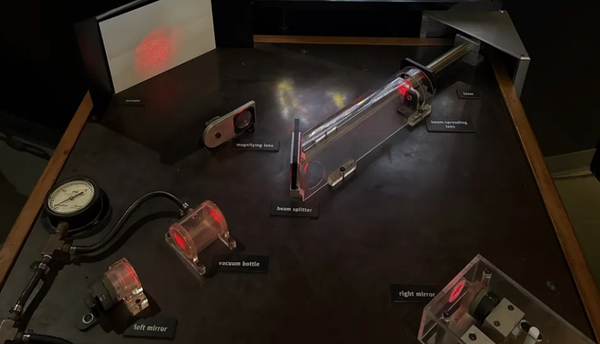
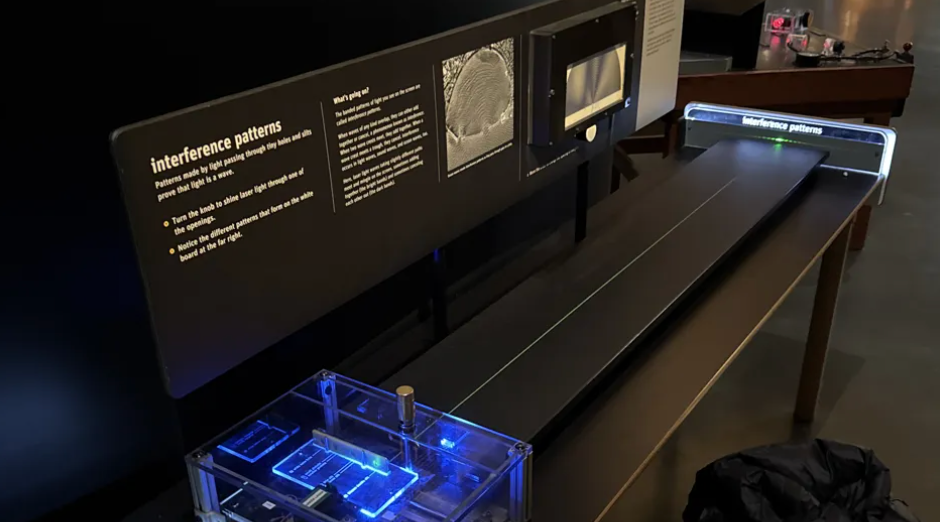
A few steps past the interferometer exhibit I wrote about last time, there's a small placard mounted on a wall. It reads, roughly:
Does it surprise you that a tiny dot of laser light passing through a slit no thicker than a human hair makes a wide, striped pattern on the screen? If not, well, maybe it should. This phenomenon, first explained in 1803 by Thomas Young, settled (temporarily) the then-raging debate over whether light was a wave or a particle.
Next to it, a green laser fires through a tiny opening onto a screen several meters away. The beam enters as a single narrow dot. It arrives at the screen as a wide pattern of bright and dark stripes.
The placard understates the strangeness. The question of whether light is a wave or a particle was not just "settled temporarily" in 1803. It was settled, unsettled, re-settled, and eventually abandoned as the wrong question entirely. What replaced it is one of the most tested, most confirmed, and least understood facts in all of science.
I want to walk through how physicists figured out that light (and matter, and everything else we can measure) behaves in a way that should not be possible, and how they've spent the last hundred years designing ever more ingenious experiments to try to catch nature cheating. Nature keeps winning.
TL;DR
For 200+ years physicists argued whether light was a wave or a particle. Quantum mechanics' answer is "neither" - it's a third kind of thing. We can prove it experimentally: shoot photons one at a time through two slits and they still build up an interference pattern, but only when nothing is watching which slit they go through. Even weirder, entangled particles correlate too strongly to fit any "things have definite properties before measurement" picture. Bell-test experiments have confirmed this hundreds of times across photons, electrons, atoms, and superconducting circuits. The 2022 Nobel Prize in Physics rewarded exactly this. We still don't know what it means.
Four rounds of a very long fight
Round 1 (1670s): Newton says particle. Isaac Newton's "corpuscular theory" held that light was a stream of tiny particles shooting in straight lines. It explained reflection beautifully (balls bouncing off walls) and the sharp shadows cast by solid objects. Because Newton was Newton, this view dominated for over a century.
Round 2 (1803): Young says wave. Thomas Young performed the experiment on that placard. He passed light through two narrow slits and saw an interference pattern on a screen beyond: alternating bright and dark bands. If light were a stream of particles, two slits should produce two bright piles. Stripes only make sense if light is a wave, with crests and troughs that can add up or cancel each other out depending on exactly how far each wave traveled. Wave theory wins.
Round 3 (1860s): Maxwell cements the wave view. James Clerk Maxwell wrote down four elegant equations describing how electric and magnetic fields wiggle through space, and noticed that those wiggles travel at exactly the speed of light. Light, he concluded, is an electromagnetic wave. For the next forty years, physicists considered the question closed.
Round 4 (1905): Einstein ruins everything. A German patent clerk noticed something odd about a phenomenon called the photoelectric effect. When you shine light on certain metals, electrons pop out. The details should have been boring: brighter light, more electrons. Shine long enough, or bright enough, and electrons should always come out.
Instead:
- Dim red light, no matter how long you shine it, ejects zero electrons.
- Even a single brief flash of dim blue light immediately ejects a few.
- Bright blue light ejects more electrons, but each one has the same energy as with dim blue.
Einstein's 1905 insight: light comes in discrete packets of energy that we now call photons. Each photon carries an energy determined only by the light's frequency (its color). A red photon individually lacks enough energy to kick an electron out. A blue photon has enough. Brightness simply means more photons, not more energetic ones.
Einstein won the 1921 Nobel Prize in Physics for this work, not for relativity. Particles were back in the game.
Round 5 (1920s, and still ongoing): It's both, and that's the point
Quantum mechanics synthesized the two views into something neither side expected. Light is not really a wave. Light is not really a particle. Those are both concepts humans borrowed from everyday objects, and neither of them is quite what light actually is. Depending on how you measure it, light shows you wave behavior or particle behavior, but never both at the same time. And every other particle in the universe does this too: electrons, atoms, whole molecules, eventually probably everything.
The experiment that forces this conclusion is still the double slit. But you have to run it in a particular way.
The experiment that breaks your brain
Set up Young's experiment with a modern twist. Instead of a laser pointer, use a source so dim that it emits photons one at a time. Each photon takes something like a millisecond to emerge. Put a sensitive detector at the screen that can register each individual arrival as a single dot.
Ask yourself: what should happen?
If light is a particle, each photon goes through one slit or the other. It can't sniff out the existence of the second slit. So dots should pile up in two vertical bands behind the two slits, just like tennis balls thrown through two doorways.
What actually happens: Each photon arrives as a single dot, one at a time. You can literally watch them land on the detector screen one by one. But as you accumulate thousands of dots over time, they don't build up two piles. They build up the striped interference pattern. The exact bands that Young saw in 1803 with bright light emerge from individual particles landing in sequence.
This was demonstrated beautifully in 1989 by a team at Hitachi (led by Akira Tonomura) using electrons instead of photons. The resulting images are hypnotic:
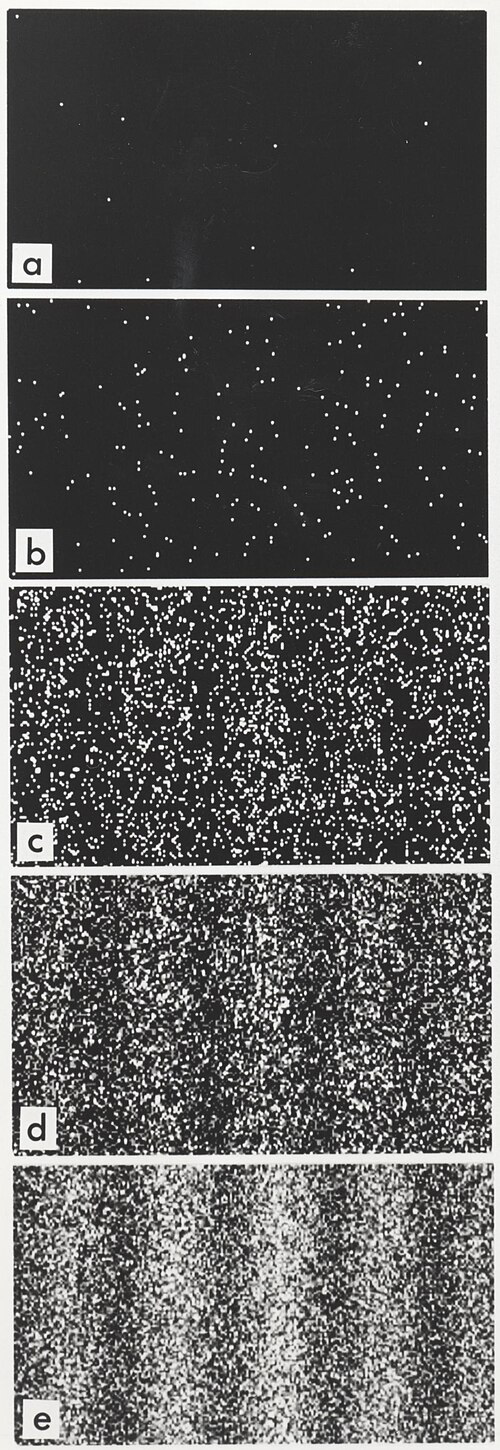
Image source: click here
Frame (a) shows about 10 electron detections, looking essentially random. By frame (e), 140,000 electrons have arrived one by one, and the striped interference pattern is unmistakable.
It means each individual particle, on its own, somehow knows about both slits. Its landing position on the screen is drawn from a probability distribution that has interference fringes in it. One particle, two slits, an interference pattern. No classical particle can do this. No classical wave can do this either, because waves shouldn't arrive as discrete dots.
Now try to catch it in the act. Put a detector at one of the slits to register whenever a photon passes through. Beep for slit A, silence for slit B. You will now always know which slit each photon went through.
Result: The interference pattern vanishes. You get two piles of dots behind the two slits, exactly as classical particles should produce.
Turn the which-path detector off. Stripes return. Turn it on. Stripes gone. Off, on, off, on. The pattern on the screen depends on whether or not you watched at the slit.
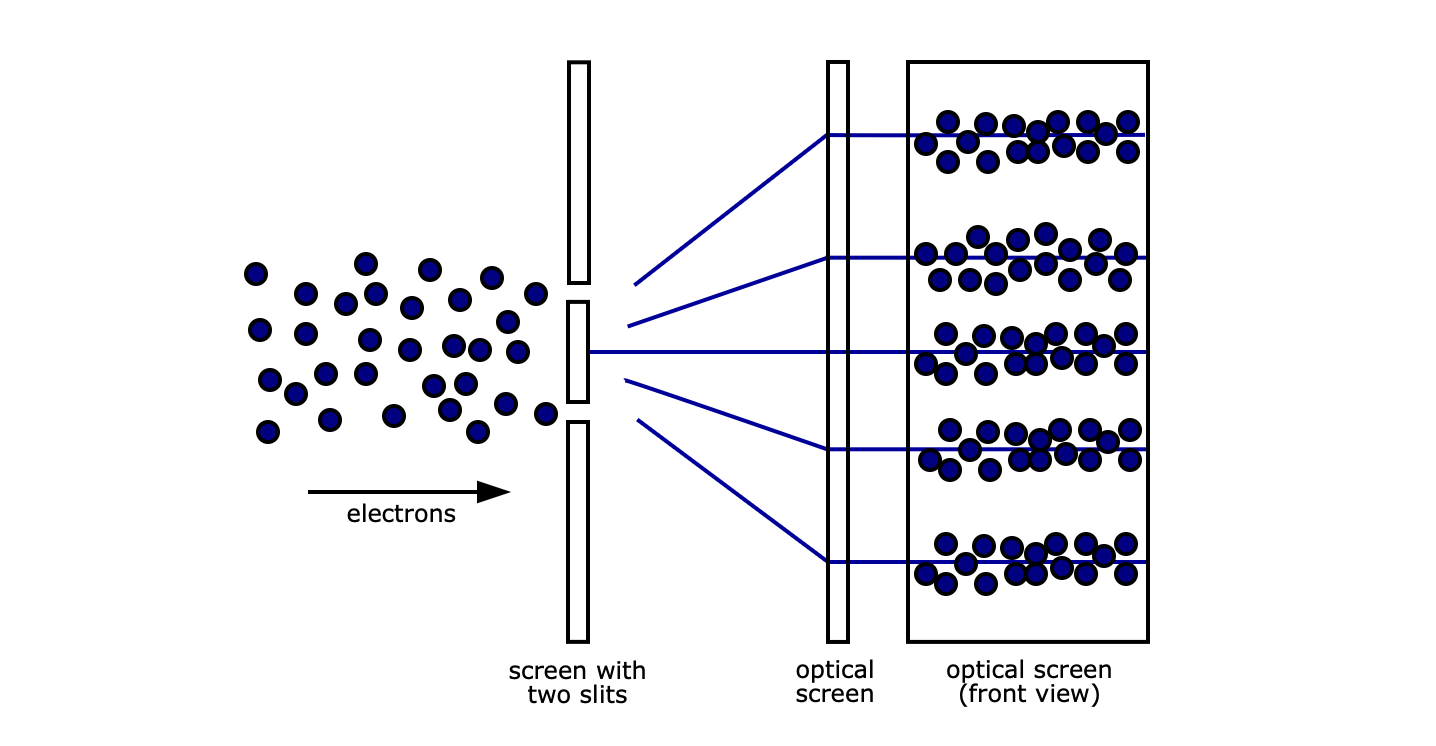
Image source: click here
This is not an artifact of clumsy measurement. Experimenters have tried every conceivable gentle, indirect, delayed variation of this, and the answer is always the same. Whenever information about which slit the particle went through exists, the interference pattern disappears. Whenever that information is truly unavailable, the interference pattern returns.
The hard part to swallow
The particle isn't conscious. It isn't "deciding" anything. The empirical fact is simpler and stranger: until something forces a measurement, the particle does not have a definite path. Asking "which slit did it go through" in the absence of a measurement is not a question that has an unknown answer. It's a question with no answer. The property doesn't exist to be known.
The delayed-choice quantum eraser
If you're not yet sufficiently annoyed, here's a more extreme version.
Arrange things so you can decide whether to measure which-path information after the particle has already hit the screen. In practice this is done with entangled photon pairs: one goes to the screen and lands right now, the other takes a longer path and gets measured later. You then have a free choice, after the first photon has already landed, whether to read out which-path info for its partner.
When you do the bookkeeping carefully, you find:
- If you later choose to look at which-path info, the first-photon data shows no interference.
- If you later choose to erase the which-path info, the first-photon data shows interference.
Your decision, made after the first photon was already detected, correlates with what pattern the first photon made.
This is not time travel. The math forbids using this to send a signal backward in time. You only see the two patterns after you sort the first-photon data based on what happened to the second photon, which requires classical communication running at light speed. But it does mean that our concepts of "when did the particle go through the slit" and "which path did it take" are not well-defined physical properties the way the position of a baseball is. They're answers that only exist in the context of a specific question, asked at a specific moment, by a specific measurement.
Richard Feynman famously said the double-slit experiment contains "the only mystery" of quantum mechanics. Everything weird about quantum physics, from superposition to entanglement to the uncertainty principle, is some version of this one phenomenon. The rest of the field is arguing over what it means.
The spooky version: two particles, one fate
In 1935, Einstein wrote a paper with Boris Podolsky and Nathan Rosen arguing that quantum mechanics had to be incomplete. Their reasoning used a setup that quantum mechanics itself predicts: you can create two particles in what's now called an entangled state, such that measuring a property of one particle instantly tells you the corresponding property of the other, no matter how far apart they are.
Consider two entangled photons emitted in opposite directions. Quantum mechanics predicts that if you measure the polarization of one photon and find it vertical, the other photon will be vertical too, even if it's on the other side of a galaxy. They behave as a single system with two locations. Einstein hated this. He called it spukhafte Fernwirkung, spooky action at a distance, in a 1947 letter to Max Born. His argument was: either quantum mechanics is wrong, or there's some hidden property the particles carry with them that tells each of them what to do when measured. Einstein preferred the second.
For thirty years, this was considered a philosophical argument. You could believe in "hidden variables" (Einstein's view) or you could believe that reality genuinely doesn't have properties until you measure them (the Copenhagen view). Either way, the predictions were the same. There was no experiment that could tell them apart.
Bell's theorem: the experiment nobody thought existed
In 1964, a Northern Irish physicist named John Bell showed that there actually was an experiment that could distinguish the two views. His argument was mathematical and elegant. He showed that if hidden variables exist and if nothing travels faster than light (a principle called "local realism"), then the statistical correlations between certain measurements on entangled pairs must obey a particular inequality. His number, called Bell's inequality, sets an upper limit on how correlated two measurements can be in any universe that respects Einstein's view.
Quantum mechanics predicts that real entangled particles will violate this inequality. The correlations it predicts are stronger than any local-realist theory can produce.
In other words: run enough entangled pairs through the right experiment, compute the correlation, and you'll get a number. If the number is below Bell's limit, Einstein was right. If the number exceeds Bell's limit, the universe is either non-local (something is communicating faster than light) or non-real (properties don't exist until measured), or both.
Here's the basic setup of a Bell test:
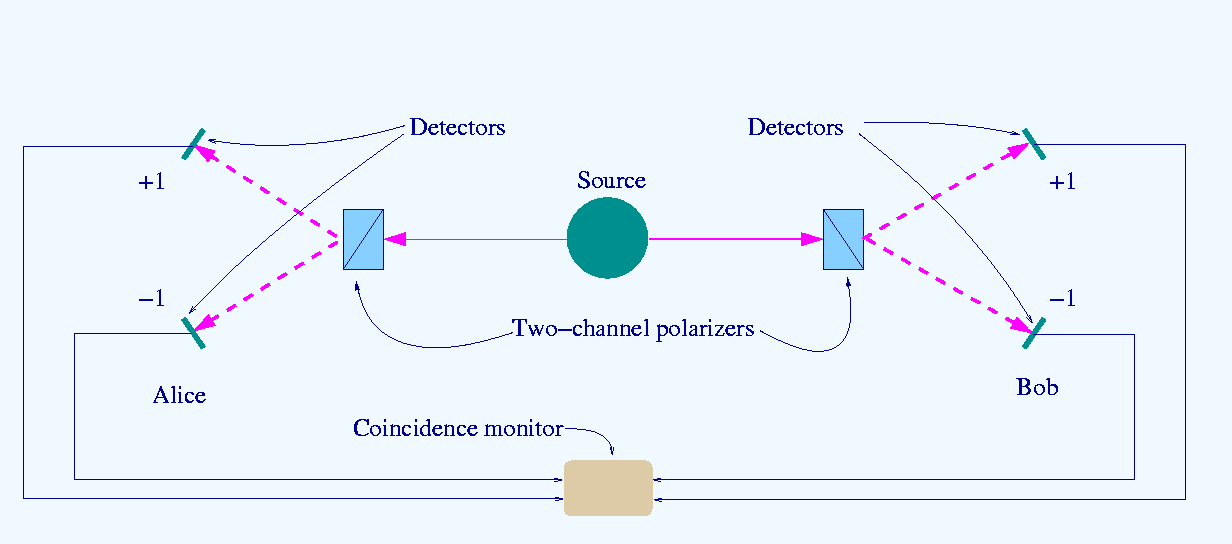
Image source: click here
This was a miracle. Philosophy had become a yes/no question answerable by measurement.
Round by round, Bell's inequality gets violated
1972, Berkeley. John Clauser and Stuart Freedman performed the first real experimental test of Bell's inequality, using entangled photon pairs from calcium atoms. They found a clear violation. Einstein's view looked shaky.
1981-1982, Orsay. Alain Aspect ran a much more careful version at the University of Paris. He added a critical refinement: the measurement settings on each side were switched rapidly while the photons were in flight, so the emission couldn't have "known" in advance what would be measured. Violation again, cleaner than before.
Late 1990s, Innsbruck and Geneva. Anton Zeilinger's group and Nicolas Gisin's group extended the experiments to distances of kilometers, with truly random settings. Violations everywhere. In 1997, Zeilinger's group also became one of the first to experimentally demonstrate quantum teleportation, moving a quantum state from one particle to another via entanglement.
But each of these experiments still had "loopholes," tiny theoretical cracks through which a sufficiently clever local-realist theory might still squeeze. The detection loophole (what if we're missing the particles that would have shown the Einstein result?) and the locality loophole (what if the two sides are secretly in communication?) stayed open for decades.
2015, three labs, three months. In a remarkable burst of simultaneous progress, three independent groups closed all the major loopholes:
- Ronald Hanson's group at Delft University, using two diamond-defect electron spins separated by 1.3 kilometers, ran 245 trials and measured a Bell violation of S = 2.42 ± 0.20, where local realism forbids anything above 2.
- Marissa Giustina, Anton Zeilinger, and collaborators in Vienna used entangled photons and ultra-efficient superconducting detectors.
- Krister Shalm and a team at NIST Boulder did the same with a different photon setup.
All three got the same answer: Bell's inequality is violated, with all significant loopholes closed at once. In 2023, a group at ETH Zurich did it yet again with superconducting circuits, closing the loopholes in a completely different physical system.
Bell test scoreboard:
| Experiment | Result |
|---|---|
| 1972 Clauser-Freedman (Berkeley) | Violated |
| 1981-82 Aspect (Orsay) | Violated |
| 1990s Zeilinger / Gisin | Violated |
| 2015 Hanson (Delft, electron spins) | Violated, loophole-free |
| 2015 Giustina (Vienna, photons) | Violated, loophole-free |
| 2015 Shalm (NIST, photons) | Violated, loophole-free |
| 2023 ETH Zurich (superconducting circuits) | Violated, loophole-free |
| Total Bell tests across all systems | Hundreds. All violated. |
Count as of today: Hundreds of Bell-inequality tests have been performed across photons, electrons, atoms, ions, superconducting qubits, and diamond defects, over distances from millimeters to satellites in orbit. Every single one that has successfully reached adequate sensitivity has violated Bell's inequality. Every single one. The local hidden-variable picture that Einstein believed in, the intuitive view that the universe has definite properties between measurements and nothing travels faster than light, is empirically dead.
The 2022 Nobel Prize and what's left
In October 2022, the Nobel Prize in Physics was awarded jointly to Alain Aspect, John Clauser, and Anton Zeilinger "for experiments with entangled photons, establishing the violation of Bell inequalities and pioneering quantum information science." Fifty years after Clauser's original experiment, spooky action at a distance is an award-winning, industrially relevant fact.
Here's the part that still gets me. After all of this, we don't agree on what it means.
The predictions of quantum mechanics are confirmed to obscene precision. Physicists can calculate the magnetic moment of the electron to more than ten decimal places of agreement with experiment, making quantum electrodynamics possibly the most accurate theory in the history of science. No experiment has ever contradicted it. Not one. And yet ask ten physicists what the theory is actually telling us about the nature of reality, and you'll get something like the following:
Five interpretations, all consistent with every experiment ever run
Copenhagen. The wave function represents our knowledge. Properties are genuinely undefined before measurement. Measurement "collapses" the wave function. Most working physicists default here.
Many-worlds. Every quantum measurement creates a branching of reality. You observe one outcome because "you" branched. Mathematically clean; ontologically wild.
Pilot-wave (de Broglie-Bohm). A real wave guides a real particle with a definite position. Deterministic but explicitly non-local; struggles to extend to relativistic field theory.
Objective collapse. The wave function is real and physically collapses spontaneously, with the rate set by some yet-to-be-discovered parameter.
QBism. The wave function is purely a description of one observer's beliefs about future measurements. Reality may not even need a single shared description.
As physicist David Mermin once put it, new interpretations appear every year, and none ever disappear.
So the situation, a century after Heisenberg and Schrödinger, is this: we have a theory that makes perfect predictions, has been confirmed by every experiment ever run, powers a significant fraction of modern technology (lasers, semiconductors, MRI, atomic clocks), and nobody knows what it's telling us about the world. We are in the position of someone holding a device that works flawlessly but has no manual and no parts diagram, and the best our field has done in a hundred years is argue about what's inside the box.
Why this isn't just a curiosity
The strangeness has consequences that are now showing up in the economy.
Quantum computing. A regular bit is 0 or 1. A qubit exists in a superposition of both until measured, exactly like the photon being in "both slits" until observed. A quantum computer with 300 well-controlled qubits can represent more states simultaneously than there are atoms in the observable universe. This isn't marketing; it's what the math forces. Practical quantum computers now exist, though they're limited by error rates and still early. The companies building them (IBM, Google, IonQ, PsiQuantum, Quantinuum, many others) are betting that the weirdness we keep confirming in Bell tests can be harnessed into computational advantage for specific problem classes.
Quantum cryptography and the quantum internet. Entanglement is strong enough to certify secrets. Two parties can use entangled pairs to establish a shared key such that any eavesdropper would break the entanglement and be detected. This is already commercially deployed in a few metropolitan networks. China launched a quantum communications satellite called Micius in 2016; Zeilinger's group collaborated on its design. The roadmap of a "quantum internet" connecting quantum computers via entangled photons is being laid out now.
Quantum sensing. The same sensitivity to interference that makes Bell tests possible also makes the most sensitive instruments ever built. LIGO uses squeezed quantum states to detect gravitational waves below the classical shot-noise limit. Atomic clocks accurate to one part in 10¹⁸ (you'd lose one second every billion years) are being built using the superposition of atomic states. Magnetometers that rely on entangled atoms are detecting neural activity non-invasively.
Closing thought
There is a single, small, extremely dull-looking experimental setup that:
- Settled a two-hundred-year argument about the nature of light.
- Showed that reality itself does not have definite properties until measured.
- Proved that entangled particles correlate in a way that no local, realistic theory can reproduce.
- Has been confirmed by hundreds of independent experiments across incompatible physical systems.
- Powered two Nobel Prizes (1921 for the photon, 2022 for entanglement).
- Spawned entire industries in sensing, computing, and cryptography.
- And still, a hundred years after we learned to calculate with it, tells us nothing we can agree on about what the universe is.
A green laser and a screen with stripes on it. A placard worth standing in front of for a very long time.
References
- Nobel Prize in Physics 2022 press release, NobelPrize.org
- Nobel Prize in Physics 2022 popular-science background, NobelPrize.org
- Explorers of Quantum Entanglement Win 2022 Nobel Prize in Physics, Scientific American
- NSF congratulates laureates of the 2022 Nobel Prize in physics, US National Science Foundation
- Aspect, Clauser, Zeilinger awarded 2022 Nobel Prize in Physics, Optica
- Former Berkeley Lab Scientist John Clauser Among Three Awarded the 2022 Nobel for Physics, Berkeley Lab
- Profile of John Clauser, Alain Aspect and Anton Zeilinger: 2022 Nobel laureates in Physics, PNAS
- Hensen et al., "Loophole-free Bell inequality violation using electron spins separated by 1.3 kilometres," Nature 526, 682–686 (2015)
- Nature article page for the Hensen et al. loophole-free Bell test
- TU Delft press release on the loophole-free Bell test
- Giustina et al., "Significant-Loophole-Free Test of Bell's Theorem with Entangled Photons," Phys. Rev. Lett. 115, 250401 (2015)
- NIST record of the Giustina et al. 2015 loophole-free photon Bell test
- Physicists claim 'loophole-free' Bell-violation experiment, Physics World
- Spooky Quantum Action Passes Test, Scientific American (Hanson and Ronald, 2018)
- Bell test, Wikipedia (overview of experiments and loopholes)
- Tonomura et al., "Demonstration of single-electron buildup of an interference pattern," American Journal of Physics 57, 117 (1989)
- Interpretations of quantum mechanics, Wikipedia
- Pilot wave theory, Wikipedia
- Quantum entanglement takes the 2022 Nobel Prize in Physics, C&EN