How AI Models for Robotics Are Really Built, Deployed, and Sold | Dr. Asad Tirmizi, Trener Robotics
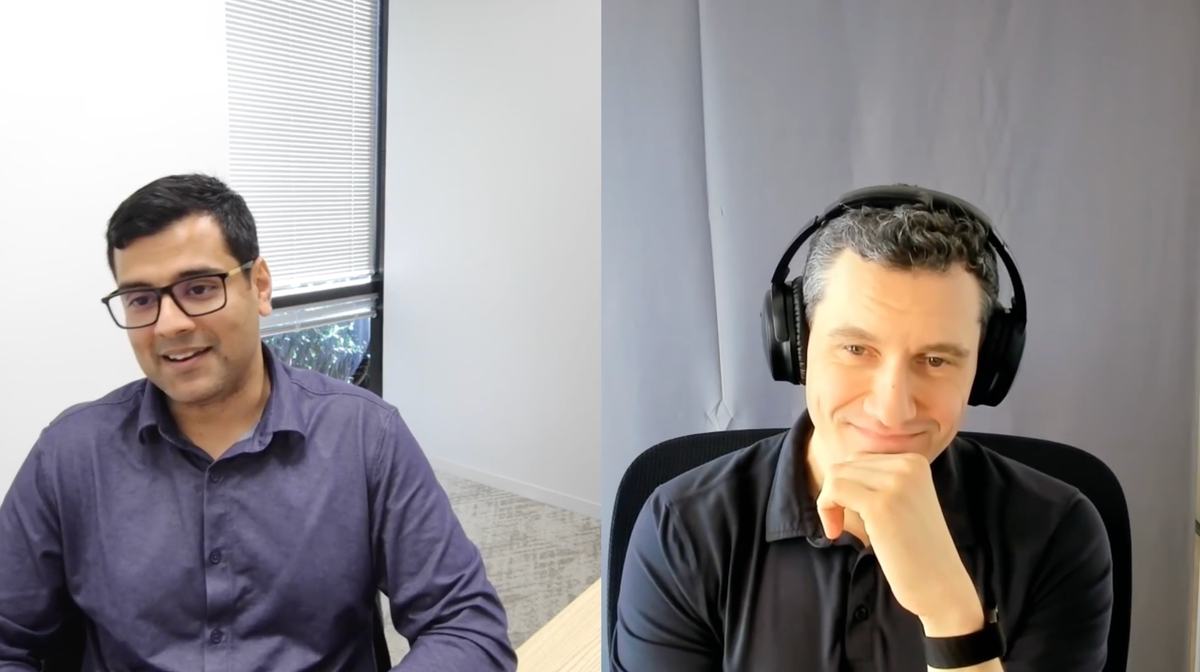
Dr. Asad Tirmizi, Co-Founder and CEO of Trener Robotics, breaks down the full lifecycle of AI in industrial robotics.
Listen to the episode here:
We cover how models are actually built - the training pipelines, the data, and what separates people who've done it from people who've read about it. Then we get into deployment reality - what happens when AI hits a real factory floor. And we close with the part nobody wants to discuss - how do you actually sell this stuff through integrators and OEMs.
Asad previously worked at Vicarious (acquired by Google) and ByteDance's robotics program. Trener recently raised a $32M Series A co-led by Engine Ventures and IAG Capital Partners to scale their Acteris platform - a robot-agnostic AI skills platform that works across ABB, Universal Robots, and FANUC.
Learn more about Trener Robotics: https://trener.ai
Summary:
I first met Asad on day one at UC Berkeley SkyDeck, before anybody had written him a check. Even back then, it was obvious he had something. Fast forward to today: a $32 million Series A co-led by Engine Ventures and IAG Capital Partners, strategic backing from Cadence and Nikon, 15+ integration partners across Europe and the US, and a Machine Tool Innovation Award from EMO Hannover.
We spent about 50 minutes going deep on the full lifecycle of AI models in robotics - how they're built, deployed, and sold. Here are the parts that stuck with me.
The tell that someone has actually built models
Asad's answer was immediate: people who haven't built a deployable model talk about data but never about how painful it is to turn that data into something useful. If your timestamps are off or your data episodes are corrupted, you're feeding garbage into a black box - and millions of good episodes won't save you from five bad ones.
The real work isn't collecting data. It's aligning timestamps, interpolating missing frames, normalizing joint coordinates, and removing corrupted runs across teleoperated data, open-source data, and simulated data - all of which have to converge into clean observation-action pairs before a GPU ever touches them.
His take: if this space takes off, dataset construction alone could be its own company.
Why factories don't care about your demo
This was probably the most grounding part of the conversation. Asad was blunt: a lot of things that look great in demos are either useless or nobody cares about them on the factory floor. What manufacturers care about is predictability, determinism, and cycle time.
His advice: it's much better to be feature-light and reliable than feature-rich and fragile. If you stop the production floor, nothing else matters.
He also made a critical point about the fundamental tension in deploying AI to factories: AI models are probabilistic. Robots need to be deterministic. Bridging that gap - making sure safety-critical functions are deterministic even when the intelligence layer is probabilistic - has been the core of Trener's research for 14 years. This is an architectural decision that most founding teams don't think about early enough.
The three bottlenecks to scaling robotics
I asked Asad to name one bottleneck. He gave me three.
Cross-embodiment. If anyone claims that running the same model across different robot brands doesn't degrade performance, Asad says that's a lie. Trener has to fine-tune models separately for FANUC, Universal Robots, and ABB. There are promising signs this will be solved, but it's fundamentally unsolved today.
Data quality. Not data quantity - data quality. Companies offering thousands of episodes from remote data foundries sound appealing until you realize there's no quality control. A handful of bad episodes buried in millions of good ones can make the whole model fail, and the black box nature of these systems makes it nearly impossible to diagnose after the fact.
Compute. This one surprised me. Roboticists have never had a chip designed for robotics. NVIDIA's Jetson modules cost $4,000 to $7,000 per deployment, lack industrial I/Os, proper safety certifications, and real-time control capabilities. Asad doesn't think NVIDIA will solve this because their business model is general-purpose GPUs. He'd be happy with a $500 chip purpose-built for robotics. As an investor, I'm bookmarking that.
Why Trener doesn't do its own deployments
This was the most counterintuitive part for me. Trener's software margins are around 83%. Their integration margins would be 17-18%. But margins aren't the only reason they go through system integrators.
Asad's logic: system integrators are simply better at integration. They've been doing it for decades. Competing with FANUC or ABB on hardware, or with experienced integrators on deployment, would be fighting battles where Trener has no advantage. Instead, Trener's models empower integrators and OEMs, and the combined offering is stronger than either could deliver alone.
This is a lesson a lot of AI companies could learn from. The instinct in Silicon Valley is to own the full stack. Asad's argument is that trying to own everything too early either kills the company or slows down the market.
The last 10% will make you cry
When I asked for advice for robotics founders, Asad didn't hesitate: don't underestimate the last 10%.
His co-founder Lars puts it well: a 90% result in academia is groundbreaking. A 99% result is a great demo. But you can only deploy at 99.99%. The field has a way of making you feel like you've cracked it at 70% or 80%, only for diminishing returns to hit you hard in the final stretch.
Getting things right at small scale, Asad argues, serves you much better than going big on something you can't control.
What will look obvious in five years
Asad's prediction: we'll move from functional programming of robots to declarative programming. Instead of coding specific movements, we'll declare our intentions to the robot - and the robot will be able to fill in the gaps. Partially declared intentions, fully executed by machines that understand the context.
This was a conversation I've wanted to have for a long time. Asad is one of the few people in robotics who has been in the trenches long enough to speak about what actually works - not what sounds good in a pitch deck.
If you're building in this space, investing in it, or just trying to understand where industrial AI is headed, I think you'll get a lot out of the full episode. Give it a listen and let me know what you think.
Full episode available on:
Learn more about Trener Robotics: https://trener.ai
Watch the recording:
The OPTIM Update is a podcast and newsletter about real-world AI - robotics, automation, and AI Infrastructure. Past the headlines, into how these technologies are really built, deployed, and scaled.