The Intelligence Layer for Precision Manufacturing
Per BLS data from December 2025, there were 433,000 unfilled manufacturing job openings across the US. Deloitte and the National Association of Manufacturers project that number could reach 2.1 million by 2030, at a potential cost of $1 trillion that year alone. The skilled machinists who've kept CNC shops running for decades are retiring, and the pipeline behind them is thin. Training a CNC programmer to real shop-floor proficiency takes 3-4 years through apprenticeship programs. Most high school machining programs have been shrinking for two decades as schools invested more in college pathways than trades.
At the same time, demand is accelerating. Reshoring, defense modernization, EV production, and clean energy infrastructure are all pulling in the same direction: more precision parts, made domestically, faster. The global CNC machine market - valued at over $100 billion in 2025 per Fortune Business Insights - is being asked to do more with fewer people, and brute-force hiring isn't going to solve it.
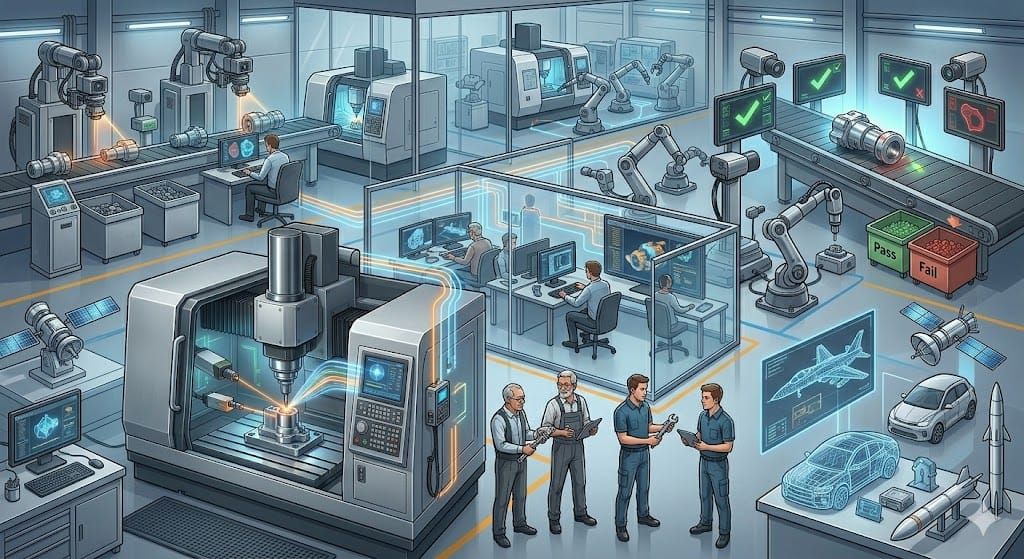
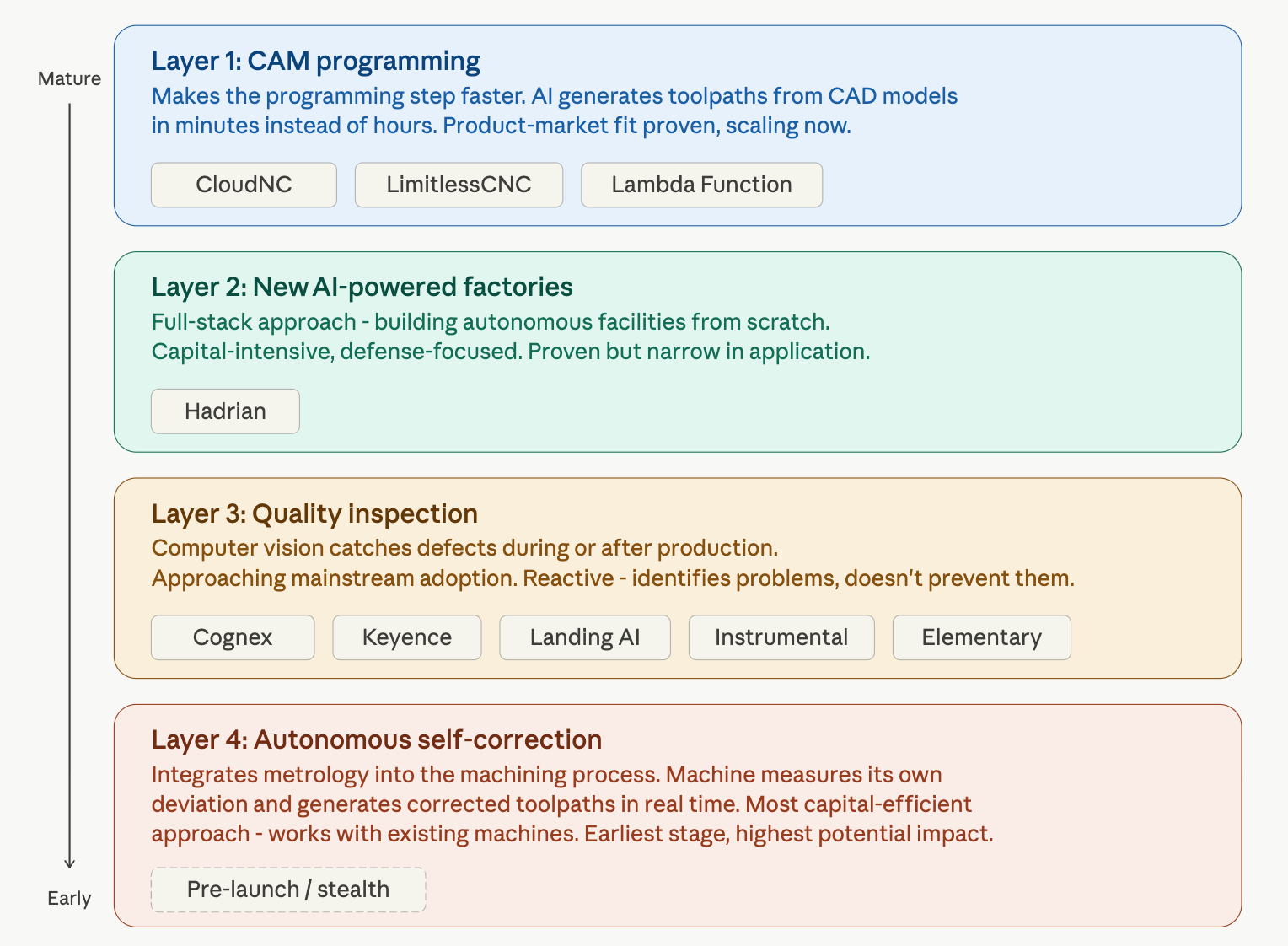
AI is starting to change this, but not in one uniform way. It's entering the precision manufacturing process at four distinct layers, each solving a different problem, each at a different stage of maturity.
Layer 1: Making programming faster
The first and most mature layer is AI for CAM programming. CAM stands for Computer-Aided Manufacturing - it's the software that translates a 3D CAD (Computer-Aided Design) model into the specific toolpaths, cutting strategies, and machine instructions that tell a CNC machine how to produce a part. Think of CAD as designing what the part looks like, and CAM as planning how to make it. Traditionally, CAM programming requires deep expertise. A skilled programmer spends hours analyzing a part's geometry, selecting tools, defining cutting strategies, and optimizing feeds and speeds. It's painstaking, manual, and entirely dependent on the programmer's experience and intuition.
CloudNC, a London-based company backed by Autodesk and Lockheed Martin ($45M Series B, June 2022), has built CAM Assist - a plugin that integrates into existing CAM software and automates roughly 80% of the programming process in minutes. Over 1,000 machine shops are now using it worldwide. LimitlessCNC, an Israeli startup that emerged from stealth in April 2025 with a $4.1M seed round led by Grove Ventures and Meron Capital, is attacking the same problem with physics-based agents that learn from historical machining data. Lambda Function takes it further by incorporating real-time shop floor feedback into its models, creating a closed loop between what the software predicts and what the machine experiences.
This layer is working. The ROI math is clear - shops that adopt AI-assisted CAM programming get more parts out the door with fewer senior programmers bottlenecking the process. But faster programming is only part of the picture. You can generate a perfect toolpath in seconds, but that toolpath still assumes a perfect machine.
Layer 2: Building entirely new factories
At the other extreme is Hadrian, valued at $1.6 billion after raising $730M, including a $260M Series C in July 2025. Backed by Founders Fund, Lux Capital, and a16z, Hadrian isn't trying to improve existing machine shops. They're replacing them with software-defined manufacturing facilities built around their proprietary Opus platform, purpose-built for aerospace and defense production.
The timing is right. The US defense establishment is urgently trying to reshore manufacturing capacity, and Hadrian's "factories-as-a-service" model lets defense primes deploy automated production without building the capability themselves. Their newest facility in Mesa, Arizona - 290,000 square feet, $200 million invested - opened in January 2026.
But this is a top-down approach. It works for high-volume defense contracts where you can justify building new infrastructure. It doesn't help the thousands of small and mid-size machine shops that make up the backbone of American manufacturing and can't afford to start from scratch.
Layer 3: Catching defects after the fact
The third layer is automated quality inspection, where computer vision is used to detect defects during or after production. The machine vision market is projected to grow from $20.4 billion in 2024 to $41.7 billion by 2030, according to industry estimates. Over 70% of manufacturers now say they plan to deploy vision-based inspection within 18 months.
The players here range from established giants like Cognex and Keyence to newer companies like Landing AI, Instrumental, and Elementary. The economics have tipped - camera costs are down roughly 40% since 2023, edge compute is similarly cheaper, and vision-based quality systems now pay for themselves in 6-9 months rather than the 18-24 months that was typical a couple years ago.
Quality inspection matters, but it's reactive. You're catching problems after the machine has already made the wrong cut. The part is either scrapped or reworked. The machine time is lost. The material is wasted. You've identified the problem, but you haven't prevented it.
Layer 4: Autonomous self-correction
Every CNC part begins its life as a flawless digital model. CAD software designs the part. CAM software generates the toolpaths. On screen, everything is perfect. But the moment the tool meets the material, reality takes over. Machines have thermal drift - metal expands and contracts as temperatures change during operation. Tools flex under cutting forces and wear down over time. Fixtures shift. Materials behave unpredictably. The gap between what the digital model assumes and what happens on the shop floor is where scrap, rework, and lost productivity live.
The traditional response has been to throw expertise at the problem. Skilled machinists develop an intuitive sense for how their specific machines behave and manually compensate. They run test cuts, measure, adjust, and iterate until the part meets spec. This works, but it depends on rare human expertise - exactly the kind that's disappearing as the workforce turns over.
A different approach is starting to emerge at this layer. Instead of making programming faster (Layer 1), building new factories (Layer 2), or catching defects after the fact (Layer 3), it integrates metrology directly into the machining process. The machine measures its own output in real time, captures the deviation from the intended geometry, and uses that data to generate corrected toolpaths for the remaining operations. Deviation becomes input, not error.
From an investment perspective, this is the most capital-efficient approach across the four layers. It doesn't require new factories. It doesn't require shops to rip out their existing CAM software. It works with the machines shops already own. For the tens of thousands of small and mid-size manufacturers who can't afford a greenfield buildout, that matters.
The reshoring angle is worth noting too. If you can deliver precision without requiring rare expertise, you can manufacture in more places. Distributed production becomes viable. The bottleneck shifts from "do we have enough skilled machinists?" to "do we have enough machines?" - and machines are easier to buy than people are to train.
This layer is still early. The companies building here are largely pre-launch or in stealth, but the technical foundations - real-time metrology, edge computing, model-based correction - are mature enough that execution is the remaining variable. Machine tool OEMs have had basic thermal compensation for years, and probing systems from companies like Renishaw can do in-process measurement. What's been missing is the intelligence layer that takes deviation data and generates corrected toolpaths autonomously. That gap is now closing.
References
- Bureau of Labor Statistics, "Job Openings and Labor Turnover Survey (JOLTS)," December 2025
- Deloitte and NAM, "2.1 Million Manufacturing Jobs Could Go Unfilled by 2030," May 2021
- Fortune Business Insights, "CNC Machine Market Size, Share & Industry Analysis," 2025
- CloudNC - CAM Assist
- LimitlessCNC - $4.1M Seed Round Announcement, March 2025
- Lambda Function - AI-Assisted CNC Programming
- Hadrian - Autonomous Manufacturing
- Hadrian $260M Series C Announcement, July 2025
- Xenonstack, "Top Vision AI Startups Solving Quality Inspection in 2026"
- Cognex - Machine Vision Systems
- Keyence - Industrial Sensors and Vision
- Landing AI - Visual Inspection
- Instrumental - Electronics Manufacturing AI
- Renishaw - Metrology and Probing Systems