The Global State of Deep Tech - Notes from Deep Tech Week SF 2026
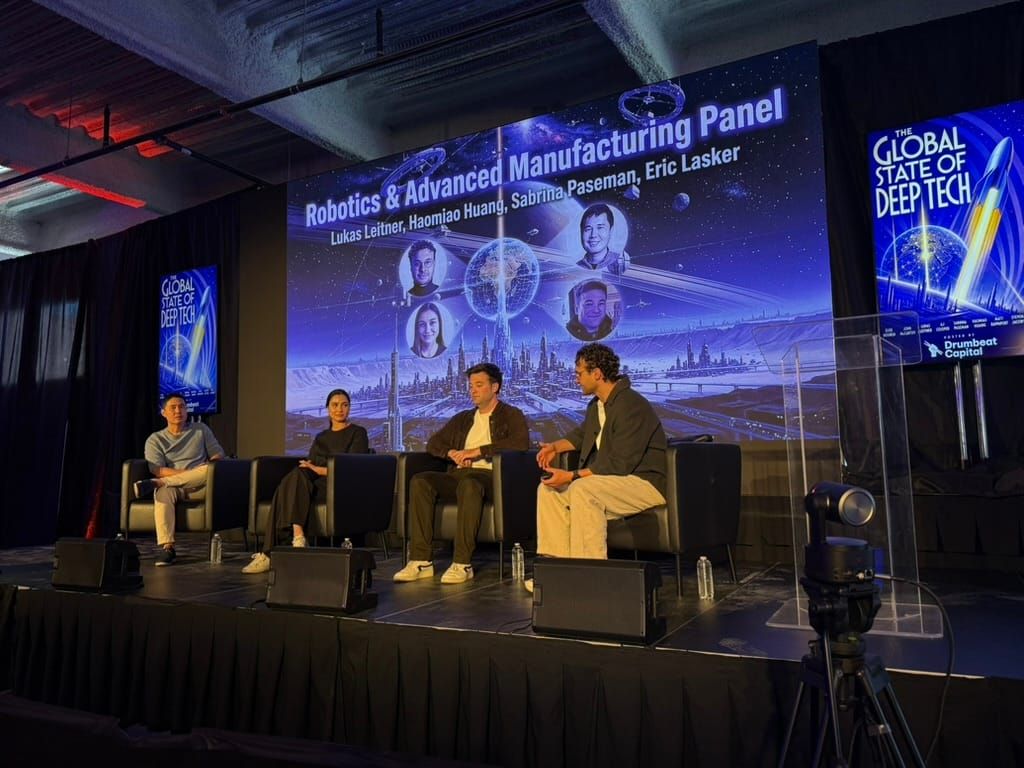
A detailed recap from the Drumbeat Capital event at Deep Tech Week SF, with a focus on the Robotics & Advanced Manufacturing panel.
Drumbeat Capital kicked off Deep Tech Week SF 2026 yesterday with a packed half-day event titled The Global State of Deep Tech. For those unfamiliar, Drumbeat Capital (Steven Jacobs and Lukas Leitner) is a seed-stage deep tech fund operating across the US and Europe, and the authors of the Global Deep Tech Report - one of the best reference documents in the space. This event was their latest installment: a mix of keynotes, fireside chats, and panels covering AI, space, robotics, manufacturing, and the future of compute.
I took detailed notes during the Robotics & Advanced Manufacturing panel, which turned into a rich conversation about reindustrialization, supply chain realities, and what it will take to build the physical infrastructure layer for the next decade of robotics. Below is a theme-by-theme breakdown of what was discussed.
The Panel
- Lukas Leitner - Founding Partner, Drumbeat Capital (moderator)
- Sabrina Paseman - Managing Partner & Co-Founder, Omni Ventures
- Haomiao Huang - Founding Partner, Matter Venture Partners
- Eric Lasker - Chief Revenue Officer, Varda Space Industries
Manufacturing Productivity Is Declining - and the Reasons Are Structural
Lukas opened the panel by pointing to a trend that often gets glossed over in the reindustrialization conversation: manufacturing productivity in the US has been declining, not growing. Why?
Sabrina Paseman (Omni Ventures) framed it as a software problem first. The manufacturing software stack, she argued, is about a decade behind what exists in enterprise software. She saw this firsthand during her time at Apple. Institutional knowledge in manufacturing has historically been passed down through word of mouth, generation to generation. Very little is documented. As attrition rates have climbed, those insights are being lost between programs, between shifts, between factories. Add to that the volume of unstructured data that no one has been able to tap into, and you get a sector that has been falling behind even as every other industry has been accelerating through software.
The thesis at Omni: AI is what finally makes it possible to capture that unstructured knowledge, augment the humans on the factory floor, and close the gap.
Don't Copy the Past - Win the Future
This was probably the sharpest exchange of the panel. Lukas posed the question directly: the US is trying to bring manufacturing back, but China became the manufacturing hub because of dramatically lower labor costs. Can we reverse that? Should we?
Haomiao Huang (Matter Venture Partners) had a strong take. His framing: if all you're doing is making the same cheap motors, the same cheap parts, but in a different geography, there's no point. You're not going to out-China China on their existing supply chains. Those ecosystems run deep in ways that aren't obvious from the outside.
He gave a memorable example. Companies in China that make robot motors - their main business often isn't robot motors. It's making motors for automated mahjong tables. That's the volume base. All the capex and engineering investment is amortized across millions of units for a consumer product that has nothing to do with robotics. The robot motor business rides on top of that. So unless you're planning to bring the entire automated mahjong table market to the US along with the robotics components, you're missing the structural economics.
His argument: the opportunity isn't in replicating what exists. It's in capturing the next generation. Build motors and systems that are more capable than what's available today. Robot actuators, by his assessment, aren't that good. You either get something fast and powerful but inefficient, or something flexible and controllable but weak. Human muscles remain far more capable than anything on the market. Go win that next-generation market. That's how you bring manufacturing back - by building the future, not copying the past.
China's Edge Is Ecosystem Density, Not Cheap Labor
Sabrina pushed back on the narrative that China is still a cheap-labor story. She was clear: that hasn't been true for a decade. From her time at Apple, she saw Chinese manufacturers building cutting-edge technology at scale. The acceleration in Chinese robotics (Unitree shipping 15,000 humanoids at $15-16K per unit, as Lukas mentioned) isn't an overnight success. It's the result of years of infrastructure investment.
But the deeper advantage, she argued, is physical proximity within manufacturing clusters. In Shenzhen and similar hubs, one manufacturer makes the speakers, the diaphragm supplier is down the street, and final assembly is a few steps away. That geographic concentration enabled innovation speeds that are extremely hard to recreate in the US, where manufacturing is fragmented across regions with no comparable density.
Her take on what changes the game: AI might enable a different kind of coordination. When you have AI agents able to parse and relay insights between factories that aren't co-located, maybe you don't need that physical clustering anymore. The manufacturing model of the future isn't going to look like Shenzhen in 2015. It's going to be something different.
Allied Nations, Not Just Onshoring
The panel converged on an important point that often gets lost in political rhetoric: reindustrialization doesn't mean everything has to be made in the US.
Lukas drew the analogy to semiconductors. Chip design happens in the US. Manufacturing happens in Taiwan (TSMC). The lithography equipment comes from the Netherlands (ASML). The optics are German. The chemicals are Japanese. That supply chain is arguably the most sophisticated on earth, and no single country owns all of it.
The same principle applies to robotics and manufacturing more broadly. Eric Lasker (Varda) noted that aerospace already operates this way by regulation - ITAR requirements mean much of what Varda builds must be made in the US, but that doesn't preclude working with allied nations for non-regulated components. Haomiao added that Matter Venture Partners has built out an ecosystem around partners in Taiwan and Europe, specifically TSMC and others who already know how to scale hardware manufacturing.
Sabrina extended the frame beyond the US: think about Germany's automotive manufacturing heritage and its potential pivot into robotics. Think about Taiwan's precision electronics infrastructure. There's edge and opportunity in countries around the world - the challenge is coordinating it, not centralizing it.
Hardware Iteration Cycles Are the Real Bottleneck
Haomiao made what I thought was the most underappreciated argument of the panel. AI models are getting faster at a rate everyone can see. Data collection for robotics is getting turbocharged by simulation and new collection methods. But the hardware - the motors, the actuators, the sensors - is improving slowly. Part of it is that the ecosystem doesn't exist yet. Part of it is that there's no volume base for next-generation robotics components to amortize costs against.
His analogy: think about what TSMC did for the semiconductor industry. Before TSMC, if you wanted to be a chip company, you had to build your own fabrication plant. That was the era of "real men have fabs." Think about how that constrained the number of companies that could participate, how it limited iteration cycles. TSMC created the shuttle run model, and suddenly you could tape out every six months. The design space exploded.
Robotics needs the same thing. Someone needs to build the equivalent of a robot foundry - a hardware platform that lets teams prototype and iterate fast without having to build their own manufacturing capability from scratch. Matter has one portfolio company working on this across Taiwan and the US, trying to build exactly that kind of infrastructure.
The ChatGPT Moment in Robotics Isn't About the Model
This was a thread I keep hearing in different forms, but Haomiao articulated it in a way that crystallized the argument.
Everyone in robotics talks about the "ChatGPT moment" - when will robotics have its breakout? But most people misunderstand what the ChatGPT moment actually was. It wasn't a model improvement. ChatGPT launched on GPT-3.5, which had been around for about a year. The breakthrough was distribution. Someone had the non-obvious idea of putting the model in a web browser instead of behind an API. That's what made it accessible to hundreds of millions of people overnight.
Now take that logic and apply it to robotics. Give someone an all-powerful, amazing robot foundation model today. What do you put it in? You can't download it to your laptop and have a robot start doing things. There's no distribution vehicle. It would be like giving someone ChatGPT in 1985 - do you have a computer in your house? Is it connected to the internet? No? Then it doesn't matter how good the model is.
This is why Haomiao is focused on the hardware layer. His reasoning: the distribution bottleneck for robotics is a hardware problem. Once robots exist that are designed to work with AI (instead of being programmed in the traditional sense) and they're widespread enough that updates can be pushed to them, then every model improvement suddenly has distribution. That's when the exponential curve kicks in.
Who Builds the Intel of Robotics?
Haomiao drew a useful analogy to the PC industry. In PCs, you had three layers: Dell (the integrator/application company), Microsoft (the software/OS), and Intel (the hardware platform). In robotics, the same structure is forming:
- The application layer - companies taking off-the-shelf models and off-the-shelf hardware to solve specific problems. Lots of these exist.
- The brain - foundation model companies building the AI that powers robots. Lots of these too.
- The hardware stack - the Intel/Foxconn/Quanta equivalent. The infrastructure layer that enables the other two.
That third layer is still an open question. Haomiao's bet: it won't be the incumbents (Kuka, Yaskawa). It's going to be new companies. This is where the biggest opportunity sits, and it's also the hardest to fund, because the venture market has historically struggled to back unproven hardware that requires patient capital before it shows obvious scale.
Sabrina agreed with the framing but flagged the chicken-and-egg problem. VCs want to invest in hardware that has proven scaling potential. But you can't prove scaling potential without building the thing first. The result: early-stage hardware with real potential but no demonstrated scale is chronically underfunded compared to software-layer companies that are easier to evaluate on familiar metrics.
Show Up at the Factory
Eric Lasker shared something that surprised me in its simplicity. When Varda needed a manufacturer for their thermal protection system precursor (the same material, incidentally, used in Steinway pianos), they went and visited the supplier in person. The manufacturer had never had a customer visit before.
That blew my mind a little. Eric's broader point: as you build in the physical space, it's people all the way down. The supply chains are operated by humans. When they tell you they can't deliver on time, sometimes just showing up changes the conversation. Coming from the software world, it's easy to forget that physical businesses run on relationships and presence in a way that digital businesses don't.
Haomiao echoed this from his own experience. When he was doing a smartphone startup, he would fly day trips to Shenzhen - land in Hong Kong at 6 AM, be in the factory by 8, back on a flight at 11 PM. You have to be there because it's physical. If you're not hands-on, you don't know what's going on. The fact that so few hardware founders do this is shocking. And it's fixable.
Founder Advice: Lateral Expansion and the Anduril Model
Sabrina offered a practical framework for founders building hardware companies: think about lateral expansion from day one.
She pointed to Anduril as a case study. Anduril started with a telemetry monitoring system, then expanded into missiles. The underlying technology between those two verticals is closely related. By choosing adjacent applications where the core technical edge transfers, they were able to scale their hardware business without having to reinvent the stack for each new market.
Her advice to founders: find a specific go-to-market where you're solving a real pain point, then map out which adjacent applications your core technology can serve. Get the most leverage from your engineering team and your hardware development cycles by expanding laterally rather than trying to go broad from the start.
Eric added his perspective from the go-to-market side: don't cast too wide a net. Hardware sales cycles are long. It's better to work with two or three champion customers deeply than to try to onboard a dozen simultaneously. The complexity of productizing hardware is high enough that spreading yourself thin burns capital faster than you expect - plane tickets, time zones, different communication norms across geographies, holidays. Find your champions and go deep.
Generative Design Needs a Reality Check
An audience question about generative design prompted a sharp response from Sabrina. When generative AI first exploded, a lot of venture capital went toward the idea that you could now design anything. The reality from someone who's worked in the industry: generative design without physical validation and testing is useless in manufacturing. Full stop.
The strongest companies today have a closed loop between design generation and physical testing. Either they're training their design models on historical manufacturing data, or they have access to facilities that can run tests in closed loop and feed results back into the generative process. Without that feedback loop, you're generating parts that look great on screen and fail on the factory floor.
The Space Industry's ChatGPT Moment Already Happened
Eric closed with an observation from the space side. A lot of people outside the industry feel like they're waiting for Starship to enable all these amazing things - orbital data centers, frequent lunar landings, Mars missions. But the core technology for most of these is already here. The "ChatGPT moment" for space happened about seven years ago with reusable rockets. There's just lag in the system because of how regulated the industry is and how long hardware development cycles take.
His prediction: over the next five years, the companies that have been building hardware will start to accelerate visibly. Whether it's lunar infrastructure, orbital energy, or moving assets between orbits, this is all becoming commonplace within the industry. Most people outside of it don't realize how fast it's moving. There will be a wake-up moment when the general public notices trading lights on the moon - and that capability will have been in development for years by then.
If you're in LA and you see a SpaceX reentry vehicle coming in off the coast and you barely glance up, that's your indicator of how normalized this has become. A teenage Eric would have been freaked out. Present-day Eric barely notices.
Bonus: Hands On with the Hardware Layer
Haomiao's robot foundry argument came with a physical counterpart at Deep Tech Week. I got a turn on a teleoperation rig from Anvil Robotics - the company he referenced building hardware infrastructure across Taiwan and the US, incubated by Matter. Two robot arms, a set of buckets, and a few minutes of moving balls from one to the other.
Sessions like this double as data collection. Teleoperation is how robots gather the demonstration data they learn from - the same motions I'm making for fun here are what data collection teams run all day to train manipulation policies.
Great event. Big thanks to Steven Jacobs, Lukas Leitner, and the Drumbeat Capital team for hosting, and to all the panelists for a conversation that went well beyond the standard reindustrialization talking points. If you're interested in their work, check out the 2026 Deep Tech Report at drumbeat.capital