From a Scaling Law to 1,590 Napkins a Day: A Saturday with Dyna Robotics
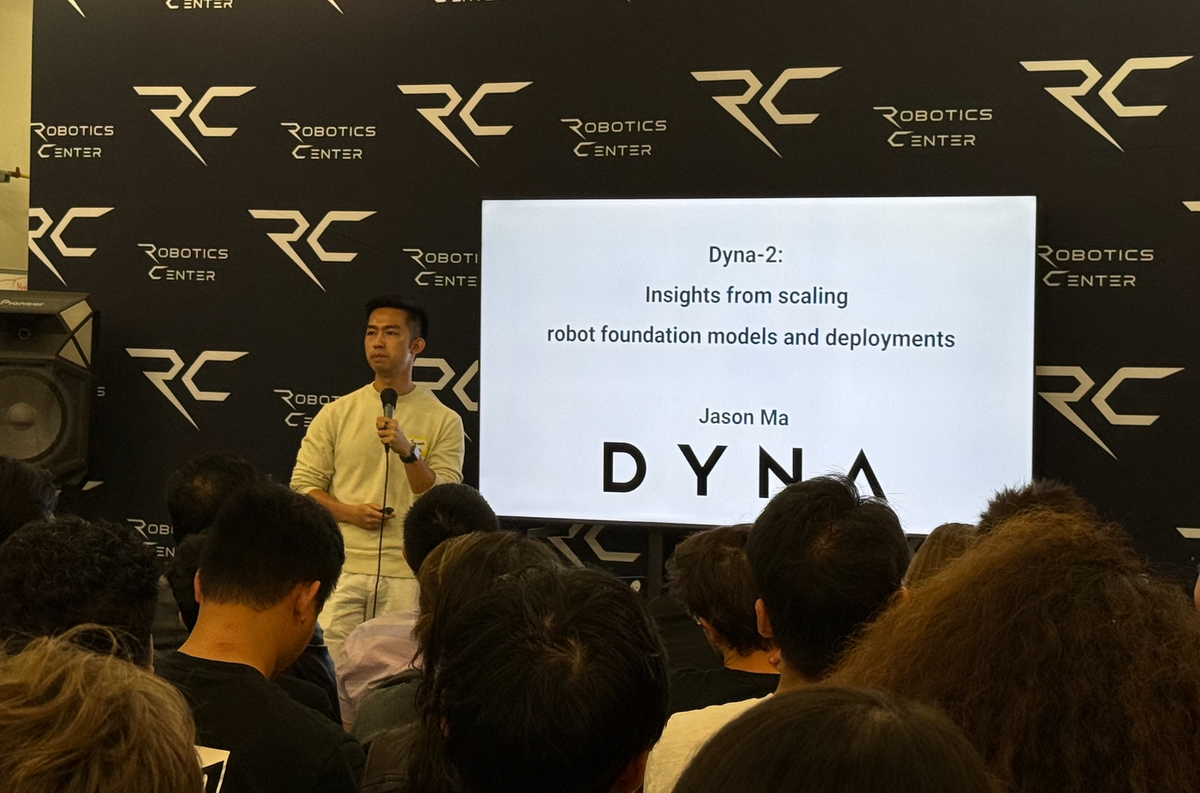
September 12, 2026 - Robotics Center of Silicon Valley, San Francisco
For months, the robots folding napkins at Din Tai Fung did the hard part well and the easy part badly. The folds passed inspection. The bins did not: each napkin landed wherever it happened to land, and restaurant staff had to square up the stacks before carrying them to the dining room. Jason Ma, co-founder and chief scientist of Dyna Robotics, showed the before-and-after bins on Saturday as his example of how a customer's pain point becomes a research priority. The fix was a model that can be told which of ten positions gets the next napkin, and that capability came out of pre-training on a million hours of human video.
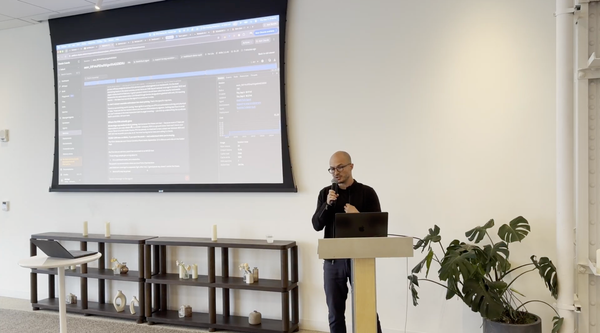
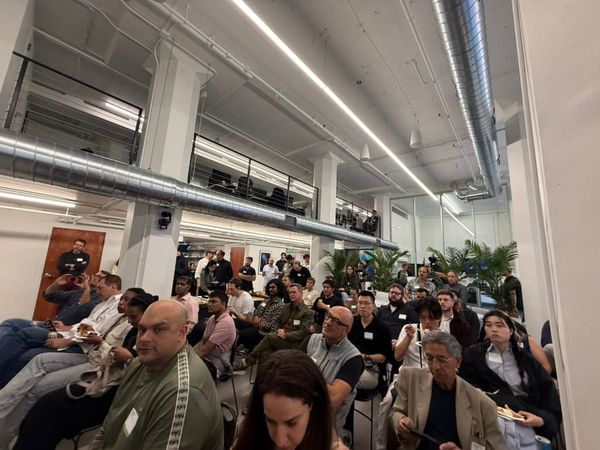
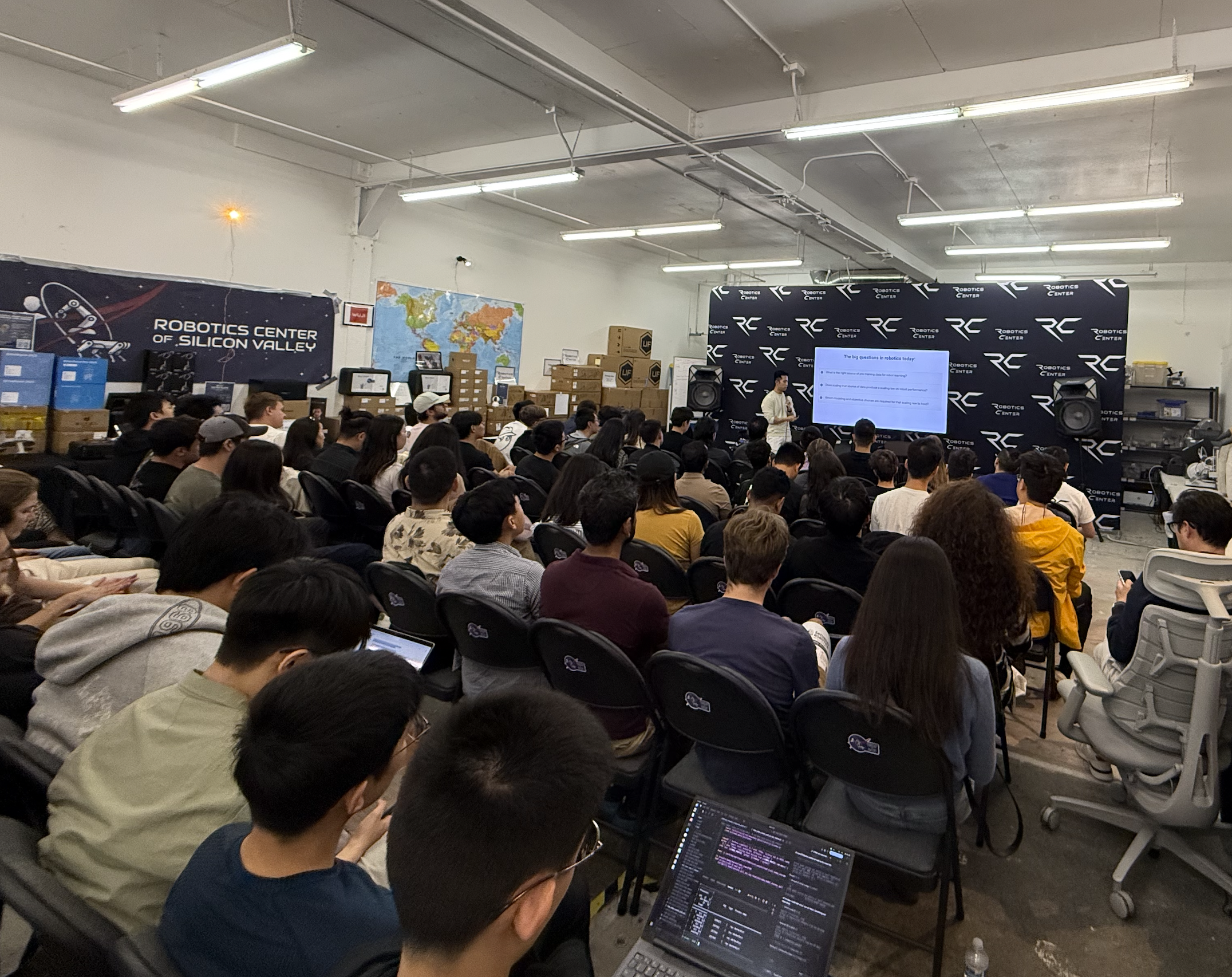
The occasion was session 28 of the Saturday Robotics & World Models Reading Club, run by Junfan Zhu and Aurora Feng and hosted this time by Jerry Huang at the Robotics Center of Silicon Valley in San Francisco. Luma shows 194 people attended. Zhen Xia, a principal at INCE Capital and co-host of the session, introduced Jason and said in his first minute that INCE is an investor in Dyna. His summary of the founding team: Jason on models, Lindon Gao on product and business, York Yang on data infrastructure and scaling. Lindon and York previously built and sold Caper AI, Jason came from DeepMind, and the company raised a $120 million Series A a year ago. Several Dyna researchers came along.
In August, Dyna published Dyna-2, a world-action model pre-trained on more than a million hours of first-person human video, along with two companion reports on training infrastructure and customer deployments. All three were the pre-reads for this session. I covered the headline results when Jason presented them at Actuate last month. A conference keynote has room for results. An hour with the research team in the room, followed by a long run of audience questions, has room for the reasoning, and that is what this recap covers.
For friends who missed it, here is what was said, with names attached. This was a public session, so the speakers earned the credit. Audience questions are paraphrased without names.
Three questions the field has not settled
Jason opened with Dyna's first year, because it explains what the company optimizes for. Dyna-1 was built around one number, a 99 percent success rate, which he described as a first for a vision-language-action model. His reasoning was commercial: no customer wants a model that fails 20 percent of the time. By last fall the team had run a live folding demo on the Actuate stage under lighting the model had never trained on, taken a robot to CoRL in Seoul where it folded laundry in an environment it had never seen, and put robots to work folding towels at a laundromat in Sacramento.
Then came the three questions he thinks robot learning still has to answer. What is the right source of pre-training data? Teleoperation data is high quality, and its volume and diversity are hard to scale. If there is an alternative, does scaling it produce predictable returns on robot performance? Training these models is capital intensive, and nobody wants to fund a data source whose payoff cannot be forecast. And is data the only thing that matters, or do architecture and training objective decide whether the data pays off?
Dyna-2 is the experiment designed to answer all three. The team pre-trained only on first-person human video, with no robot data and no robot-shaped data either. Jason drew the line at handheld gripper devices like UMI, which still require someone to build a device and hand it out, and that limits scale. The assumptions about the video were kept minimal on purpose. Some was collected in house, and most came from crowdsourcing and vendors. There were no motion-capture rigs and no requirement for metric-accurate hand poses, and a meaningful share of the footage has no usable action labels, because extracting hand poses from a single head-mounted camera is hard. He called the result a lower bound: combine human video with robot data, as Dyna does in production training, and he expects the curves to look better.
The experiment, in order
The study is built so that each step earns the next one.
Step one is a sanity check. Train on 1,000, 10,000, 100,000, and 1,000,000 hours of human video, then predict human actions on held-out human video. Error falls and accuracy rises at every rung. Jason was plain about why this comes first: if human data does not scale on humans, there is little hope of it scaling on robots.
Step two is the result that gives the report its title. Take the same four checkpoints and, with no adaptation of any kind, ask them to predict robot actions from robot video. The test set covers 39 tasks on two bimanual platforms, and 27 of those tasks come from an external open dataset, which keeps the evaluation from favoring tasks Dyna designed. A model that has never seen a robot gets steadily better at predicting what a robot should do as the human hours grow. The report notes an inflection between 10,000 and 100,000 hours, which suggests a coverage threshold before transfer kicks in.
He also explained why the science is done offline. Real-robot evaluation is noisy. Hardware wears, setups drift, and in his words results from last week may not be directly comparable to this week. So the offline curves carry the claim, and the robot trials confirm it.
Step three is that confirmation. Each checkpoint was post-trained with what Jason called a linear probe, the simplest recipe possible, on tens of minutes to a few hours of robot data per task - the first time the model had seen either the robot or the task. Across 14 tasks and three robot types, scored in blind trials, the average rose from 20 percent of the attainable maximum at 1,000 hours to 28, then 45, then 53 percent at a million. Jason volunteered that 53 percent is far below what Dyna ships to customers. The slope is the finding. One task in the report makes the point on its own: turning a key in a lockbox failed on every attempt up to 100,000 hours of pre-training and succeeded 90 percent of the time at a million.
Hands may end up easier than grippers
The result I did not expect came from the two tasks that used dexterous hands. On paper, a multi-fingered hand is the harder control problem. A parallel-jaw gripper adds one number to the action space: how wide to open. The pair of 20-degree-of-freedom hands in these experiments pushes the action space to around fifty dimensions. The hands were still the easier embodiment to post-train. The bottle-cap task needed minutes of robot data, roughly ten according to the report, while several gripper tasks needed hours.
Jason's explanation is that the pre-training data is human hands, so a hand is the embodiment closest to what the model already knows. To show what that buys, the team post-trained a hand to pick up a pair of scissors, work its fingers into the handles, and cut. A gripper cannot do that task at all.
His read on the implication was careful. Today a gripper is still the easier thing to teach, because gripper hardware is mature and hand hardware is not. If pre-training keeps moving toward sensorized humans, that ordering may flip once the hands catch up. The Dyna-2 report makes the same argument from the other direction: the path forward is more sensorized human data and robots that get closer to humans in form factor. Jason mentioned that Dyna is working on hardware of its own and hopes to show it at some point.
What crosses the embodiment gap
A vision-language-action model starts from a vision-language model and learns to output actions. A world-action model like Dyna-2 starts from a video generation model and learns to predict two things together: how the scene will evolve and what the actions should be. To test whether the video half does any work, the team trained the same architecture three ways on the same human data. Action-only training, which is how a VLA learns, did not improve on robot data as the human hours grew, and it overfit in unpredictable ways. Joint video-and-action training beat action-only on all 39 robot tasks at every scale, and still did not improve with more data. The only recipe that scaled was joint training plus a large additional pool of video with no action labels, used only to predict what happens next.
One detail in the report deserves the attention of anyone running small ablations: at 5,000 hours the video co-training recipe showed no advantage. The gap opens as the data grows. Jason said it directly: modeling findings from the low-data regime do not necessarily hold at scale.
A follow-up experiment isolated video as its own variable. Hold action-labeled data fixed at 50,000 hours and scale only the unlabeled video from zero to 50,000 hours. On human test data nothing improves, and the report shows it getting slightly worse. On robot test data, prediction error drops to about a third of where it started. The pattern held when the team repeated it with 250,000 action-labeled hours and up to 750,000 hours of video. More video does little for the embodiment you trained on and a great deal for the one you did not.
His intuition for why: the way a laptop lid opens and closes has nothing to do with who is opening it. Video prediction forces the model to learn how objects and scenes behave, and that knowledge is shared across bodies. Action labels describe one body.
Hand-pose labels are the expensive, lagging part of a human-video pipeline, and much of a million-hour corpus will never have good ones. Under this recipe that footage is still useful. Jason's summary of the winning recipe: train on video plus action wherever labels exist, then feed in as much additional video as you can. One more detail from the report for anyone worried about latency: the policy does not generate video at runtime. Video prediction shapes the representation during training, and at inference the action path runs alone.
One of the Dyna researchers took the mic for the robustness demos, and the origin story was better than the demos. The team learned by accident that the celery-chopping robot works in the dark. A film shoot at the next station needed the lights off, the model was left running, and it kept chopping. Darkness was nowhere in the training data. The strobe-light, covered-camera, and keep-putting-the-celery-back versions followed. Jason added that there is a riskier video involving the knife that he will not show publicly, because he does not want anyone copying it.
The customer grades on neat and fast
Research papers report success rate. In production, Jason said, 100 percent success is close to assumed, and the questions that matter are whether the output meets the customer's quality standard and how fast it gets made. Dyna's deployment report puts numbers on that. Each robot at Din Tai Fung has to produce 1,500 table-ready napkins in an 18-hour shift. Dyna-1 folded about 35 an hour with 75 percent clearing the quality bar. Dyna-2 folds 95 an hour with 93 percent clearing it, which comes to 1,590 a day, and it does so with an added folding step to meet the restaurant's presentation standard.
The report's zero-shot comparison is the number I would show anyone who evaluates robots in an office. At customer sites neither model had seen, graded on the customer's acceptance criteria by operators outside the model team, Dyna-1 passed 46 percent of the time and Dyna-2 passed 87 percent. In house, both pass at close to 100.
The napkin bin is the same lesson from another angle. Placing each napkin at an instructed position, cycling through ten stacks that look nearly identical, is a language-following problem, and Dyna's write-up argues it is harder than the usual demos where instructions name visibly different actions. On the team's language benchmark, action-only pre-training scored 35 percent, video co-training on an early corpus scored 67, and video co-training on the full corpus scored 96. The capability that tidied the bin came from the same recipe that produced the scaling law. It also means a new bin layout is a new instruction, where the alternative was a new model per site.
Jason drew a line between a pilot and a customer who asks for more robots at more sites, and said Dyna recently crossed it. Din Tai Fung is rolling the robots out across its restaurants, Best Western has them at multiple hotels, and the deployment report projects a fleet in the hundreds by the first half of 2027, with new deployments reaching the customer's ROI bar in as little as three days.
What did the robot do today?
Dyna's evaluation system for deployments reduces to one question, and Jason put it on a slide: what did the robot do today? Answering it around the clock, in detail, takes more than tracking the model. It means tracking software health, down to I/O congestion on the CPU, and hardware drift, because deployed robots wear.
The piece that makes it work is a labeling model Dyna trained for the purpose. It watches every production episode, segments it into the steps of the customer's procedure, scores each step, and tags failure modes. Plotted across a day, the steps look like repeating staircases, and a step that starts running long is visible at a glance. The deployment report has the example that sold me on it. Throughput slipped at one Din Tai Fung site with nothing in the logs to explain it. The labels showed missed grabs climbing in step one, where the robot pulls a single napkin off the stack. The cause was a worn gripper. On camera, worn hardware and a bad policy are hard to tell apart, which is why Dyna also tracks a degradation index for each component and schedules maintenance before a shift gets interrupted.
This is the layer where deployments become repeatable. Jason's version: a bespoke model and a bespoke stack per site can work for tens of deployments, and it will not take anyone from tens to hundreds or from hundreds to a thousand. Asked later how a startup balances one demanding customer against building a platform, he said the filter is whether the work for that customer also moves the general system forward, with a solutions-engineering function for the needs that do not.
Everything breaks at every order of magnitude
The infrastructure section was short on stage and long in the pre-read. Every time the data grew tenfold, Jason said, everything broke and everything got slow. Ingestion throughput went from 14,000 episode-hours a week to 440,000, which turns processing a million hours from a 16-month job into one that takes under three weeks. Building the manifest for a training run over 43 million episodes went from about 48 hours to under a minute. One GPU node had logged more than 250,000 corrected memory errors before the team connected its crashes to the hardware.
His advice for other teams was cultural. Treat data infrastructure as a first-class asset. Build it ahead of the training run it has to support, because a team operating at scale can forecast which model it will want to train by which date. And protect iteration speed. Dyna's target is that the time to launch a training job stays flat no matter how much data it touches, since nobody gets the recipe right on the first try. His closing slide drew the company as two pillars and a foundation: research and deployment feeding each other, with infrastructure as the horizontal layer under both.
Can versus should, and other answers
Seven people got questions in, and I have grouped the answers by theme.
Will post-training ever go away? Jason separated can from should. Today's models can already zero-shot easier tasks from a language or video prompt. When the goal is customer value, he sees no reason to skip post-training. The performance gain is paid for once, where prompting pays a context cost on every inference, and the ceiling for prompting has always sat below the ceiling for fine-tuning. He pointed at language models as evidence: the big labs send forward-deployed engineers into Fortune 500 companies to post-train on company data. People need training for a new job too. Trying to zero-shot everything, he said, is a false economy. As a research milestone, zero-shot capability is still a good anchor for how strong the pre-training is.
The same questioner asked how this competes with RL-100, a real-world reinforcement learning framework. Jason spent much of his PhD on RL and was measured about it. Learning from scratch on a physical robot is expensive, and it suits only tasks that reset themselves. Given ten hours of robot time, he would spend them collecting data and skip the exploration. His bet is strong pre-training followed by light adaptation, and he called the paper a good one.
One questioner raised the force problem: opening a heavy door and opening a light door look the same on video. Jason agreed, and corrected his own vocabulary. The goal is predicting the future state of the world, and video is the modality available in bulk today. He expects human data to grow to include audio and wearable sensing such as EMG, which would let a model tell the two doors apart. It is the same objection the Data Wars panel raised at Actuate, where egocentric video was compared to searching for your keys under the streetlamp. A related question about the fortune-cookie demo, where the robot opens a cookie far enough to pull out the paper strip without crushing it, got a shorter reply: there is no free lunch, a gripper commanded open-or-closed cannot do it, and once a model has seen enough data, adding a new sensing modality gets much easier.
On whether to collect data in house or buy it, his answer was both, with a clear division of labor. Diverse human video is becoming a commodity, and he sees no reason to produce a commodity internally. In-house collection earns its keep on quality and on control over the distribution. The gate on either source is ingestion. If a billion hours were for sale tomorrow, a team without the pipeline could not use them. At Actuate, the going rate quoted for egocentric video was $3 to $40 an hour, which fits his description.
Another researcher asked whether pre-training could use video alone, saving action data for post-training. Dyna has not tested that much. What the team has seen is that predicting the future helps in post-training as well. Jason's framing was that a robot is one more object in the world, so there is little reason to restrict prediction to the robot's own actions. Predict the whole scene and extract the part that controls the robot.
Someone asked which change mattered most between Dyna-1 and Dyna-2. The napkin comparison holds the task and the evaluation fixed, so the difference is the model, and the largest difference in the model is pre-training scale. For architecture alone, the report includes a matched comparison with data and hyperparameters held fixed, and the world-action model still came out ahead of the VLA.
The last question was about competition at the model layer, and the answer is one I would underline for investors. Models will get larger, data will get more plentiful, and in Jason's view capabilities across labs will end up more or less similar. Earlier, asked about the newest frontier model from one of the big AI labs, which the Dyna team had spent the previous day testing in an internal hackathon, he had called such models complementary and said Dyna is more than a model company. In robotics, value is captured in the product or service delivered to the end customer, and he expects the winning combination to pair the model with hardware. His technical prediction was hybrid foundation models that both output joint-level actions and write programs that control the robot. Dexterity of the fortune-cookie kind needs learned control at high frequency. Free-space motion is mostly geometry, and code can handle it.
A few things to remember
- Video is a scaling axis, and it only shows up at scale. Action-only training on human data did not transfer to robots at any size. Extra unlabeled video showed no advantage at 5,000 hours, and at 50,000 hours it cut robot prediction error by about two thirds. Small ablations would have pointed the wrong way.
- The end-effector question is open again. If the pre-training corpus is human hands, the embodiment closest to a hand is the cheapest to post-train. Ten minutes of data for a bottle cap is a number worth the attention of every team building dexterous hands.
- Can versus should. Zero-shot is a measure of pre-training strength. Customers buy post-trained performance, and the language-model industry already works that way.
- The chief scientist of a model company expects model capabilities to converge. He put the value in the product delivered to the customer, and the rest of the talk - the deployment flywheel, the observability, the infrastructure - described how Dyna intends to earn it. It is the same sales-to-deployment-to-data loop this newsletter keeps finding in the companies that work.
- Human video is turning into a commodity, and ingestion is the gate. For anyone investing in picks and shovels, that points at hand-pose extraction, episode-level quality control, data infrastructure, and fleet observability as the scarce layers.
- Deployment is the eval. Both models scored close to 100 percent in the office. At customer sites one passed 46 percent of the time and the other 87. The only way to see that gap is to measure where the work happens.
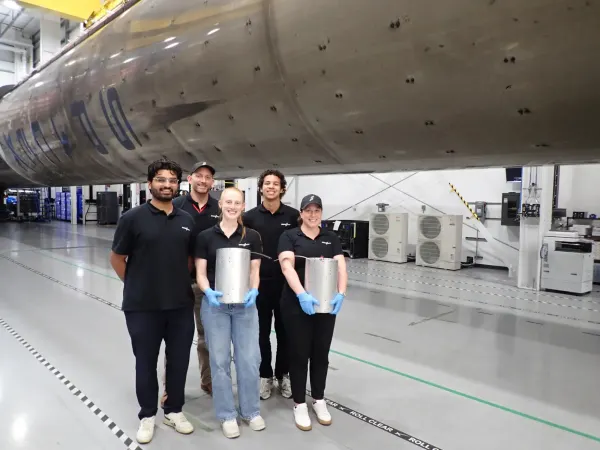
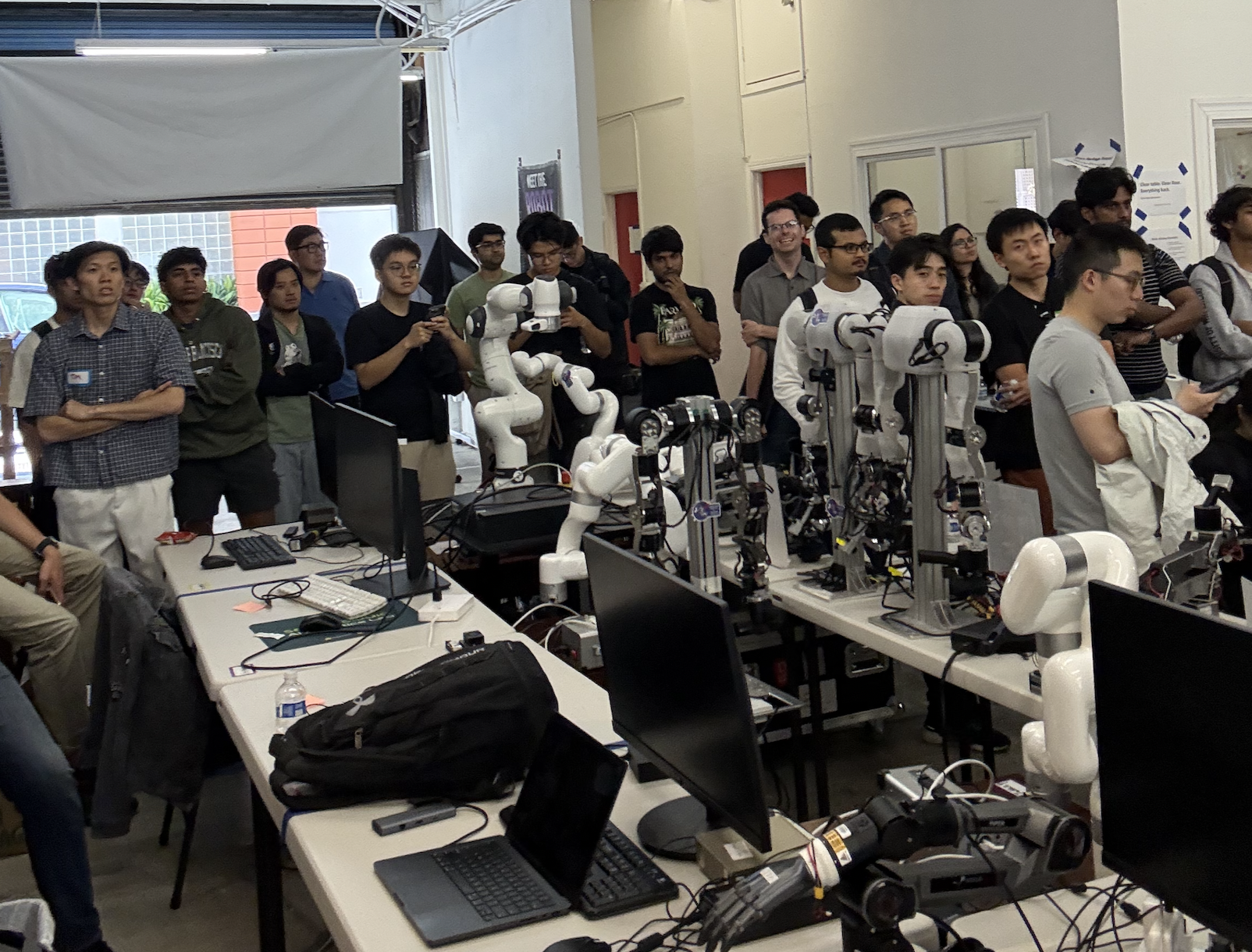
Thanks to Junfan Zhu and Aurora Feng for running this club every Saturday, to Zhen Xia for bringing the Dyna team in, to Jerry Huang and the Robotics Center of Silicon Valley for hosting, and to Jason and the Dyna researchers for staying through the questions. The club's tradition of taking one egocentric and one third-person group photo has never been more on theme. Next on the Saturday Robotics calendar: AgiBot and ManiFormer on September 19, Interaction World Models on September 26, a research night at IROS in Pittsburgh on September 28, and a Stanford session on October 3.
References
- Dyna-2: A 1-Million-Hour Scaling Law for World-Action Models - Dyna Robotics, August 2026
- Training Dyna-2 at million-hour scale, repeatably - Dyna Robotics, August 2026
- Not Just a Model, But a Product - Dyna Robotics, August 2026
- Robotics & World Models Reading Club 28: DYNA-2, Dyna Robotics - Saturday Robotics on Luma, September 12, 2026
- RL-100: Performant Robotic Manipulation with Real-World Reinforcement Learning - Lei et al., arXiv, October 2025
- Dyna Robotics Raises $120 Million to Advance Robotic Foundation Models - PR Newswire, September 2025
- One Million Hours and One Demonstration: Two Days at Actuate 26 - The OPTIM Update, August 2026
Figures and claims above come from Jason Ma's talk and Q&A at the Saturday Robotics Reading Club on September 12, 2026 and from Dyna's three published reports linked above. They reflect Dyna's own reporting. Audience questions are paraphrased.